Menu


TL;DR:
- Child custody in New Hampshire is legally defined as parental rights and responsibilities, emphasizing shared parenting. Preparing the correct documents and completing required programs are essential steps before filing, with strict service rules to follow. Since 2025, the law presumes equal parenting time benefits the child’s best interests, guiding final custody decisions.
Child custody in New Hampshire is legally defined as “parental rights and responsibilities,” a term the state adopted in 2005 to replace the older “custody” and “visitation” language. This step by step guide for child custody in New Hampshire walks you through every stage of the process, from gathering required forms to attending your final hearing. Since january 2025, NH law presumes approximately equal parenting time is in the child’s best interests under RSA 461-A:6. Knowing the law, the required documents, and the court’s expectations gives you a real advantage before you file a single page.
Preparation is the most overlooked part of the child custody process in New Hampshire. Parents who arrive at the courthouse without the right documents face delays, dismissals, and added stress. Getting organized before you file protects your time and your case.
The three core documents you need are the Parenting Petition (NHJB-2059-F), the Parenting Plan (NHJB-2064-F), and the UCCJEA Affidavit. The Parenting Plan must include a residential schedule, decision-making authority, holiday and vacation plans, and a dispute resolution process. The court must approve this plan before it becomes a legal order.
The UCCJEA Affidavit establishes that your child has lived in New Hampshire for at least 6 consecutive months, which gives the NH court jurisdiction over the case. Without this affidavit, or if your child recently moved from another state, the court may dismiss your petition. Document your child’s residence carefully, including school records, medical records, and any lease agreements.
If you and the other parent are not married, you must also establish paternity before filing. This can be done through a voluntary acknowledgment of paternity affidavit or through genetic testing ordered by the court. Paternity is the legal foundation for an unmarried father’s parental rights in New Hampshire.
The mandatory Child Impact Program is a 4-hour course that educates parents on how separation affects children. You must complete it before your first court appearance, within 45 days of filing. Skipping this step will delay your case.
Pro Tip: Register for the Child Impact Program the same day you pick up your court forms. Spots fill quickly, and the 45-day deadline comes faster than most parents expect.
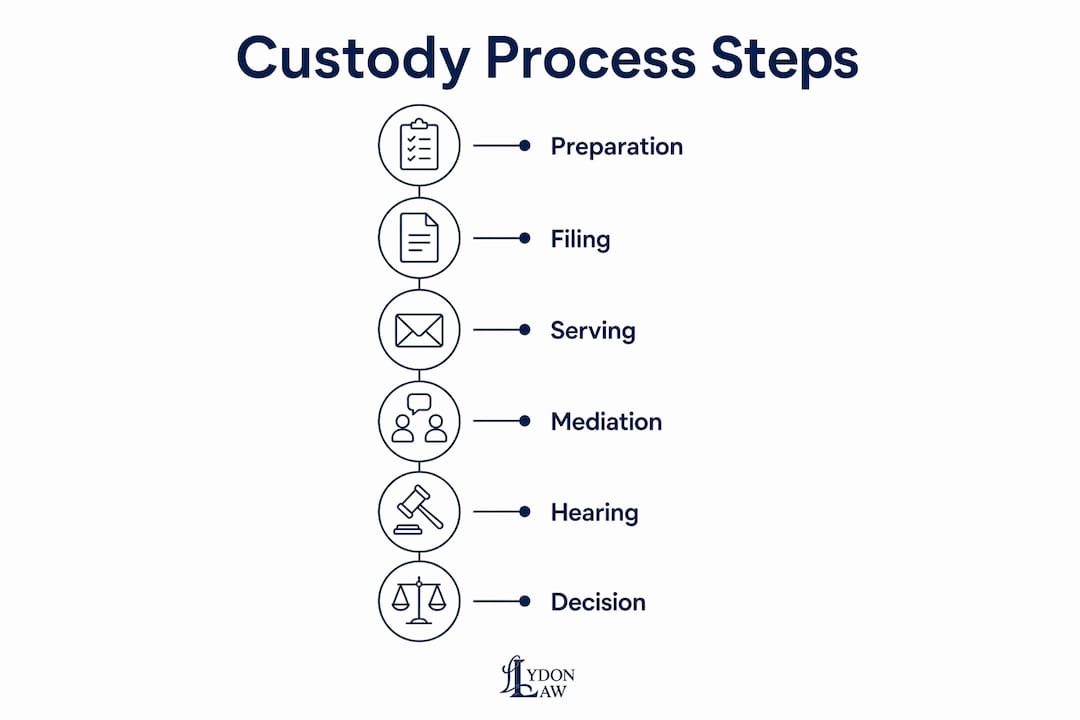

Filing your petition correctly is the first official step in the child custody process in New Hampshire. You file at the Family Division of the Superior Court or Circuit Court in the county where your child lives. Bring all completed forms, your UCCJEA Affidavit, paternity documentation if applicable, and payment for the filing fee.
The filing fee ranges from $225 to $282, and card payments carry a 3% surcharge. If you cannot afford the fee, you can apply for a waiver through an in forma pauperis petition based on federal poverty guidelines. For 2026, the poverty threshold for a single person is $18,900 annually.
Once the court accepts your filing, you must serve the other parent with copies of all filed documents. New Hampshire courts strictly enforce service rules. Failure to serve correctly can cause delays or dismissal of your case.
Serving the other parent by sheriff or certified mail with return receipt is the accepted standard in New Hampshire. Personal service by sheriff is the most reliable method because it creates a clear record. If you have safety concerns, you can also request a protective order at the time of filing.
Pro Tip: Ask the court clerk to date-stamp a copy of every document you file. Keep these copies in a dedicated folder. You will need them at every future hearing.
After filing, the court schedules a preliminary hearing, sometimes called a status conference. This hearing sets temporary arrangements for where the child lives, how decisions are made, and what the schedule will look like while the case is pending. Judges use this hearing to assess the situation and set a timeline for resolution.
Temporary orders issued at this stage are not permanent, but they carry real weight. Courts often look at how temporary arrangements are working when making final decisions. Showing up prepared, calm, and focused on your child’s needs makes a strong impression.
New Hampshire courts strongly encourage mediation before trial. Mediation is a structured process where a neutral third party helps both parents reach an agreement on parental rights and responsibilities. It is less adversarial than a trial, less expensive, and often produces agreements both parents can live with long-term.
Courts in New Hampshire view a parent’s willingness to cooperate as a positive factor. Refusing mediation without good reason or showing hostility toward the other parent can hurt your case. The court’s goal at every stage is to find the arrangement that best serves your child.
When parents cannot reach an agreement through mediation, the case proceeds to trial. At trial, both parents present evidence and testimony. The judge then applies the best interest of the child standard to make a final decision on parental rights and responsibilities.
Since january 2025, New Hampshire courts operate under a legal presumption that approximately equal parenting time, meaning each parent receives more than 40% of parenting time, serves the child’s best interests. This presumption can be rebutted with evidence showing that equal time would harm the child. The burden falls on the parent opposing equal time to present that evidence.
The factors a judge considers include each parent’s ability to meet the child’s daily needs, the child’s relationship with each parent, the stability of each home environment, and each parent’s willingness to support the other parent’s relationship with the child. Attempts at parental alienation, meaning actions that damage the child’s relationship with the other parent, are treated as a serious negative factor.
| Custody outcome | What it means |
|---|---|
| Joint decision-making authority | Both parents share decisions on education, health, and religion |
| Sole decision-making authority | One parent makes major decisions; requires strong justification |
| Shared residential responsibility | Child lives with both parents on a roughly equal schedule |
| Primary residential responsibility | Child lives mainly with one parent; other parent has scheduled time |
| Divided responsibility | Different aspects of parenting assigned separately to each parent |
Understanding the court’s role in NH custody helps you prepare realistic expectations before trial. Judges are not looking to punish either parent. They are looking for the arrangement that gives your child the most stable, supported life possible.
Custody orders are not permanent. Life changes, and New Hampshire law allows parents to request modifications when circumstances shift significantly. The legal standard requires you to show a substantial change in circumstances since the original order was entered.
Examples of qualifying changes include a parent relocating out of state, a significant change in a child’s school or medical needs, evidence of abuse or neglect, or a major shift in a parent’s work schedule that affects availability. Minor disagreements or personal preferences do not meet the legal threshold.
Common mistakes in modification cases include filing too soon after the original order, relying on verbal agreements instead of court-approved changes, and failing to document the changed circumstances before filing. Courts take modification requests seriously, but they also protect the stability of existing orders.
Pro Tip: Keep a dated journal of significant events related to your child’s care and the other parent’s behavior. This record becomes your most credible evidence in a modification hearing.
The child custody process in New Hampshire follows a defined legal path, and parents who prepare thoroughly, file correctly, and focus on their child’s needs consistently achieve better outcomes.
| Point | Details |
|---|---|
| Know the correct legal terms | NH uses “parental rights and responsibilities,” not “custody” or “visitation,” since 2005. |
| File the right forms | NHJB-2059-F, NHJB-2064-F, and the UCCJEA Affidavit are all required before the court accepts your case. |
| Complete the Child Impact Program | This 4-hour program must be finished within 45 days of filing or your case will be delayed. |
| Equal parenting time is presumed | Since january 2025, NH law presumes more than 40% parenting time for each parent is in the child’s best interests. |
| Modifications require real evidence | A substantial change in circumstances must be documented and proven, not just claimed. |
After working with families through the NH custody process, one pattern stands out clearly. Parents who treat the process as a cooperative legal procedure almost always do better than those who treat it as a fight to win.
New Hampshire’s shift away from “custody” language is not just semantic. It reflects a genuine legal philosophy that both parents have a role in a child’s life unless there is a concrete reason to limit that role. The 2025 presumption of approximately equal parenting time reinforces this. Judges are not looking for a winner and a loser. They are looking for a workable plan.
The most common mistake I see is parents who arrive at mediation or a preliminary hearing without a written parenting plan proposal. Showing up with a detailed, realistic schedule signals to the court that you are focused on your child, not on conflict. The parenting plan guide for New Hampshire is one of the most practical tools available to you before you ever set foot in a courtroom.
Early legal advice matters more than most parents realize. The UCCJEA Affidavit, the paternity documentation, the Child Impact Program registration — these are not formalities. Getting any one of them wrong can set your case back by months. Talking to an attorney before you file, not after something goes wrong, is the single most effective step you can take.
— Rich
Lydon is a boutique law firm with offices in Nashua and Portsmouth, serving parents throughout New Hampshire in family law matters including child custody, parenting plan preparation, and court representation. Attorney Kalie Lydon has appeared in New Hampshire courts and the state’s Supreme Court, bringing direct courtroom experience to every custody case. Clients work one-on-one with their attorney from the first consultation through the final order. Whether you are filing a new petition, preparing for mediation, or seeking a modification, Lydon provides clear guidance at every step. Contact Lydon to discuss your parental rights and get the legal support your family needs.
You need the Parenting Petition (NHJB-2059-F), the Parenting Plan (NHJB-2064-F), and the UCCJEA Affidavit. Unmarried parents must also provide paternity documentation before the court will accept the case.
The filing fee is typically $225–$282, with a 3% surcharge for card payments. Parents who cannot afford the fee can apply for a waiver through an in forma pauperis petition based on federal poverty guidelines.
The Child Impact Program is a mandatory 4-hour course that teaches parents how separation affects children. You must complete it within 45 days of filing and before your first court appearance.
New Hampshire custody law is gender-neutral. Since january 2025, the law presumes that approximately equal parenting time for each parent is in the child’s best interests under RSA 461-A:6, unless evidence shows otherwise.
You must file a Motion to Modify with the original court and show a substantial change in circumstances since the order was entered. The court may require mediation before scheduling a modification hearing.

© 2026 Lydon Law|Legal Disclaimer|Privacy Policy