Menu


TL;DR:
- Civil and criminal law in New Hampshire involve distinct processes, protections, and outcomes, with civil cases focusing on remedying private disputes and criminal cases targeting societal offenses. The burden of proof, court jurisdiction, and defendant rights differ significantly, affecting how cases are prosecuted and resolved. Understanding these differences is critical for making informed legal decisions and avoiding costly missteps.
When two neighbors both end up tangled in legal disputes on the same day, the difference in what happens next can be striking. One faces a personal injury lawsuit after a slip-and-fall on her property. The other is charged with assault after an argument escalated. On the surface, both are heading to court. But the rules, protections, rights, and possible outcomes they face are entirely different. If you live in New Hampshire and you’re trying to understand the legal system, knowing that difference is not just academic. It could shape decisions that affect your freedom, your finances, and your family for years to come.
| Point | Details |
|---|---|
| Core distinction | Civil law resolves disputes between parties, criminal law prosecutes offenses against society. |
| Burden of proof | Civil cases use ‘preponderance of evidence’; criminal needs ‘beyond a reasonable doubt’. |
| NH jurisdiction | Circuit Court handles smaller matters; Superior Court oversees serious cases and large civil claims. |
| Legal protections | Jury verdicts, representation rights, and case classifications differ between systems. |
| Common misconceptions | Nuances like merger doctrine and blurred penalties are critical for New Hampshire litigants. |
Now that you understand why this distinction matters, let’s break down the basic definitions of each area.
Civil law governs disputes between private parties seeking remedies like monetary damages or injunctions, while criminal law addresses offenses against society prosecuted by the government seeking punishment. That single sentence carries a lot of meaning. In a civil case, you are typically suing another person or business because they caused you harm. In a criminal case, the government is bringing a case against someone because their actions violated a law designed to protect the public.
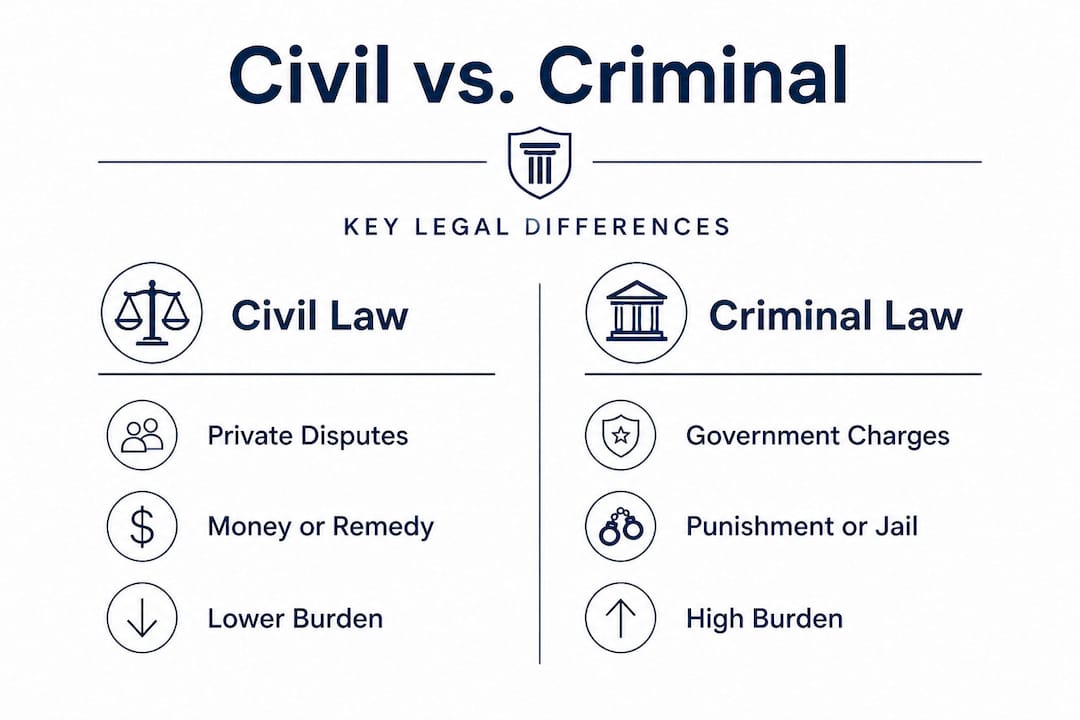
In civil cases, the plaintiff initiates the action. In criminal cases, prosecutors bring charges on behalf of the state. This is a key distinction. If you were injured in a car accident, you decide whether to sue. But if you were assaulted, the state of New Hampshire can prosecute the person responsible even if you personally decide you don’t want to pursue the matter.
Here is a quick summary of what each area covers:
The purpose of civil law is to restore the injured party to where they were before the harm occurred. Criminal law focuses on punishment, deterrence, and in some cases, rehabilitation.
Understanding criminal defense rights under this framework is especially important for anyone facing charges in New Hampshire. The stakes are higher, the protections are different, and the process moves in a distinct way from civil litigation.
With the basics established, let’s explore what really separates civil and criminal cases when it comes to evidence requirements and the impact of verdicts.
One of the most important differences is the burden of proof, which refers to how much evidence is needed to win a case. Civil cases use preponderance of the evidence, meaning the plaintiff must show it is more likely than not (greater than 50%) that their claim is true. Criminal cases require proof beyond a reasonable doubt, a much higher standard. This is why someone can be found not guilty in a criminal trial but still lose a civil lawsuit based on the same facts.
Civil outcomes include compensatory and punitive damages as well as injunctions. Criminal outcomes include fines, probation, and imprisonment. Here is a side-by-side comparison:

| Feature | Civil law | Criminal law |
|---|---|---|
| Who brings the case | Plaintiff (individual or business) | Prosecutor (state or federal government) |
| Standard of proof | Preponderance of evidence (>50%) | Beyond a reasonable doubt |
| Possible outcomes | Money damages, injunctions | Fines, probation, jail or prison |
| Jury verdict | May not require unanimity | Must be unanimous |
| Right to free counsel | No | Yes (if facing incarceration) |
The numbered steps below show what typically happens as a civil case progresses compared to a criminal one:
Pro Tip: If you’re unsure whether your situation is a civil or criminal matter, ask yourself: is the government involved in bringing the case? If yes, you are likely dealing with criminal law and need to take that seriously from the start.
You can review your options in civil law litigation if you believe you have a dispute that warrants legal action outside the criminal system.
Understanding burdens and outcomes is just one piece. Next, let’s see how New Hampshire’s court system impacts where your case will be heard.
New Hampshire organizes its courts in a way that reflects the seriousness of each legal matter. Circuit Court handles misdemeanors and civil claims up to $25,000, while Superior Court has jurisdiction over felonies and civil cases that exceed that threshold. Choosing the wrong court can cause real delays and additional costs, so knowing where your case belongs is a practical first step.
Here is what each court handles:
The distinction matters in a very practical sense. If you have a breach of contract dispute worth $18,000, Circuit Court is your venue. If you’re facing a felony drug charge, the Superior Court will hear your case. Working with a criminal defense NH attorney who understands both levels of the court system can make a meaningful difference in how your case is managed from the beginning.
It’s also worth noting that family law matters, including divorce and custody disputes, can sometimes intersect with both civil and criminal proceedings. A domestic violence order of protection, for example, may originate in the Circuit Court’s family division but carry consequences that affect criminal proceedings as well. The layers of jurisdiction can feel confusing, which is why legal guidance is often the most efficient path forward.
Once you know your court, it’s crucial to understand what rights and legal protections apply depending on the type of case.
Criminal cases require unanimous jury verdicts; civil cases may allow non-unanimous verdicts in some states. Criminal defendants also have the right to counsel and the right to remain silent. Civil parties do not have those same constitutional guarantees. If you cannot afford an attorney in a criminal case where incarceration is a possible outcome, the court must appoint one for you. That protection simply does not exist in a civil dispute.
Here is what the constitutional protections look like in practice:
Some penalties that appear civil in nature can actually trigger criminal protections if a court determines they are punitive rather than remedial. This principle, stemming from Kennedy v. Mendoza-Martinez, means the label a law places on a penalty is not always the end of the analysis.
Classification boundaries matter. Some penalties deemed punitive trigger criminal protections even when labeled civil. This has real implications in areas such as civil forfeiture, sex offender registration, and certain financial sanctions.
Pro Tip: If you are facing any action that could result in a significant penalty, whether it’s labeled civil or criminal, consult an attorney before responding. Saying the wrong thing in a civil deposition can create complications in a related criminal matter.
Understanding the overlap is especially important in cases involving domestic violence law in NH, where a protective order issued through civil court proceedings can directly affect a parallel criminal case.
Beyond rights and protections, there are unique New Hampshire nuances that can dramatically impact how cases play out.
One doctrine that surprises many people is the merger doctrine in New Hampshire criminal law. The merger doctrine prevents multiple convictions for the same act when one offense is merely incidental to another. For example, false imprisonment charges may merge into an assault charge when both arise from the exact same conduct. Many people facing multiple charges in New Hampshire don’t realize that this doctrine could significantly narrow the charges that actually proceed to sentencing.
Criminal systems are often overwhelmed with high case volume compared to the more deliberate pace of civil litigation. This affects how quickly cases move, how much time prosecutors can devote to each matter, and how plea negotiations unfold. In civil court, the pace tends to allow for more thorough discovery and strategic maneuvering.
Here are a few common misconceptions worth correcting:
Pro Tip: If you’re being asked to pay restitution as part of a criminal sentence, that does not prevent a civil lawsuit from the same victim. Both can occur. Understanding this early allows you to plan accordingly.
If you are working through a complex situation and need to know your options for defending criminal charges in NH, having clear and accurate information about these nuances is a strong starting point.
Most guides on civil versus criminal law cover the basics: who brings the case, what the burden of proof is, and what the outcomes look like. That’s useful information. But in practice, the issues that trip people up most are rarely the foundational ones.
Restitution is a perfect example. People frequently assume it functions like a civil damages award. It does not. In New Hampshire, restitution ordered as part of a criminal sentence is a punitive tool. It can coexist with a civil lawsuit for damages. Failing to understand that distinction has led people to resolve a criminal matter thinking they’ve closed the book, only to face a civil claim months later.
The merger doctrine is another area where practical reality diverges from what people expect. When someone faces multiple charges stemming from a single incident, the assumption is often that each charge is a separate fight. But New Hampshire courts have consistently applied the merger doctrine to reduce the number of convictions that can stand when charges overlap. This is exactly the kind of issue that requires experienced legal counsel, not because the rule is difficult to understand, but because identifying when it applies requires familiarity with how NH courts interpret specific fact patterns.
Jurisdictional confusion is perhaps the most costly mistake people make without realizing it. Filing in the wrong court or failing to understand which court governs your specific claim can result in dismissed cases, missed deadlines, and wasted legal fees. We’ve seen clients come to us after spending months pursuing a matter in Circuit Court only to learn their claim should have been in Superior Court from the start.
Our perspective is direct: the importance of legal counsel cannot be overstated when the stakes involve your freedom, your finances, or your family. Early guidance prevents the costly errors that are so common when people try to navigate these distinctions alone. And legal representation in NH matters because the state’s courts have their own practices, their own local rules, and their own precedents that a general overview cannot adequately address.
If you’re facing a legal issue that’s civil, criminal, or somewhere in between, here’s how to get expert support in New Hampshire.
At Lydon Law, we work with clients throughout New Hampshire on both civil law matters and criminal defense cases, from estate planning and probate to felony charges and DWI defense. Attorney Kalie Lydon brings extensive courtroom experience, including appearances before the New Hampshire Supreme Court, and works directly with every client rather than passing cases off to staff. Whether you need help understanding where your situation falls legally or you’re ready to pursue or defend against formal proceedings, you can review our full practice areas to find the right starting point. We’re here to help you make informed decisions at every stage.
Civil law governs disputes between private parties seeking remedies like monetary damages, while criminal law addresses offenses against society prosecuted by the government. Ask yourself whether a private individual or the state is bringing the case against you.
Circuit Court handles civil claims up to $25,000 and misdemeanor charges, while Superior Court oversees felonies and civil disputes above that dollar threshold.
Criminal defendants have rights to counsel and to remain silent, and juries must reach a unanimous verdict to convict. These constitutional protections do not apply in the same way to civil defendants.
Yes. A single act, such as assault or domestic violence, can trigger a criminal prosecution and a separate civil lawsuit for damages. Some statutes blur these lines, but the two proceedings remain legally distinct.
No. Because civil cases use preponderance of evidence while criminal cases require proof beyond a reasonable doubt, the outcomes of each proceeding can differ even when the underlying facts are identical.

© 2026 Lydon Law|Legal Disclaimer|Privacy Policy