Menu


TL;DR:
- Being charged with a crime is a stressful experience that requires understanding the distinct legal stages to effectively navigate the process. Early involvement and prompt evidence preservation within the first 72 hours are crucial to building a strong defense and securing critical evidence before it is lost. Working closely with an experienced attorney and maintaining organized records enhances your chances of a favorable outcome throughout the criminal justice workflow.
Being charged with a crime is one of the most unsettling experiences you can go through. Whether you are facing a misdemeanor, a felony, or a drug offense in New Hampshire, the criminal defense process workflow can feel overwhelming when you do not know what to expect. Understanding the distinct phases ahead of you, from arrest through sentencing, gives you a real advantage. It helps you ask better questions, make informed decisions, and work more effectively with your attorney. This guide walks you through every stage, plainly and practically.
| Point | Details |
|---|---|
| Know the phases early | The criminal defense workflow has six distinct stages, and each requires a different strategy. |
| Act within 48-72 hours | Critical evidence like body camera footage can be lost permanently if not secured immediately after arrest. |
| Most cases settle before trial | Roughly 98% of federal criminal cases resolve through guilty pleas, making plea strategy central to defense planning. |
| Client involvement matters | Providing your attorney with organized facts, documents, and timelines directly strengthens your defense. |
| Local counsel is an advantage | Attorneys familiar with New Hampshire courts understand local judges and prosecutors in ways that affect outcomes. |
The criminal defense process workflow in New Hampshire follows a sequence of legally defined stages. Knowing where you are in that sequence, and what comes next, removes a significant amount of the fear that surrounds criminal charges. Let’s look at what actually happens after an arrest.
An arrest is the formal act of law enforcement taking you into custody based on probable cause. It does not mean you are guilty. It means the state believes it has enough to charge you. You have the right to remain silent and the right to an attorney. Exercise both immediately.
Under Rule 5, an arrested person must be brought before a magistrate judge without unnecessary delay, typically within 24 hours. At this hearing, the judge informs you of the charges, addresses bail, and confirms your right to counsel. This is not the time to make statements or argue your case. It is the time to listen and to have an attorney present.
Arraignment follows shortly after. This is the formal reading of charges against you, and the court asks how you plead: guilty, not guilty, or no contest. In most cases, your attorney will advise a not guilty plea at this stage, preserving all your options while the defense builds its case. Understanding your criminal defense rights in NH before this hearing helps you walk in prepared.
Pro Tip: Contact a criminal defense attorney before your arraignment if at all possible. The decisions made in those first hearings shape the entire case that follows.
Discovery is the formal process through which both sides share the evidence they plan to use. It is one of the most critical phases in the entire criminal case preparation workflow, and how your defense team manages it directly affects your outcome.
Rule 16.1 of the Federal Rules of Criminal Procedure requires government and defense counsel to confer no later than 14 days after arraignment to set discovery timelines. This means your attorney is immediately working to identify what evidence exists and when it must be produced. The prosecution must disclose witness lists, police reports, lab results, and any exculpatory evidence, meaning evidence that may help your defense.
Time is a genuine factor here. The first 48-72 hours after arrest are critical for securing evidence like body camera footage before it is overwritten. 911 call recordings, surveillance video, and GPS data all have retention windows. Miss them and they are gone permanently.
Pro Tip: Write down everything you remember about the incident as soon as possible. Dates, times, names, what was said, and who was present. Your attorney cannot build a defense around facts you cannot recall.
The table below shows common evidence types, why they matter, and how quickly they can disappear.
| Evidence type | Why it matters | Preservation window |
|---|---|---|
| Body camera footage | Shows exactly what officers did and said | 30-90 days, sometimes less |
| 911 recordings | Establishes initial report and caller statements | 30-90 days |
| Surveillance video | May contradict or support the official account | As few as 72 hours |
| Cell phone records | Places you at or away from a location | Weeks to months depending on carrier |
| Witness statements | Provides context and alternative accounts | No formal window; memory degrades fast |
Actively gathering records and maintaining a clear event timeline enables your attorney to build a stronger, more personalized defense strategy. Your participation is not just helpful. It is often decisive.
This is where the defense case management work becomes most strategically intense. Your attorney is simultaneously preparing for trial while evaluating every option to resolve the case short of one.

Pre-trial motions are formal requests asking the court to take specific legal actions before trial begins. Common motions include requests to suppress evidence obtained unlawfully, to dismiss charges due to procedural violations, or to change venue. A strong motion to suppress, for example, can remove key prosecution evidence from the case entirely, which changes the calculus for everyone involved.
The statistics here are striking. Approximately 98% of federal criminal convictions are resolved through guilty pleas rather than trials. That number reflects a legal system built around negotiated outcomes. More than 90% of federal convictions result from a guilty plea, with contested trials accounting for only about 2% of cases.
A plea agreement is not an admission of defeat. It is a legal tool. Under Rule 11 of the Federal Rules of Criminal Procedure, plea agreements can take different forms. Some include non-binding sentencing recommendations where the judge can still impose a different sentence. Others are binding, locking in specific outcomes subject to court approval. Your attorney will explain precisely what you are agreeing to before you sign anything.
| Option | What it means | Key consideration |
|---|---|---|
| Accept a plea deal | Agree to plead guilty in exchange for reduced charges or sentencing | Gives up your right to trial; may limit appeal options |
| Reject the deal and go to trial | Contest the charges before a judge or jury | Higher risk but preserves full defense; outcomes are uncertain |
| Seek case dismissal | Motion to have charges dropped before trial | Requires strong legal grounds such as procedural error |
If your case proceeds to trial, your defense attorney will prepare witness examinations, develop opening and closing statements, organize exhibits, and anticipate the prosecution’s arguments. This process can take weeks. Thorough preparation for defending criminal charges in New Hampshire at the trial stage requires both legal skill and detailed knowledge of local court procedures.
If you are convicted at trial or enter a guilty plea, the case moves to sentencing. This stage carries its own workflow and its own opportunities.
New Hampshire judges consider multiple factors when imposing a sentence, including the nature of the offense, your criminal history, victim impact statements, and sentencing guidelines. Judicial discretion plays a significant role. This is not a formulaic calculation. Your attorney can present mitigating factors, character references, and arguments for reduced or alternative sentences.
After sentencing, your legal options do not end. You may have grounds to file an appeal if legal errors affected your trial outcome. Post-trial motions, such as a motion for a new trial based on newly discovered evidence, are also possible. Continued legal support after conviction is not optional. It protects your rights going forward.
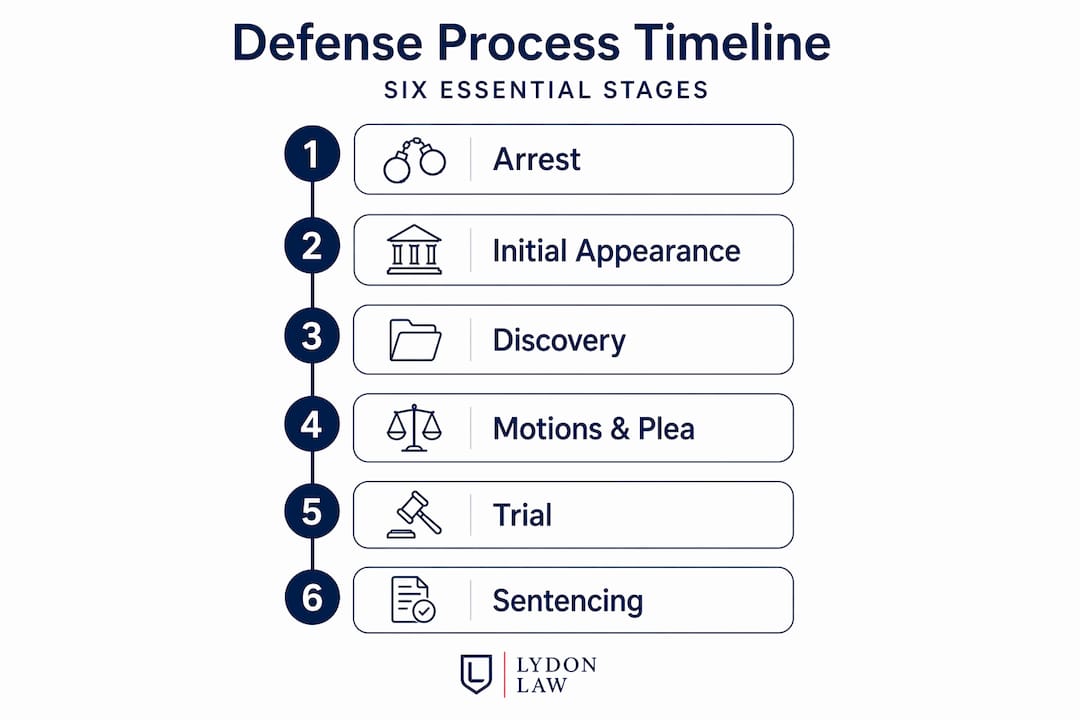
The steps in criminal defense are not something your attorney handles alone. Your cooperation at every stage shapes the outcome. Specialized training and local knowledge of defense attorneys greatly affect case outcomes, but so does what you bring to the table as a client.
Here is what that looks like in practice.
Be completely honest with your attorney. They cannot protect you from facts they do not know. Withholding information does not help you. It creates gaps in the defense that opposing counsel will eventually find.
Gather documents proactively. Employment records, medical history, character references, and any relevant communications should be collected and organized early. Write down a detailed timeline of events from your perspective and update it as you remember new details.
Establish clear communication expectations with your attorney from the start. Ask how often you will receive updates, what the preferred contact method is, and how quickly you can expect responses to urgent questions.
Pro Tip: Treat every piece of paper connected to your case as potentially important. Save text messages, emails, receipts, and any correspondence from law enforcement or the courts. Organization now saves your attorney significant time later.
I have seen people walk into this process treating it like a single event when it is actually a sequence of connected decisions. That misunderstanding costs them. The criminal justice system consists of distinct phases, and the strategy that serves you at arraignment is not the same strategy that serves you at sentencing.
What I find most striking is how much the first 72 hours matter. Clients who contact an attorney immediately, before their initial appearance, preserve options that disappear for those who wait. Evidence is lost. Statements get made without counsel present. Early mistakes become very difficult to correct later.
I also want to be direct about plea negotiations. Accepting a plea is not losing. For many clients, especially those facing a drug offense legal process workflow with mandatory minimums in play, a well-negotiated plea is the most protective outcome available. What matters is that you understand what you are agreeing to and that someone with real New Hampshire courtroom experience is negotiating on your behalf.
Local counsel who knows the courts where your case is being heard understands things that no out-of-state attorney can quickly replicate. That knowledge affects negotiations, motions, and ultimately, your outcome.
— Rich
If you or someone you care about is facing criminal charges in New Hampshire, Lydon Law offers direct, hands-on representation at every stage of the workflow for criminal defense. Attorney Kalie Lydon has appeared in New Hampshire courts, including the state’s Supreme Court, and brings real courtroom experience to each client’s case. You work directly with your attorney throughout the process, not with assistants or case managers.
Lydon’s criminal defense services cover DWI, drug offenses, felonies, and misdemeanors throughout New Hampshire. The firm also handles related legal matters including family law and civil disputes through its full range of practice areas. If you are ready to talk through your situation, reach out to Lydon Law for a consultation and get clear answers about what comes next.
The criminal defense process workflow is the sequence of legal stages a case moves through after an arrest, including initial appearance, arraignment, discovery, pre-trial motions, plea negotiations or trial, and sentencing.
Timelines vary based on charge severity and case complexity. Misdemeanor cases can resolve in a few months, while felony cases often take a year or more to reach a final resolution.
That decision depends on the evidence, the charges, and your specific circumstances. Approximately 98% of federal cases resolve through guilty pleas, but the right choice for you requires a thorough case evaluation with your attorney.
The 48-72 hours post-arrest are critical because key evidence like body camera footage and surveillance video can be overwritten or deleted, permanently affecting your defense.
Bring any paperwork you received from law enforcement, a written timeline of events from your perspective, contact information for potential witnesses, and any documents relevant to the charges against you.

© 2026 Lydon Law|Legal Disclaimer|Privacy Policy