Menu


TL;DR:
- Understanding criminal law terminology is essential to effectively navigate and respond to charges, procedures, and outcomes in your case. Knowing the differences between charges, convictions, and legal stages like verdicts and sentences helps ensure you make informed decisions and meet critical deadlines. Proper legal comprehension significantly enhances your ability to protect your rights in the criminal justice system.
Criminal law terminology is the defined vocabulary used by courts, prosecutors, and defense attorneys to describe charges, procedures, and outcomes in criminal cases. If you are facing a criminal charge in New Hampshire, or simply trying to understand legal documents related to a case, knowing these terms is not optional. A charge is the specific crime you are alleged to have committed, while a conviction occurs when you are found guilty by verdict or guilty plea. Understanding the difference between those two words alone can change how you read every document in your case file. This guide covers the core criminal law glossary terms you will encounter, from indictment to arresting judgment, with plain-language definitions grounded in federal rules and New Hampshire practice.
The foundation of any criminal law glossary starts with the terms that appear in nearly every case. These words show up in charging documents, court orders, and plea agreements, and confusing them can lead to serious misunderstandings about where your case stands.
Here are the key terms in criminal law that you are most likely to encounter:
Pro Tip: Write down every term you see in your court documents and look up each one before your next meeting with your attorney. Arriving with specific questions about defined terms leads to far more productive conversations than arriving confused about the basics.
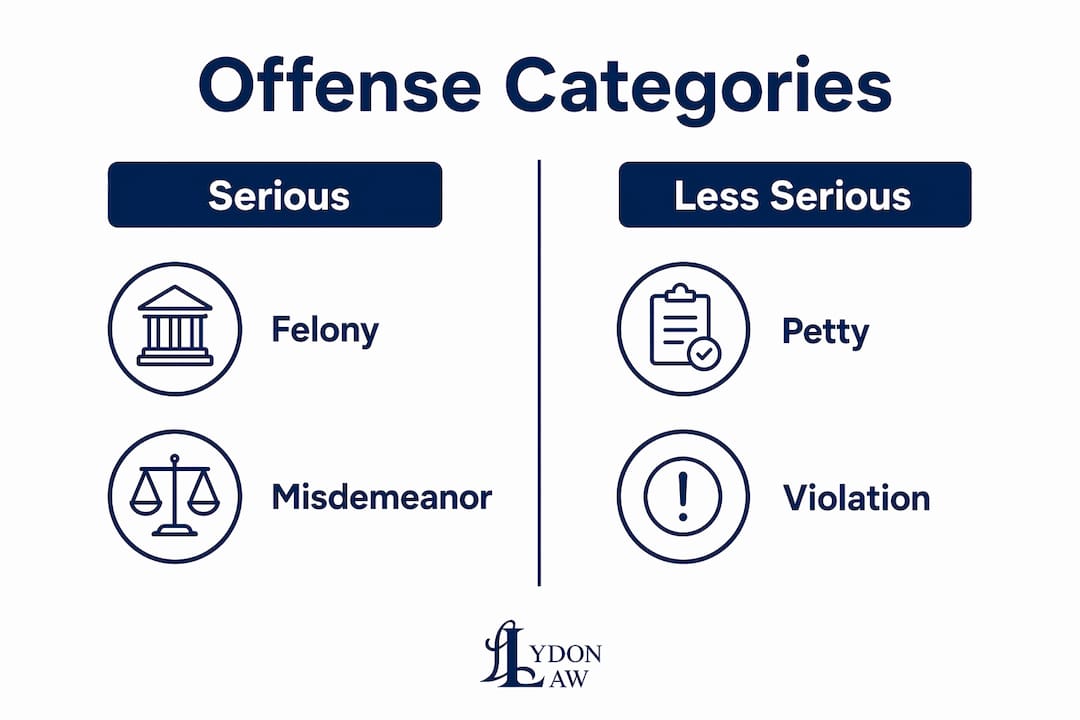
Not all criminal charges are treated the same way, and the category of offense you face directly shapes the procedures that apply to your case. This is one area where understanding criminal jargon has real, practical consequences.

Serious offenses include felonies and misdemeanors where the potential confinement exceeds six months. Petty offenses are misdemeanors where confinement is six months or less. That distinction matters because it affects your right to a jury trial, the type of court that handles your case, and the procedural protections available to you. In New Hampshire, felonies are tried in Superior Court while misdemeanors are typically handled in Circuit Court, which means the category of your charge determines the entire procedural path ahead.
The charging document used also carries significant weight. An indictment is a grand-jury-approved document, while an information is filed directly by the prosecutor. Under federal rules, a defendant can waive the right to indictment, but that waiver must be made in open court. Waiving indictment is not always in your best interest, and it is the kind of decision that requires careful legal counsel.
| Term | Category | Key distinction |
|---|---|---|
| Felony | Serious offense | Confinement over one year; tried in Superior Court in NH |
| Misdemeanor (Class A) | Serious offense | Confinement over six months; full procedural protections apply |
| Misdemeanor (Class B) | Petty offense | Confinement six months or less; limited procedural rights |
| Indictment | Charging document | Requires grand jury approval before charges are filed |
| Information | Charging document | Filed by prosecutor directly; defendant may waive indictment |
Pro Tip: If you are charged with a felony in New Hampshire, do not assume the indictment process is a formality. Grand jury proceedings are closed to the public and to you, which makes having an attorney who understands that stage critically important.
When a court issues process after an indictment or information, it chooses between two tools: an arrest warrant or a summons. The difference between them is not just procedural. It is the difference between being arrested and being asked to appear voluntarily.
An arrest warrant authorizes law enforcement to take you into custody. A summons, by contrast, orders you to appear in court on a specific date without placing you under arrest. Under federal rules, the court issues a warrant or summons upon the filing of an indictment or information. The choice between them often depends on the severity of the charge and whether the court believes you will appear voluntarily.
Ignoring a summons is one of the most damaging mistakes a defendant can make. Failure to respond to a summons leads directly to the issuance of an arrest warrant. What started as a voluntary court appearance becomes an active warrant, which means law enforcement can arrest you at any time, including at your home or workplace.
If you receive either document, here is what to do:
Pro Tip: A summons may feel less serious than a warrant, but the legal obligations attached to it are identical. Treat every court document as urgent, regardless of how it is labeled.
Many people use verdict, judgment, and sentence interchangeably, but these are three distinct stages in a criminal case. Conflating them leads to real confusion about what has actually been decided and what options remain available to you.
A verdict is the jury’s or judge’s decision at the end of trial: guilty or not guilty. A judgment is the court’s formal legal conclusion based on that verdict, which officially establishes your legal status in the case. A sentence is the punishment imposed after a guilty verdict or plea, such as imprisonment, fines, probation, or community service. These are distinct stages and must not be confused, particularly when evaluating whether to appeal or file post-trial motions.
One term that surprises many people is “arresting judgment.” This is not about stopping an arrest. It is a post-trial motion asking the court to set aside a judgment because the court lacked jurisdiction over the offense or the charging document was defective. Under federal rules, a motion to arrest judgment must be filed within 14 days after the verdict or guilty plea. Missing that window forfeits the right entirely, regardless of the strength of the underlying argument.
Understanding these distinctions matters most when you are evaluating your options after a verdict:
Knowing the precise definitions of criminal law terms is the single most effective way to protect your rights and make informed decisions at every stage of a criminal case.
| Point | Details |
|---|---|
| Charge vs. conviction | A charge is an accusation; a conviction is a legal finding of guilt after trial or plea. |
| Offense categories matter | Felonies and serious misdemeanors carry broader procedural rights than petty offenses. |
| Warrant vs. summons | Ignoring a summons leads directly to an arrest warrant, escalating your legal risk immediately. |
| Verdict, judgment, sentence | These are three separate stages; confusing them can cause you to miss critical deadlines. |
| Deadlines are absolute | Post-trial motions like arresting judgment must be filed within 14 days or the right is lost. |
When someone walks into Lydon’s office facing a criminal charge, the first thing I notice is how much stress comes from not knowing what the words in their documents actually mean. People assume a charge is the same as a conviction. They think a summons is less serious than a warrant. They hear “indictment” and assume the worst, or they hear “information” and assume it means something informal.
The terminology gap is not a sign of ignorance. Legal language is deliberately precise, and it was never designed to be self-explanatory to someone outside the profession. But that gap has real consequences. I have seen clients make decisions about pleas, waivers, and court appearances based on misunderstandings of what a single word meant. Those decisions are hard to undo.
My advice is to treat every term in your case documents as a defined term with a specific legal meaning, not a general English word. “Serious offense” does not just mean something bad happened. It is a procedural classification that determines your rights in court. “Judgment” is not the same as “verdict.” Knowing the difference tells you whether the case is over or whether you still have options.
The clients who fare best are the ones who come prepared with questions about specific terms, not general anxiety about the process. Understanding the criminal defense process in New Hampshire starts with the vocabulary. Everything else builds from there.
— Rich
Facing a criminal charge in New Hampshire is stressful, and the legal language surrounding it can make an already difficult situation feel even more overwhelming. Lydon Law is a boutique criminal defense firm with offices in Nashua and Portsmouth, serving clients throughout New Hampshire. Attorney Kalie Lydon brings extensive courtroom experience, including appearances before the New Hampshire Supreme Court, and works directly with every client throughout the process. If you are trying to make sense of a charging document, a court order, or a plea agreement, Lydon’s criminal defense services provide the clear, practical guidance you need to make informed decisions about your case. Contact Lydon Law to speak directly with an attorney who will explain your rights and options in plain language.
A charge is the formal accusation that you committed a crime, while a conviction is the legal finding of guilt after a trial verdict or guilty plea. Being charged does not mean you are guilty.
Beyond a reasonable doubt is the burden of proof the prosecution must meet to obtain a guilty verdict. It is the highest standard in American law, meaning the evidence must leave no reasonable uncertainty about guilt.
Yes, under federal rules a defendant can waive the right to indictment, but the waiver must be made in open court. This decision carries significant consequences and should only be made with legal counsel.
Ignoring a summons causes the court to issue an arrest warrant, which authorizes law enforcement to take you into custody at any time. Treat every summons as an urgent legal obligation.
An arresting judgment is a post-trial motion asking the court to set aside a judgment due to a jurisdictional defect or a fatal flaw in the charging document. It must be filed within 14 days of the verdict or the right is permanently forfeited.

© 2026 Lydon Law|Legal Disclaimer|Privacy Policy