Menu


Divorce in New Hampshire has no mandatory waiting period, which makes it one of the more straightforward states to finalize a separation when both spouses agree on the key terms. An uncontested divorce typically wraps up in 2–3 months; contested cases run 8–14 months or longer, depending on complexity. Complex matters can exceed 18 months in some situations. Before you file, one of three residency conditions must be met under RSA 458:5:
Most New Hampshire divorces are filed on no-fault grounds of irreconcilable differences, and all cases go through the NH Family Division of the Circuit Court. If you have minor children, additional requirements apply, including a parenting plan and a court-ordered educational seminar.
Filing starts with choosing the right petition form. If both spouses agree to divorce, even without settling every detail, you can file a Joint Petition for Divorce together with a Personal Data Sheet. This approach skips the cost of formal service of process. If only one spouse is filing, you submit an individual Petition for Divorce, and your spouse must be notified through one of three methods: picking up the papers at the court, certified mail, or service by the sheriff.
Required documents at filing:
The filing process, step by step:
If you receive divorce papers rather than file them, understanding your rights and response deadlines is critical. Lydon Law has a detailed guide on what to do when served that walks through your options clearly.
About 90% of NH divorces are filed on no-fault grounds, specifically irreconcilable differences under RSA 458:7-a. You do not need to prove wrongdoing, and neither spouse has to accept blame. That simplicity is why the overwhelming majority of people choose this route.
Fault-based grounds do exist under RSA 458:7 and include adultery, extreme cruelty, abandonment for at least two years, habitual drunkenness, and a few other specific circumstances. Choosing a fault ground rarely changes how the court divides property, but it almost always increases legal costs and extends the timeline because fault must be proven with evidence.
Domestic violence allegations change the picture significantly. When abuse is alleged, the court can issue protective orders, restrict contact, and adjust custody arrangements immediately. Mediation is generally not required in cases involving domestic violence, and the court takes a more active role in protecting the affected spouse and any children. If you are in this situation, getting legal representation before you file is not optional.
Key points on grounds:
Divorces with minor children carry additional court requirements that do not apply to childless cases. The court’s priority is the children’s wellbeing, and the process reflects that from the very first filing.

Both parents must complete the Child Impact Program, a four-hour educational seminar that costs about $85 per parent. A certificate of completion must be filed before the court will issue a final decree. The program covers how divorce affects children at different developmental stages and how parents can reduce conflict for their children’s benefit.
Additional requirements for cases with minor children:
Mediation is strongly encouraged and often required when parents disagree on custody or parenting time. The court will not schedule a temporary hearing until after First Appearance and mediation have occurred. For a thorough look at how custody arrangements are structured, Lydon Law’s guide on child custody in NH covers the process step by step.
Pro Tip: Bring your calendar to the First Appearance session. The court selects the next hearing date at that meeting, and requesting a reschedule later can add weeks to your timeline.
Support options for parents navigating custody disputes are also available through specialized family law support services, including child custody clinical support for families dealing with high-conflict situations.
New Hampshire follows an equitable distribution model, governed by RSA 458:16-a. The court starts with a presumption of a 50/50 split but can deviate based on 15 statutory factors, including the length of the marriage, each spouse’s earning capacity, contributions to the marital estate, and the needs of any children. Notably, NH treats nearly all property as potentially divisible, including assets one spouse owned before the marriage and even gifts like engagement rings, though the court weighs those circumstances in its analysis.
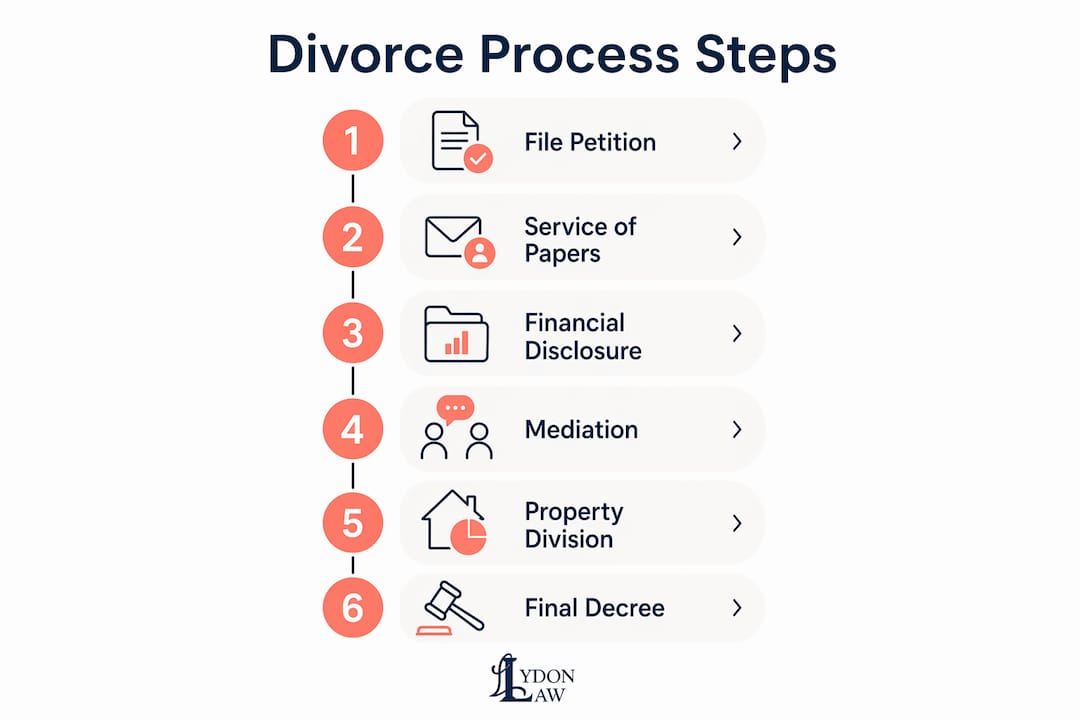
Financial affidavits must be exchanged within 45 days of service under Family Division Rule 1.25A. Missing that deadline, or submitting incomplete information, can seriously damage your credibility with the court. Even in cases that start amicably, incomplete financial disclosures have a way of turning cooperative spouses into adversaries.
What the court considers in property division:
For contested cases, the court may issue temporary orders covering property use, support, and custody while the case is pending. Those temporary orders often set the tone for the final decree, so getting them right matters. Lydon Law’s resource on property division in NH explains how the court weighs these factors in practice.
The single most common mistake people make in a New Hampshire divorce is moving out of the marital home without a court order or written agreement. Voluntary departure can weaken your custody position and complicate property claims, even if you left to reduce conflict. Before you make any major housing decision, get legal advice.
About 70% of Superior Court domestic relations cases in New Hampshire involve at least one self-represented party. That is understandable for simple, uncontested divorces with no children and minimal assets. But when custody, significant property, or fault allegations are involved, self-representation carries real risk. Attorneys in NH typically bill at $150–$400 per hour, and the cost of a mistake in a contested case usually exceeds the cost of hiring counsel from the start.
Pro Tip: If your spouse has an attorney and you do not, the procedural disadvantage is immediate. You are expected to know the same rules, meet the same deadlines, and present your case with the same precision.
Situations where legal representation is strongly advisable:
Legal separation is a separate option under NH law that some couples choose when they are not ready to divorce or have religious objections. It carries many of the same legal effects as divorce, including property division and support orders, but the marriage remains legally intact. A detailed comparison of legal separation vs. divorce can help you decide which path fits your situation.
Mediation is available at multiple points in the NH divorce process and is often required in contested cases without abuse allegations. It tends to reduce both cost and conflict, and agreements reached in mediation are generally more durable than those imposed by a judge. For complex financial situations, alternative dispute resolution can also protect privacy in ways that courtroom litigation cannot.
A final divorce decree is a court order, and violating it carries real consequences. If your former spouse fails to pay court-ordered child support or alimony, you can file a motion for contempt with the Family Division. The court has authority to enforce compliance through wage garnishment, license suspension, and in serious cases, incarceration.
Circumstances change after divorce, and NH law allows either party to seek a modification of existing orders when there has been a substantial change in circumstances. Common reasons include a significant change in income, a parent relocating, or a child’s needs evolving as they get older. Modifications to child support follow the Child Support Guidelines, and custody modifications require showing that the change serves the child’s best interests. Filing a motion to modify is a formal court process, not simply an agreement between the parties.
New Hampshire does not have a broad personal income tax on wages or salaries, which simplifies some aspects of divorce compared to other states. However, federal tax rules still apply and can significantly affect how you structure a settlement.
Alimony paid under divorce agreements finalized after December 31, 2018 is no longer deductible for the paying spouse under federal law, and the recipient does not report it as income. This is a meaningful shift from older agreements and affects how support amounts are negotiated. Child support has never been taxable income or deductible at the federal level.
Property transfers between spouses as part of a divorce settlement are generally not taxable events at the time of transfer, but the recipient takes on the original cost basis of the asset. That matters most with appreciated assets like investment accounts or real estate, where a future sale could trigger a capital gains tax. Retirement account transfers require a Qualified Domestic Relations Order, known as a QDRO, to avoid early withdrawal penalties and taxes. Getting the tax structure of your settlement reviewed by both a family law attorney and a tax professional is worth the time.
Divorce is one of the most consequential legal processes you will go through, and the decisions you make early, about property, custody, and support, shape your life for years afterward. Lydon Law is a boutique New Hampshire family law firm with offices in Nashua and Portsmouth, serving clients throughout the state. Attorney Kalie Lydon brings hands-on courtroom experience, including appearances before the New Hampshire Supreme Court, and clients work directly with her throughout the process rather than being passed to support staff.
Whether your divorce is straightforward or deeply contested, Lydon Law offers clear legal advice, practical strategy, and steady representation at every stage. Contact Lydon Law to schedule a consultation and get honest guidance on your specific situation.
New Hampshire divorce law gives you a clear procedural path, but the timeline and outcome depend heavily on whether your case is contested and whether children are involved.
| Point | Details |
|---|---|
| No mandatory waiting period | NH has no required waiting period; uncontested cases typically finalize in 2–3 months. Contested cases generally take 8–14 months or longer, and complex matters can exceed 18 months. |
| Residency requirements | One of three conditions under RSA 458:5 must be met before you can file. |
| Child Impact Program | Both parents must complete this four-hour seminar, which costs about $85 per parent, before a final decree is issued. |
| Financial disclosure deadline | Both parties must exchange financial affidavits within 45 days of service under Family Division Rule 1.25A. |
| Lydon Law | Lydon Law provides direct attorney representation for NH divorce cases from offices in Nashua and Portsmouth. |
An uncontested divorce in New Hampshire typically takes 2–3 months; contested cases run 8–14 months or longer, and complex matters can exceed 18 months.
Leaving the marital home voluntarily, without a court order or written agreement, can weaken your custody position and complicate your property claims in the final settlement.
A licensed New Hampshire family law attorney is your most important resource, particularly if children, significant assets, or disputes are involved. Lydon Law offers consultations for NH residents navigating divorce.
Very few assets are fully protected. NH courts can divide nearly all property, including premarital assets and gifts, though the court weighs the circumstances of how those assets were acquired when determining a fair split.
Mediation is strongly encouraged and often required by the court in contested cases, except when domestic violence allegations are present. It tends to reduce costs and produce more lasting agreements than courtroom litigation.

© 2026 Lydon Law|Legal Disclaimer|Privacy Policy