Menu


TL;DR:
- New Hampshire law offers survivors both civil protective orders and criminal prosecutions for domestic violence. Civil orders can be issued quickly to ensure immediate safety, while criminal charges involve higher burdens of proof and potential jail time. Proposed legislative changes may restrict access to civil protections, particularly for non-physical abuse cases.
Domestic violence laws in New Hampshire define abuse broadly, establish criminal penalties for offenders, and give survivors access to civil and criminal protections. New Hampshire law covers physical, emotional, and financial abuse between family members, household members, and intimate partners. Whether you are seeking protection, facing charges, or supporting someone in crisis, understanding how these laws work is the first step toward making informed decisions.
Domestic violence under New Hampshire law is defined by RSA 173-B:1 as abuse committed by a family or household member against another. The statute covers a wide range of conduct, including physical assault, sexual assault, stalking, criminal threatening, and harassment. Protected relationships include current and former spouses, cohabitants, people who share a child, and intimate partners regardless of whether they live together.
The law does not limit protection to physical harm. Emotional manipulation and financial control are recognized as forms of abuse in the civil protective order context. This matters because many survivors experience controlling behavior long before any physical violence occurs, and the law gives courts the authority to respond to that pattern.
New Hampshire currently operates two parallel systems for domestic violence cases: civil protective orders and criminal prosecution. These systems work independently, which means a survivor can seek a civil protective order without waiting for police to make an arrest or a prosecutor to file charges.
A civil protective order, commonly called a restraining order, can include several conditions:
To file for a restraining order in NH, you submit a petition to your local Superior or Circuit Court. A judge reviews the petition and can issue an emergency temporary order the same day. A full hearing is scheduled within 30 days, at which both parties can present evidence.
Pro Tip: Document every incident with dates, photos, texts, and witness names before you file. Courts weigh evidence carefully, and a detailed record strengthens your petition significantly.
Violating a protective order in New Hampshire is a Class A misdemeanor. Repeat violations carry escalating penalties, including criminal charges and possible jail time. If you use force to defend yourself against someone violating a protective order, New Hampshire law generally justifies that force, except during chance encounters in public.
Criminal domestic violence charges in New Hampshire fall under several statutes, with RSA 631:2-b governing domestic violence assault specifically. The offense is classified as a Class A misdemeanor at minimum, but charges escalate to felony level when serious bodily injury occurs, a weapon is used, or the defendant has prior convictions.
Common charges connected to domestic violence cases include:
Penalties for a Class A misdemeanor conviction include up to one year in jail and fines up to $2,000. Felony convictions carry state prison sentences ranging from 3.5 to 15 years depending on the class of felony.
The collateral consequences of a conviction extend well beyond the courtroom. A misdemeanor domestic violence conviction triggers a permanent federal firearm ban under the Lautenberg Amendment. This ban applies with no exceptions, affecting hunters, law enforcement officers, military personnel, and concealed-carry permit holders alike. A conviction can also affect child custody determinations and, for non-citizens, immigration status.

Pro Tip: If you are charged with a domestic violence offense, do not make statements to police without an attorney present. Anything you say can be used to establish intent, which directly affects whether charges are elevated to a felony.
Understanding the types of domestic violence charges in New Hampshire helps both survivors and defendants know what to expect from the legal process.
House Bill 1740 proposes a significant rewrite of New Hampshire’s domestic violence laws. The bill would eliminate independent civil protective orders and require criminal probable cause before any protective order can be issued. This would tie all domestic violence protections directly to the criminal justice system.
Advocates have raised several concerns about this proposal:
The bill also introduces potential penalties for false accusations, which supporters argue addresses misuse of the protective order system. Critics counter that fear of such penalties could silence genuine victims.
| Aspect | Current law | Under House Bill 1740 |
|---|---|---|
| Civil protective orders | Available independently of criminal charges | Requires criminal probable cause first |
| Non-physical abuse coverage | Covered under civil system | May not qualify for protection |
| Firearms restrictions | Included in civil orders | Tied to criminal process |
| Survivor autonomy | Can file without police involvement | Requires law enforcement action |
“Recent legislative debates highlight the policy tension between making protective orders faster and more accessible versus linking them to criminal probable cause.” — New Hampshire Public Radio, january 2026
Legal advocates recommend verifying the current status of protective order eligibility before filing, because the legislative environment is shifting quickly and case strategy may need to adjust.
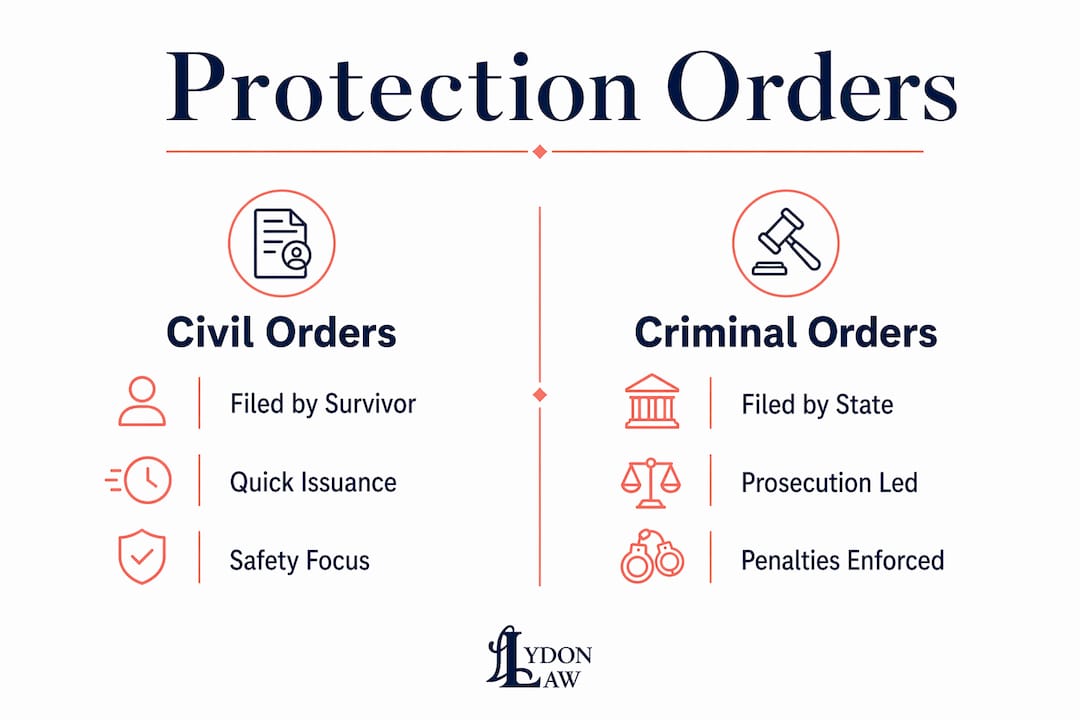
The civil and criminal systems in New Hampshire serve different purposes and operate under different rules. Understanding the distinction helps you choose the right path, or pursue both simultaneously.
The civil protective order system is designed for speed and survivor safety. You file a petition yourself, a judge can issue a temporary order the same day, and the burden of proof is a preponderance of the evidence, meaning it is more likely than not that abuse occurred. The process does not require a criminal arrest or conviction.
The criminal prosecution system is driven by the state, not the survivor. A prosecutor decides whether to file charges based on evidence gathered by law enforcement. The burden of proof is much higher: the state must prove guilt beyond a reasonable doubt. A criminal conviction carries jail time, fines, and a permanent record.
| Feature | Civil protective order | Criminal prosecution |
|---|---|---|
| Who files | The survivor | The state prosecutor |
| Burden of proof | Preponderance of evidence | Beyond a reasonable doubt |
| Outcome | Restraining order, custody terms | Conviction, jail, fines |
| Firearms ban | Yes, through civil order | Yes, through Lautenberg Amendment |
| Timeline | Same-day emergency order possible | Months to years |
The two systems can and often do run at the same time. A survivor may hold a civil protective order while criminal charges are pending. For defendants, a civil order can affect bail conditions and custody arrangements even before any criminal verdict. Reviewing the NH domestic violence legal process gives you a clearer picture of how these timelines interact.
New Hampshire’s domestic violence laws give survivors two separate paths to protection, and the choice between them carries real legal and practical consequences.
| Point | Details |
|---|---|
| Two systems exist | Civil protective orders and criminal prosecution operate independently in New Hampshire. |
| Civil orders are faster | Survivors can get a same-day emergency order without waiting for criminal charges. |
| Convictions carry lasting consequences | A misdemeanor conviction triggers a permanent federal firearm ban under the Lautenberg Amendment. |
| Proposed law changes matter | House Bill 1740 could eliminate independent civil orders, affecting survivors of non-physical abuse most. |
| Legal advice is time-sensitive | Protective order eligibility rules may shift quickly; consult an attorney before filing. |
Working with clients on domestic violence matters in New Hampshire, I see the same misunderstanding repeat itself. People assume the civil and criminal systems are interchangeable. They are not. A survivor who waits for police to act before filing a civil petition may wait weeks for protection that a court could have granted the same afternoon.
The proposed changes in House Bill 1740 concern me for a specific reason. Non-physical abuse, including financial control and psychological coercion, is often the foundation of a dangerous relationship. Removing civil protections for those forms of abuse does not make the situation less dangerous. It makes it harder to document and address before physical violence occurs.
For anyone facing charges, the firearm consequence alone justifies immediate legal counsel. Most people do not realize that a misdemeanor, not a felony, triggers the permanent federal ban. That distinction changes everything for someone whose livelihood, career, or personal safety depends on firearm access.
The law in this area is also moving fast. Knowing why hiring a domestic violence attorney matters is not just about courtroom strategy. It is about having someone who tracks these legislative shifts and adjusts your case approach accordingly.
— Rich
Lydon is a boutique law firm with offices in Nashua and Portsmouth, serving clients throughout New Hampshire in both family law and criminal defense matters. If you need a protective order, attorney Kalie Lydon works directly with you through every step, from filing the petition to representing you at the full hearing. If you are facing domestic violence charges, Lydon provides defense counsel focused on protecting your rights, your record, and your future.
Lydon’s family law services cover protective orders, custody, and related civil matters, while the firm’s criminal defense practice addresses misdemeanor and felony domestic violence charges. Contact Lydon to schedule a consultation and get clear, direct legal guidance for your situation.
New Hampshire law defines domestic violence as abuse committed by a family member, household member, or intimate partner. Covered conduct includes physical assault, sexual assault, stalking, criminal threatening, and harassment.
You file a petition at your local Superior or Circuit Court. A judge can issue an emergency temporary order the same day, with a full hearing scheduled within 30 days.
Violating a protective order is a Class A misdemeanor in New Hampshire. Repeat violations carry escalating criminal penalties, including potential jail time.
Yes. Even a misdemeanor domestic violence conviction triggers a permanent federal firearm ban under the Lautenberg Amendment, with no exceptions for hunters, officers, or military personnel.
Under current New Hampshire law, yes. Survivors can file for a civil protective order independently of any criminal process. House Bill 1740 proposes changing this, so verifying current law before filing is advisable.

© 2026 Lydon Law|Legal Disclaimer|Privacy Policy