Menu


TL;DR:
- A domestic violence restraining order is a civil court order that prevents an abuser from contacting or threatening the protected person. Filing begins at local courts with a petition that describes the abuse, and judges can issue temporary orders without the other party present. Violating the order is a criminal offense with serious penalties, and the full hearing determines whether a longer-term order is granted based on evidence showing more likely than not that abuse occurred.
A domestic violence restraining order is a civil court order that legally prohibits an abuser from contacting, approaching, or threatening the protected person. In New Hampshire, these orders are issued by the court to stop ongoing abuse and prevent future harm. Understanding domestic violence restraining orders explained in full, including how they work, what they cover, and how courts decide to grant them, gives you the clearest path to protecting yourself or your family. Whether you are seeking protection or responding to a petition filed against you, knowing the process reduces fear and helps you make informed decisions.
Filing starts at your local New Hampshire Superior Court or Family Court. You submit a petition describing the abuse, the relationship between you and the abuser, and the specific protection you need. The court clerk provides the forms, and you do not need an attorney to file, though having one significantly strengthens your petition.

After you file, a judge reviews your petition without the other party present. New Hampshire courts can issue ex parte orders granting immediate protection based on your petition alone. The judge must find “immediate and present danger” before signing a temporary order. That order stays in effect until a full hearing is scheduled, typically within a few days.
Danger does not follow business hours. If you need protection when courts are closed, after-hours emergency protective orders are available through local police, who contact an on-call judge by phone. The judge can issue an order over the phone that night. That emergency order remains valid until the next business day, when you must file formally at the courthouse.
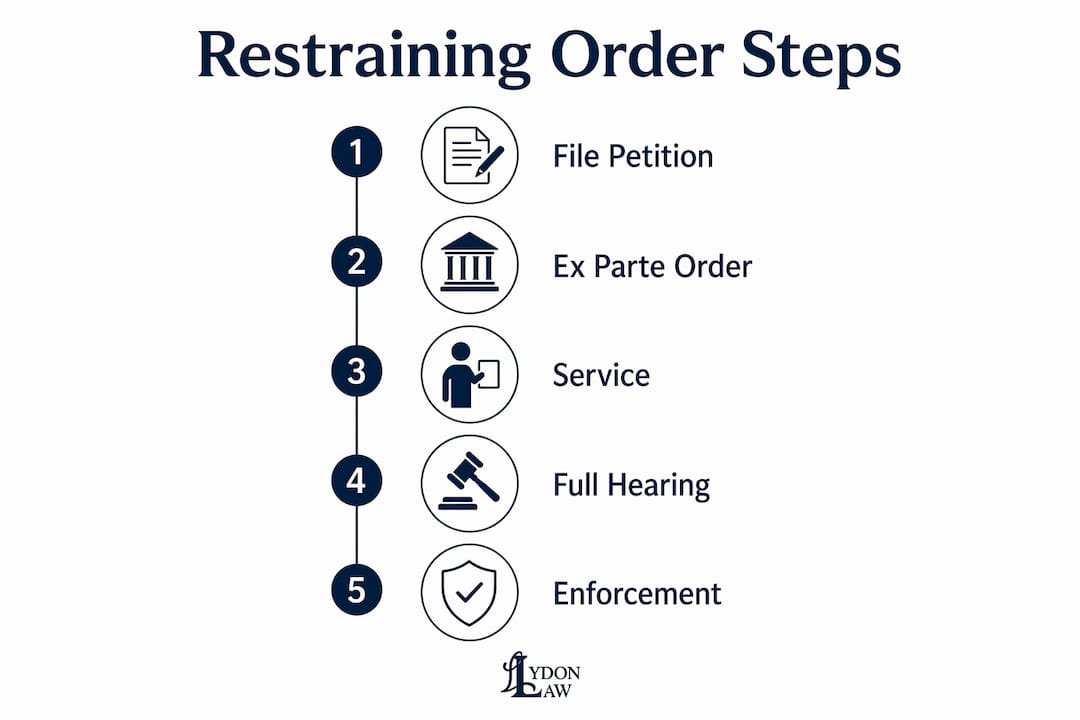
Once a temporary order is issued, law enforcement serves it on the respondent. The respondent must receive official notice before the order is legally enforceable against them. Timing matters here. The court schedules the full hearing, and both parties receive notice of that date.
Pro Tip: Bring every piece of documentation you have when you file. Photos, text messages, voicemails, and a written timeline of incidents all strengthen your petition and give the judge a clearer picture of the danger you face.
New Hampshire courts have broad authority to tailor protective orders to your specific situation. Understanding what the court can order helps you ask for the right protections when you file.
The most common provisions include:
Violating a domestic violence protective order in NH is a criminal offense with possible arrest and jail time. Penalties range from misdemeanors to felonies depending on how serious the violation is and whether the respondent has prior violations. A single violation can result in immediate arrest.
The full hearing is where the court decides whether to grant a longer-term protective order. Both you and the respondent appear before a judge, present evidence, and may call witnesses. This hearing is your opportunity to make your case with documentation and testimony.
New Hampshire courts apply the preponderance of the evidence standard to domestic violence protective order hearings. This means you must show it is more likely than not that abuse occurred and that continued protection is needed. You do not need to prove abuse beyond a reasonable doubt, which is the higher standard used in criminal cases. That distinction matters because it makes the civil protective order process more accessible to petitioners.
Police reports, medical records, photographs of injuries, and documented communications such as threatening texts or emails provide the strongest foundation for your case. Witness testimony from people who observed the abuse or its aftermath also supports your petition. Organize your evidence chronologically so the judge can follow the pattern of behavior clearly.
Pro Tip: Avoid emotional arguments during the hearing. Judges respond to facts, dates, and documentation. A calm, organized presentation of evidence is far more persuasive than an emotional account, even when your feelings are completely understandable.
Respondents have the right to appear, present evidence, and cross-examine witnesses. Respondents should focus on factual evidence and avoid emotional or argumentative testimony. Presenting police reports, medical records, and documented communications provides the strongest defense. Composure in the courtroom matters. Judges notice how each party conducts themselves, and aggressive or dismissive behavior works against you. You can read more about NH domestic violence defense rights to understand your full range of options as a respondent.
Many people have practical questions about what happens after an order is granted. These answers address the most frequent concerns.
How long does a restraining order last in New Hampshire? Temporary ex parte orders last until the full hearing. After the hearing, a judge can issue an order for up to one year. Courts can extend orders upon petition before they expire.
What is the difference between a restraining order and a no-contact order? A restraining order is a civil order you petition the court for directly. A no-contact order is typically issued as a condition of bail or probation in a criminal case. Both restrict contact, but they arise from different legal processes and carry different consequences for violations.
Can a restraining order be modified or dissolved? Yes. Either party can petition the court to modify or dissolve an order if circumstances change. The court reviews the request and may hold a hearing before deciding.
What happens if the respondent violates the order? Call 911 immediately. Law enforcement can arrest the respondent on the spot. Carrying a physical copy of your restraining order helps law enforcement act quickly, even though officers can verify orders through national databases. Having the document on hand avoids any delay in enforcement, especially across state lines.
Does a restraining order affect the respondent’s background check? A civil protective order itself may appear in certain background check systems. A criminal conviction for violating the order will appear on a criminal record and can affect employment, housing, and firearm rights long after the order expires.
What should you do if you face danger outside court hours? Contact local police. Officers can reach an on-call judge by phone to obtain an emergency protective order effective until the next business day. You can also review the NH domestic violence legal process for a full overview of your options at every stage.
A domestic violence restraining order in New Hampshire is a civil court tool that provides immediate, enforceable protection and carries serious criminal consequences for any violation.
| Point | Details |
|---|---|
| Ex parte orders provide immediate protection | A judge can issue a temporary order the same day you file, based on your petition alone. |
| After-hours protection is available | Police can contact an on-call judge by phone to issue emergency orders when courts are closed. |
| Orders cover more than no-contact | Courts can address child custody, firearms surrender, financial support, and animal custody in one order. |
| Preponderance of evidence is the standard | You must show abuse is more likely than not, a lower bar than the criminal standard. |
| Violations carry criminal penalties | Breaking a protective order can result in immediate arrest and charges ranging from misdemeanor to felony. |
The most common mistake I see people make is treating the full hearing as an afterthought. They get the temporary order and feel relieved, then show up to the hearing unprepared. The temporary order is exactly that: temporary. The full hearing is where your long-term protection is decided, and the outcome depends almost entirely on how well you document and present your case.
The second mistake is letting emotion drive the courtroom presentation. I understand why that happens. These situations are frightening and deeply personal. But judges are evaluating evidence, not feelings. The petitioner who walks in with a clear timeline, organized documents, and calm testimony almost always fares better than someone who is visibly distressed and disorganized, even when their situation is just as serious. Good evidence organization is not just a legal strategy. It is a form of self-advocacy.
For respondents, the same principle applies. Composure and factual rebuttal are your strongest tools. Emotional outbursts or attempts to discredit the petitioner through personal attacks rarely work and often backfire. Focus on the facts, and let the record speak.
— Rich
Lydon’s family law attorneys have guided New Hampshire clients through domestic violence restraining order cases from initial filing through contested hearings. Whether you are a petitioner seeking protection or a respondent preparing your defense, having an attorney who knows New Hampshire courts and procedures makes a real difference. Lydon handles the paperwork, prepares your evidence strategy, and stands with you in the courtroom so you are never facing the process alone. Attorney Kalie Lydon works directly with every client, with offices in Nashua and Portsmouth serving clients throughout New Hampshire. Contact Lydon to discuss your situation and understand your legal options clearly.
A domestic violence restraining order is a civil court order that prohibits an abuser from contacting or approaching the protected person. New Hampshire courts issue these orders to stop abuse and prevent future harm.
You file a petition at your local NH Superior Court or Family Court, describing the abuse and the protection you need. A judge reviews the petition and can issue a temporary order the same day.
Temporary orders last until the full hearing, which is typically scheduled within days. After the hearing, a judge can issue an order lasting up to one year, with the option to extend it before it expires.
Violating a protective order is a criminal offense in New Hampshire. The respondent can be arrested immediately, and penalties range from misdemeanor charges to felony charges depending on the severity and frequency of violations.
Yes. Contact local police, who can reach an on-call judge by phone to issue an emergency protective order valid until the next business day when you can file formally at the courthouse.

© 2026 Lydon Law|Legal Disclaimer|Privacy Policy