Menu


Drug possession charges in New Hampshire range from a $100 civil fine for small amounts of marijuana to felony imprisonment and fines reaching $50,000 for controlled substances, depending on the drug type, quantity, and your prior record. The governing law is RSA 318-B, the New Hampshire Controlled Substances Act, which defines every possession offense, sets the schedule classifications, and determines how prosecutors build their case against you.
Three types of possession matter under New Hampshire law:
The charge you face depends heavily on what substance was found and how much. Here is a quick breakdown of where offenses land:
Understanding where your situation falls within this framework is the first step toward making informed decisions about your defense.
RSA 318-B organizes every controlled substance into five schedules based on medical use, abuse potential, and safety profile. The schedule a drug falls under directly determines the severity of a possession charge.
Possession of a Schedule I or II substance carries the most serious consequences. Prosecutors treat these cases as felonies by default, and the quantity found can push a class B felony into class A territory. By contrast, marijuana occupies a distinct legal space under RSA 318-B:2-c, with its own graduated penalty structure that treats small quantities as civil violations rather than crimes.
The critical distinction: Possessing any amount of heroin, fentanyl, or cocaine is a felony from the first offense. Possessing a small amount of marijuana is not even a misdemeanor for adults 21 and older. The schedule and substance type create a wide gap in legal consequences.
Penalties follow a tiered structure tied to substance type, quantity, and criminal history. The table below reflects the ranges set by RSA 318-B:26.

| Offense Type | Substance / Quantity | Fine | Imprisonment |
|---|---|---|---|
| Civil violation | Marijuana ≤ 3/4 oz (adult 21+, 1st or 2nd offense) | $100 | None |
| Civil violation | Marijuana ≤ 3/4 oz (3rd+ offense within 3 years) | Up to $300 | None |
| Misdemeanor | Marijuana > 3/4 oz or > 5g hashish | Varies | Up to 1 year |
| Misdemeanor | Marijuana-infused products (person under 21) | Varies | Up to 1 year |
| Class B felony | Controlled substance (non-marijuana), first offense | Up to $25,000 | Up to 3 years |
| Class A felony | Repeat or high-quantity controlled substance offense | Up to $50,000 | Up to 5 years |
| School zone | Any controlled substance within 1,000 feet of school | Up to 2x standard | Mandatory minimum 1 year |
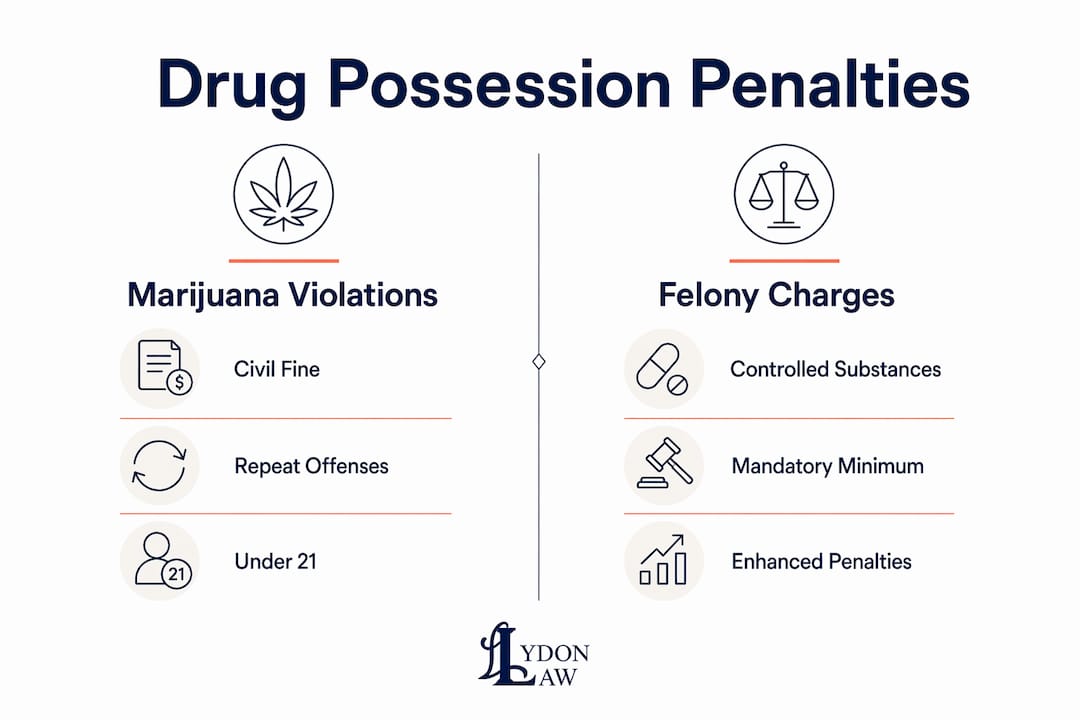
A few points deserve attention beyond the table. Repeat offenses within three years can convert a marijuana violation into a class B misdemeanor, which creates a criminal record where none existed before. For anyone under 21, possessing marijuana-infused products is already a misdemeanor, not a violation. And for controlled substances, the minimum fine is $350 for a first offense and $500 for subsequent offenses, separate from any other penalties the court imposes.
School zone enhancements are particularly serious. The mandatory minimum of one year cannot be suspended or reduced by the court, which removes the judge’s usual discretion entirely.
Drug Treatment Courts in New Hampshire offer a genuine alternative to standard criminal prosecution for eligible defendants. These are 18–24 month programs designed for high-risk, high-need felony offenders who are at least 18 years old, county residents, and have a substance use disorder that contributed to their criminal history.
Eligibility is selective. The program targets people whose substance use is directly linked to their criminal behavior, and acceptance requires coordinated screening by both legal and clinical teams. Not every defendant qualifies, and the court makes the final determination.
If accepted, participants must meet demanding requirements:
Participants who violate program rules face graduated sanctions, which can include time in custody, and repeated violations can result in termination from the program and a return to standard criminal prosecution. The program is demanding by design.
Pro Tip: If you are considering Drug Treatment Court, speak with your attorney before applying. The program requires you to plead guilty and waive certain rights as a condition of entry. Understanding exactly what you are agreeing to before you sign is not optional.
Diversion programs outside of Drug Treatment Court may also be available for first-time or lower-level offenders. These vary by county and are worth discussing with a drug possession defense attorney early in your case.
A drug possession charge is not a guaranteed conviction. Several defenses are available under New Hampshire law, and the right one depends on the specific facts of your case.
Knowing which defense fits your situation requires a careful review of the police report, the search circumstances, and the evidence. An experienced criminal defense attorney can identify weaknesses in the prosecution’s case that are not obvious from the charge itself.
Drug possession cases in New Hampshire are rarely straightforward, and the details that seem minor at first often turn out to matter most. Attorney Kalie Lydon, who leads Lydon Law and has appeared in New Hampshire courts including the state’s Supreme Court, works directly with clients throughout every stage of a drug case rather than delegating to support staff.
A few realities that clients frequently misunderstand:
Lydon Law’s approach centers on clear, honest communication. You will know what the charges mean, what the realistic outcomes are, and what your options look like at every stage. That clarity is what allows you to make decisions that protect your future.
The process from arrest to arraignment follows a predictable sequence, and knowing what to expect at each stage helps you respond effectively.

Arrest. Police arrest you when they have probable cause to believe you possessed a controlled substance. They are required to inform you of your Miranda rights, including the right to remain silent and the right to an attorney. Exercise both immediately. Anything you say after arrest can be used against you, and there is no legal benefit to explaining yourself at the scene.
Booking. After arrest, you are transported to a local police station or county jail for booking. This involves recording your personal information, photographing, fingerprinting, and a review of your criminal history. Your belongings are inventoried and held. Depending on the charge, you may be held until arraignment or released on bail.
Bail hearing. For felony charges, a bail hearing typically occurs within 24 hours. The judge considers the severity of the charge, your ties to the community, and your criminal history when setting bail. A drug possession defense attorney can argue for release on personal recognizance or reduced bail at this stage.
Arraignment. At arraignment, the formal charges are read and you enter a plea. Pleading not guilty at this stage is standard practice and preserves all of your options. It does not prevent you from negotiating a plea later. Your attorney should be present at arraignment, and if you cannot afford one, the court will appoint a public defender.
After arraignment, the case moves into the discovery and pretrial motion phase, where your attorney reviews the evidence, challenges any constitutional violations, and begins building your defense strategy.
Prior convictions carry real weight in New Hampshire drug cases, and the escalation can be steep. Under RSA 318-B:27, a prior offense is defined broadly and includes convictions from other states for equivalent conduct, not just New Hampshire convictions.
For marijuana violations, a third offense within three years converts what would have been a $100 fine into a class B misdemeanor, which means a criminal record, potential jail time, and a conviction that follows you. For controlled substance felonies, a prior conviction can double the maximum sentence and fine. A class B felony with a $25,000 maximum fine becomes a class A felony with a $50,000 ceiling. For the most serious offenses involving Schedule I or II substances, a prior conviction can push the maximum sentence to 40 years and the fine to $500,000.
Beyond the sentencing ranges, prior convictions affect bail decisions, plea negotiations, and a judge’s discretion at sentencing. Prosecutors are also more likely to pursue the higher charge when a defendant has a record. If you have prior convictions, your attorney needs to know about them from the start, because they shape every strategic decision in your case.
Your rights do not begin at arraignment. They apply from the moment police begin investigating you, and knowing them protects you at every stage.
The right to remain silent. You are not required to answer questions from police beyond providing your name and identification when lawfully stopped. Politely declining to answer questions is not an admission of guilt, and it cannot be used against you. This right applies whether you are stopped on the street, questioned at home, or sitting in a police station.
The right to an attorney. Once you invoke your right to an attorney, police must stop questioning you until your attorney is present. Do not wait to exercise this right. Contact a criminal defense attorney in New Hampshire as soon as possible after an arrest or if you believe you are under investigation.
The right against unreasonable searches. Police generally need a warrant, your consent, or a recognized legal exception to search your home, car, or person. You have the right to refuse consent to a search. Refusing does not give police the right to search; it simply means they must establish another legal basis. If they search anyway, your attorney can challenge the search in court.
The right to a fair trial. You are presumed innocent until proven guilty beyond a reasonable doubt. The prosecution bears the entire burden of proof. You have the right to confront witnesses, present evidence, and have a jury decide your case. You also have the right to appeal a conviction if legal errors occurred during trial.
Understanding these rights is not just reassuring. It is the foundation of any effective defense.
New Hampshire allows for annulment of criminal records, which is the state’s equivalent of expungement. Under RSA 651:2 and related statutes, a person convicted of a drug possession offense may petition the court to annul the record after a waiting period has passed.
The waiting period depends on the severity of the offense. Violations and class B misdemeanors carry shorter waiting periods than felonies. The court considers factors including the nature of the offense, your conduct since conviction, and whether annulment serves the interests of justice. Annulment is not automatic, and not every conviction qualifies.
A successful annulment removes the conviction from your public criminal record, which can affect employment background checks, housing applications, and professional licensing. It does not erase the record from all law enforcement databases, and certain agencies may still access it. If you are considering a petition for annulment, speaking with an attorney about your eligibility and the likely outcome is a practical first step. You can review your criminal record through the New Hampshire State Police to understand exactly what appears before filing.
Facing a drug charge is stressful, and the decisions you make in the early stages of a case can have lasting consequences for your freedom, your record, and your future. Lydon Law represents clients throughout New Hampshire from offices in Nashua and Portsmouth, providing direct, hands-on representation from attorney Kalie Lydon at every stage of the process.
Whether you are dealing with a first-time marijuana violation or a felony controlled substance charge, Lydon Law offers the kind of clear, honest legal guidance that lets you understand your situation and make informed choices. The firm’s drug charge defense services cover the full range of criminal defense work, from challenging unlawful searches to negotiating with prosecutors to representing clients at trial.
You deserve an attorney who will tell you the truth about your case, not just what you want to hear. Contact Lydon Law to discuss your situation and explore your options.
Drug possession charges in New Hampshire carry consequences that range from a $100 fine to decades in prison, depending on the substance, quantity, and prior record under RSA 318-B.
| Point | Details |
|---|---|
| Marijuana violations vs. felonies | Adults 21+ with ≤ 3/4 oz of marijuana face a $100 fine; any other controlled substance typically triggers a felony charge. |
| Felony fine ranges | Class B felonies carry fines up to $25,000; class A felonies reach up to $50,000 under RSA 318-B:26. |
| Drug Treatment Court eligibility | Programs run 18–24 months and require high-risk, high-need status, a substance use disorder, and full compliance with strict rules. |
| Prior convictions escalate charges | A third marijuana violation within three years becomes a misdemeanor; prior felony convictions can double maximum sentences and fines. |
| Search and seizure defense | Evidence obtained through an unlawful search can be suppressed, often leading to reduced or dismissed charges. |
New Hampshire does not impose mandatory minimum sentences for simple drug possession in most cases. The exception is possession within 1,000 feet of a school, which carries a mandatory minimum of one year that cannot be suspended or reduced.
The outcome depends on the substance and quantity. Marijuana at 3/4 ounce or less results in a civil fine starting at $100 for adults 21 and older. Any other controlled substance typically results in a felony arrest, booking, and arraignment, with potential fines up to $25,000 and imprisonment.
Possession of a controlled substance other than marijuana is generally a class B felony under RSA 318-B:26, carrying fines up to $25,000. Repeat offenses or high-quantity cases can be elevated to a class A felony with fines up to $50,000.
New Hampshire allows annulment of criminal records, including drug possession convictions, after a waiting period that varies by offense severity. Annulment removes the conviction from your public record but does not erase it from all law enforcement databases.
A lawful prescription is an affirmative defense under RSA 318-B:2, but only when it was issued following a genuine practitioner-patient relationship with a physical examination. Prescriptions obtained online or by telephone without an in-person exam do not qualify as a valid defense.

© 2026 Lydon Law|Legal Disclaimer|Privacy Policy