Menu


TL;DR:
- New Hampshire uses a flexible, child-focused “parental rights and responsibilities” framework instead of traditional custody labels. Courts determine arrangements based on decision-making and residential responsibility, guided by the child’s best interests, with Parenting Plans formalizing agreements or court orders. Parents should document involvement, communicate respectfully, and seek legal help for enforcement or complex situations such as domestic violence or grandparent visitation.
If you’ve recently separated or started a divorce in New Hampshire, you may be searching for information about “custody” and finding that the answers don’t quite match what you expected. That’s because New Hampshire handles custody through a system called “parental rights and responsibilities” under RSA Chapter 461-A, rather than the traditional custody and visitation labels used in many other states. The good news is that this framework is actually more flexible and child-focused than the old model. This guide will walk you through the types of arrangements available, how courts make decisions, how to handle unique situations, and what to do when things go wrong.
| Point | Details |
|---|---|
| NH uses unique custody terms | Parental rights are divided into decision-making and residential responsibilities, not traditional custody. |
| Best interests standard | Courts decide custody based on what serves your child’s best interests using clear legal criteria. |
| Enforcement options exist | If the parenting plan isn’t followed, you can file a Family Access motion to enforce your rights. |
| Special rules for tough cases | Grandparent rights and safety concerns can substantially change available options and court procedures. |
| Preparation matters most | Success in custody cases depends on planning, documentation, and understanding the court’s priorities. |
Many parents are surprised to learn that “custody” in New Hampshire means something quite different from other states. The moment you understand the language, the entire process becomes clearer and far less intimidating.
Under RSA Chapter 461-A, New Hampshire replaces the traditional terms “legal custody” and “physical custody” with two more precise concepts: decision-making responsibility and residential responsibility. Decision-making responsibility refers to which parent has the authority to make major decisions about the child’s education, healthcare, religion, and general welfare. Residential responsibility refers to where the child actually lives on a day-to-day basis. This distinction matters because a court can assign these responsibilities in different combinations depending on what fits your family’s specific circumstances.
All custody arrangements in New Hampshire flow through a document called a Parenting Plan. This plan is the foundation of how your child’s time and care will be divided. It must address both decision-making and residential responsibilities, and it can be created by agreement between both parents or ordered by the court when parents cannot agree. The NH court custody factors that go into evaluating a Parenting Plan are extensive, which is why understanding them early gives you a real advantage.
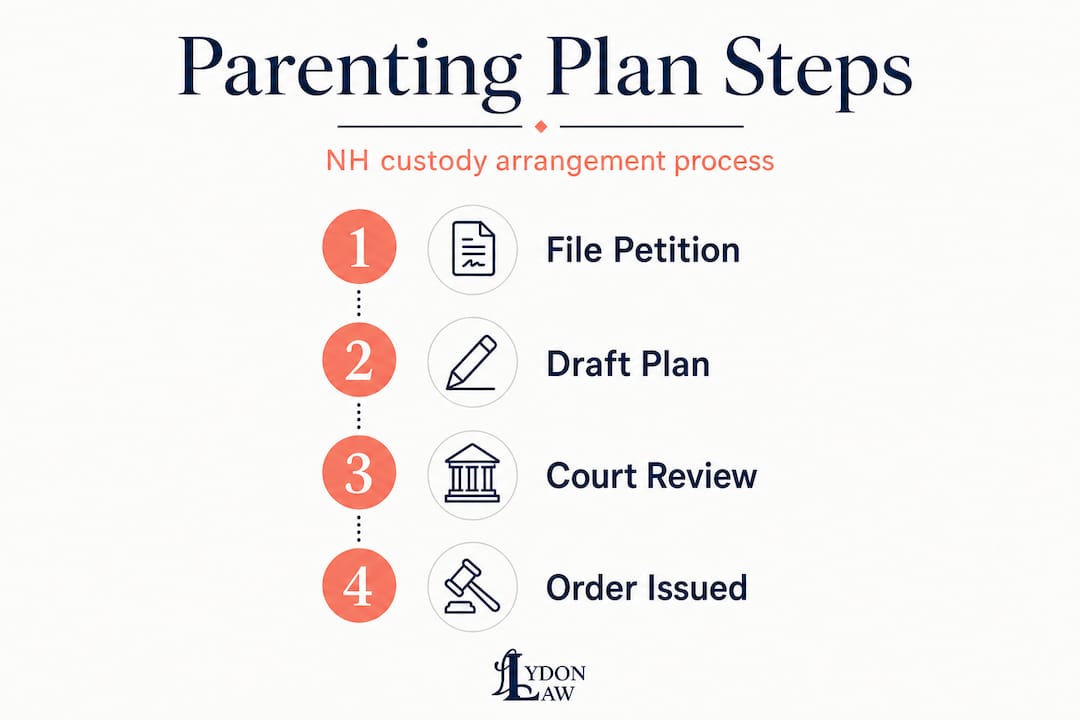
Here is a side-by-side look at how the old terminology compares to the current New Hampshire framework:
| Traditional term | New Hampshire term | What it means |
|---|---|---|
| Legal custody | Decision-making responsibility | Authority over major life decisions for the child |
| Physical custody | Residential responsibility | Where the child lives day to day |
| Sole custody | Sole decision-making/residential responsibility | One parent holds primary authority or residence |
| Joint custody | Shared decision-making/residential responsibility | Both parents share authority and/or residence |
| Visitation | Parenting time | Scheduled time with the non-residential parent |
This updated language is more than cosmetic. It signals a shift toward thinking about what each parent contributes to a child’s life, rather than who “wins” or “loses” a custody battle. Parents who internalize this shift tend to navigate the NH custody process with less conflict and better results.
Now that the language is clear, let’s look at the practical options and how judges make their determinations.
New Hampshire courts recognize several types of parenting arrangements. Joint residential responsibility means the child spends significant time living with both parents, though not necessarily a perfect 50/50 split. Sole residential responsibility places the child primarily with one parent, while the other has scheduled parenting time. Split residential responsibility is less common and typically applies when there are multiple children who may be divided between homes. Courts can also approve fully custom schedules that reflect unusual work hours, school schedules, or geographic realities.

When it comes to decision-making, parents can share this responsibility jointly or one parent can hold it alone. It is entirely possible, and fairly common in New Hampshire, for one parent to have sole residential responsibility while both parents share decision-making responsibility. The combinations are flexible by design.
The best interests of the child standard is the driving force behind every custody decision a New Hampshire court makes. This is not just a phrase. It refers to a specific set of statutory factors listed in RSA 461-A:6 that a judge must weigh when evaluating any parenting arrangement. Some of the most significant factors include:
Courts also require that a Parenting Plan address specific components before it can be approved. These typically include a residential schedule, a holiday and vacation schedule, a plan for handling disputes, and provisions for how the plan will be modified if circumstances change significantly.
Pro Tip: When preparing for a custody case, document everything that demonstrates your involvement in your child’s daily life. School pickups, medical appointments, extracurricular activities, and daily routines all paint a picture of who is the consistent, engaged parent. Courts respond to evidence, not just arguments.
You should also be aware that child support and residential responsibility are closely connected. Tools like the NH child support estimator can help you understand how financial obligations may shift depending on how residential time is divided. And if communication with your co-parent is already strained, learning how to communicate during disputes can protect both your child and your legal standing.
Of course, not every family situation fits the typical mold. Unique scenarios can shift what’s possible and how fast you can act.
Grandparent visitation rights are one area that many people don’t realize New Hampshire addresses directly. Grandparent visitation is recognized under NH law, and grandparents may petition the court for visitation when it serves the child’s best interests. This right is not automatic. Grandparents must file a petition and demonstrate that a meaningful relationship exists, that contact would benefit the child, and that the court’s intervention is warranted. If you are a grandparent concerned about losing access to your grandchild after a family separation, reviewing grandparent visitation rights in New Hampshire can help you understand what steps to take.
Enforcement of parenting plans is another reality many parents face. Once a parenting plan is approved by the court, it becomes a binding legal order. But what happens when the other parent doesn’t follow it? New Hampshire provides a specific legal mechanism for this situation. Under RSA 461-A:4-a, a parent can file what is called a Family Access motion. This motion asks the court to enforce the existing parenting order and can result in make-up parenting time, payment of legal fees, or other remedies depending on the severity of the noncompliance. Filing one does require documentation, so keeping records of every missed exchange or violation is essential.
The following situations are among the most common reasons parents need to go beyond standard procedures:
Safety-driven custody situations deserve special attention. For parents dealing with domestic violence or safety concerns, New Hampshire law treats these as priority edge cases that can alter the standard process significantly. Courts can issue protective orders, restrict or supervise parenting time, and consider documented abuse as a heavily weighted factor against the offending parent. If your situation involves any form of abuse or threats, reviewing your options under dealing with domestic violence in custody and NH domestic violence protections is a critical first step.
Pro Tip: Do not assume mediation is always appropriate or required. When safety is genuinely at risk, courts recognize that placing both parties in a room to negotiate may not be feasible. An attorney can help you request alternative procedures that protect you and your child.
Knowing what options exist is step one, but what if your co-parent simply ignores the rules or won’t communicate?
The shift you need to make in these situations is moving from negotiating the schedule to enforcing the court’s schedule. Trying to reason with a non-compliant co-parent through informal conversations can actually weaken your position over time. The Family Access motion under RSA 461-A:4-a is the procedural tool designed for exactly this situation, and using it sends a clear legal message that the order must be followed.
Here is a practical sequence of steps when co-parenting consistently breaks down:
Before you file, gather the following documents:
If your co-parent keeps changing the schedule without notice or agreement, document each instance and include it in your motion. Courts take a pattern of behavior seriously, and showing that pattern clearly is often more persuasive than a single incident.
Pro Tip: Use written communication for all significant co-parenting discussions, even if verbal conversations seem easier in the moment. A text or email creates a record. A phone call does not. How NH courts enforce orders matters, and your records can make the difference between a successful motion and one that stalls.
Those are your structured options. But what really helps parents get fair outcomes in New Hampshire, based on experience in these cases?
The most significant mistake parents make is treating custody like a conflict to be won rather than a problem to be solved. Courts in New Hampshire are remarkably focused on one question: what does this child need? A parent who walks in determined to “beat” the other parent, without clear evidence of how their proposed arrangement serves the child’s actual needs, often loses credibility with the judge quickly.
The second biggest misconception is that expressing grievances about the other parent will help your case. It rarely does. Judges have heard every version of co-parent conflict. What moves them is evidence of stability, cooperation where possible, and a genuine focus on the child’s welfare. Parents who can demonstrate that they support the child’s relationship with the other parent, even when that’s uncomfortable, consistently fare better than those who don’t.
Written, respectful communication with your co-parent is one of the most underrated tools available to you. It serves two purposes. First, it keeps conflict low, which is good for your child. Second, it creates a written record that shows the court you are the reasonable party. Many parents overlook this entirely.
The real costs and timelines involved in custody proceedings also surprise many families. Even “simple” cases can become complicated when emotions run high or one party stops cooperating. Getting legal guidance early, even if only for a consultation, can prevent costly mistakes and help you understand what realistic outcomes look like given your specific facts.
If you want knowledgeable, compassionate support for your family’s custody journey, here’s how you can get it.
At Lydon Law, we help parents across New Hampshire understand their full range of options under RSA Chapter 461-A, from negotiating parenting plans to enforcing court orders and handling difficult situations involving domestic violence or grandparent rights. Attorney Kalie Lydon works directly with each client, so you will never feel passed around or uncertain about where your case stands. Whether your situation is straightforward or involves unique and sensitive challenges, our family law attorneys in New Hampshire are ready to provide clear, practical guidance. We also know that negotiation in family law can lead to better outcomes and less stress for everyone, and we use both courtroom advocacy and thoughtful negotiation to protect your family’s best interests. Contact Lydon Law today to schedule a consultation.
Courts weigh factors like each parent’s relationship with the child, ability to cooperate, home stability, and the child’s own preferences, all guided by the best interests standard in RSA 461-A:6.
Yes. Grandparent visitation is recognized under NH law, and grandparents may petition the court for contact when it serves the child’s best interests and a meaningful prior relationship exists.
You can file a Family Access motion under RSA 461-A:4-a to ask the court to enforce the approved parenting plan and impose appropriate remedies for noncompliance.
Credible evidence of domestic violence is a heavily weighted factor under RSA 461-A:6, and courts can limit, supervise, or restructure parenting time to protect those facing safety concerns.
Yes. Parents can develop a unique schedule that reflects their family’s real circumstances, as long as the arrangement meets the best interests of the child standard and satisfies the court’s requirements for a complete Parenting Plan.

© 2026 Lydon Law|Legal Disclaimer|Privacy Policy