Menu


A first-offense DWI in New Hampshire is a Class B misdemeanor carrying a statutory minimum fine of $500, with additional court fees and assessments increasing the total financial penalties. Beyond the money, you face license revocation, mandatory enrollment in state-approved programs, and the possibility of probation. Here is a clear breakdown of what the law requires:
The financial and logistical burden adds up quickly. Program fees, court costs, and the near-certain spike in auto insurance premiums make a first DWI far more expensive than the fine alone suggests.

New Hampshire runs two separate suspension tracks simultaneously, and understanding both is critical to protecting your driving privileges.
The first is the Administrative License Suspension (ALS), which is triggered at the point of arrest, not conviction. Under New Hampshire’s implied consent law, drivers are required to submit to chemical testing upon reasonable suspicion of impairment. If you take the test and your blood alcohol concentration (BAC) registers at 0.08 or above, the arresting officer files a sworn report with the DMV, and a 180-day administrative suspension follows automatically, effective 30 days after you are served notice.
Refusing the test does not avoid suspension. Refusal triggers a separate administrative suspension that runs on top of any court-ordered penalty, extending the total period without driving privileges considerably. Whether the suspensions run concurrently or consecutively depends on the specific circumstances of your case.
Completing the IDCMP and staying compliant with your treatment plan can reduce the court-ordered 9-month revocation by up to 6 months, potentially cutting your time without a license substantially. That reduction is not automatic. It requires documented compliance and court approval.
The second track is the court-imposed revocation upon conviction, which runs a minimum of 9 months. These two tracks can overlap, but if you refused testing, expect them to stack.
Pro Tip: Whether to take a breathalyzer is one of the most consequential decisions you face at the roadside. Review the breathalyzer decision in New Hampshire before you are ever in that situation, not after.
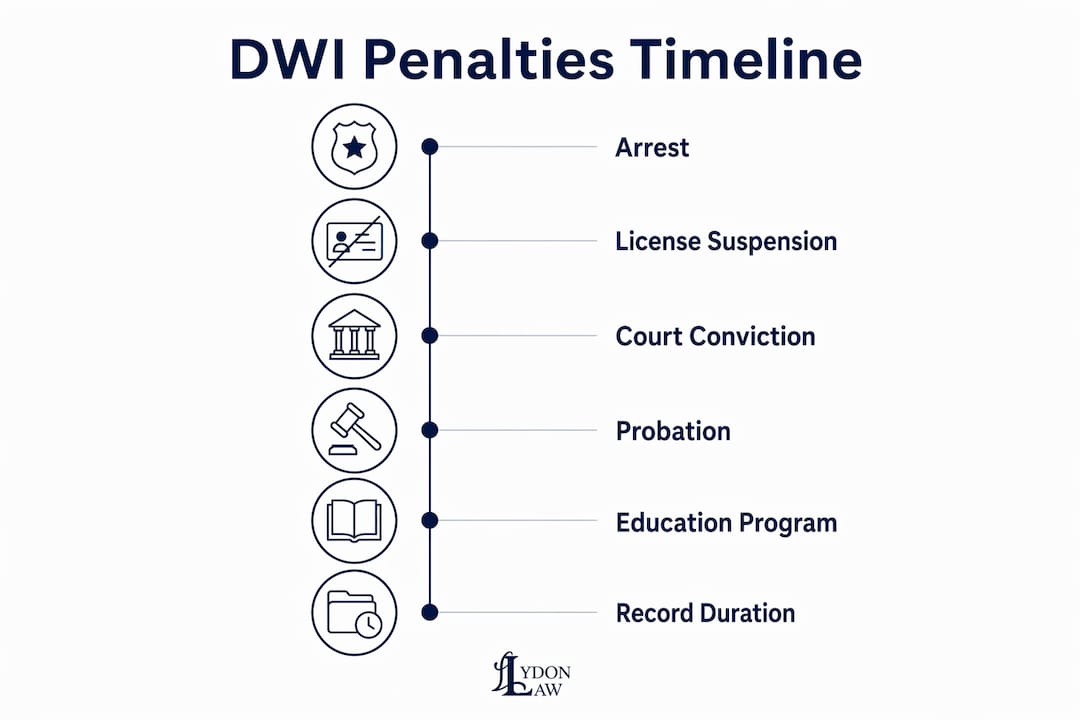
The process moves faster than most people expect. Knowing the sequence helps you respond at each stage without missing a critical window.
A first-offense DWI conviction remains on your criminal record for a defined period before you become eligible to petition for annulment under RSA 651:5. Annulment seals the record from public view, but it does not erase it entirely. Law enforcement retains access to the prior conviction when assessing penalties for any subsequent offense within that 10-year look-back window.
The distinction between sealing and deletion matters practically. You can answer “no” to most employment and licensing questions about prior convictions after annulment, but the record still exists for sentencing purposes if you are charged again.
There is also a meaningful option before the 10-year mark. Under RSA 265-A:18, the court may reduce a first-offense DWI conviction to a violation upon a motion filed at least one year after the conviction date. The court weighs your subsequent driving record, IDCMP recommendations, and any hardship a criminal record creates. This reduction does not guarantee annulment, but it changes the classification of the offense, which can matter for employment and licensing.
Drivers under 21 face stricter consequences at every level. New Hampshire’s zero-tolerance approach for underage drivers sets the BAC threshold at 0.02, meaning even a single drink can trigger a charge. The administrative suspension kicks in at the same 0.02 threshold.
The one-year minimum revocation for underage offenders is non-negotiable at sentencing, unlike the adult standard where IDCMP compliance can reduce the 9-month revocation. That distinction makes early legal counsel especially important for young drivers.
Acting within the first 30 days after a DWI arrest is not optional. Miss the administrative hearing request window and you lose the ability to challenge the suspension, no matter how strong your underlying defense may be.
At Lydon Law, attorney Kalie Lydon has handled DWI cases across New Hampshire courts, including appearances before the state’s Supreme Court. The firm’s approach starts with the facts specific to your arrest: the reason for the stop, the administration of the field sobriety test, the calibration history of the breathalyzer, and whether your rights were respected throughout. Each of those details can shape the outcome.
Pro Tip: Early attorney involvement consistently produces better outcomes in DWI cases. The DWI defense attorneys at Lydon Law work directly with you throughout the process, not through staff intermediaries.
If you are facing a first DWI charge and want to understand your options clearly, Lydon Law’s criminal defense practice is available to guide you through every stage.
Probation following a first DWI conviction in New Hampshire is not automatic, but the court has broad discretion to impose it. When probation is ordered, conditions typically include random urinalysis, compliance with IDCMP recommendations, and no further alcohol-related offenses.
The mandatory program requirements are separate from probation and apply to every first-offense conviction. You must complete an alcohol and drug screening within 14 days of conviction. If that screening indicates a likely substance use disorder, a full evaluation with an IDCMP-indicated provider follows within 30 days. The service plan developed from that evaluation becomes a binding condition of your sentence. Noncompliance can result in the court reimposing the longer suspension period that was previously reduced.
The impaired driver education program must be completed before the DMV will restore your license. The victim impact panel, an online program where offenders hear directly from people affected by impaired driving, is also required unless the court finds exceptional circumstances. These programs carry their own fees, which you are responsible for paying in full.
A first-offense DWI in New Hampshire triggers a Class B misdemeanor, a minimum $500 fine (typically near $1,200 total), at least 9 months of license revocation, and mandatory IDCMP enrollment, with IDCMP compliance potentially reducing the revocation by up to 6 months.
| Point | Details |
|---|---|
| Minimum fine | Statutory minimum is $500; total costs typically approach $1,200 with court fees and assessments. |
| License revocation | Court-ordered revocation is at least 9 months; IDCMP compliance can reduce it by up to 6 months. |
| Administrative suspension | A 180-day ALS applies at arrest; refusal to test adds a separate suspension on top of the court penalty. |
| Record duration | The conviction stays on your record for 10 years before annulment eligibility; law enforcement retains access even after sealing. |
| Underage drivers | Drivers under 21 face a minimum one-year revocation with no reduction option, plus mandatory IDCMP evaluation. |
Yes, in some cases. A skilled attorney may challenge the legality of the traffic stop, the accuracy of the breathalyzer, or the officer’s conduct, which can lead to reduced charges or dismissal. The outcome depends heavily on the specific facts of your arrest.
A first-offense DWI conviction remains on your criminal record for 10 years before you can petition for annulment under RSA 651:5. Annulment seals the record from public access but does not remove it from law enforcement visibility for future sentencing.
Most first-offense cases result in a Class B misdemeanor conviction with fines near $1,200, a 9-month license revocation (often reduced with IDCMP compliance), and mandatory program enrollment. Some cases resolve with a plea to a lesser charge depending on the evidence.
A standard first-offense DWI is a Class B misdemeanor, not a felony. Felony charges apply to aggravated DWI cases involving specific aggravating factors, such as a child passenger or a high BAC level, under RSA 265-A:3.
Refusing a chemical test triggers a separate administrative suspension under New Hampshire’s implied consent law, which stacks on top of any court-ordered penalty and extends your total time without driving privileges.

© 2026 Lydon Law|Legal Disclaimer|Privacy Policy