Menu


TL;DR:
- Grandparents in New Hampshire must petition the court for visitation rights; these are not automatic.
- State law emphasizes the child’s best interests and respect for parental decisions in visitation cases.
- Federal constitutional principles limit court power, requiring grandparents to show more than just a relationship.
Many grandparents in New Hampshire assume that their bond with their grandchildren automatically gives them the right to maintain contact, even when family relationships break down. That assumption can lead to painful surprises. Under New Hampshire law, grandparents have no automatic right to visitation or custody, and pursuing those rights requires navigating a specific legal process. This guide explains what the law actually says, when you can petition the court, what judges look for, and how constitutional doctrine shapes the outcome of these cases. Whether you are facing a divorce in the family, the death of a child, or a parent who has cut off contact, understanding the legal landscape is your first and most important step.
| Point | Details |
|---|---|
| No automatic visitation | Grandparents in New Hampshire must petition the court to request visitation rights. |
| Statutory triggers required | Petitions for grandparent rights are only possible in specific family circumstances such as divorce or loss of a parent. |
| Courts favor fit parents | A fit parent’s decision about grandparent visitation gets special constitutional weight, making petitions complex. |
| Best interests of the child | Courts consider the child’s well-being, the grandparent relationship, and possible interference with the parent-child bond. |
| Evidence matters | Strong evidence of a positive, established relationship with the grandchild boosts the chance of a successful petition. |
The phrase “grandparent rights” refers to a grandparent’s legal ability to seek court-ordered visitation or, in more serious situations, custody of a grandchild. In New Hampshire, these rights are not assumed. They must be formally requested through the court system.
The governing statute is RSA 461-A:13. Under this law, grandparents may petition the court for reasonable rights of visitation, but the process is not automatic. The court must weigh several factors before granting any access, and the burden falls on the grandparent to show that visitation serves the child’s best interests. This is a meaningful legal standard, not a formality.
Many grandparents are surprised to learn this, especially when they have been closely involved in a grandchild’s life for years. The law, however, starts from the premise that parents have the primary authority to make decisions about their children’s relationships. That presumption shapes everything about how these petitions are evaluated.
Common family situations that lead grandparents to explore grandparent rights in NH include:
Understanding which category your situation falls into matters, because the law treats each scenario somewhat differently.
Not every difficult family situation gives a grandparent the legal standing to file a petition. RSA 461-A:13 identifies specific circumstances that allow the court to consider a grandparent’s request. Generally, you need to show that the family structure has changed in a meaningful way, such as through divorce, the death of a parent, or a situation where the parents were never married.
The statute also sets clear limits. RSA 461-A:13 does not apply in certain situations where grandparent access was already restricted by a prior court order or where the family circumstances fall outside the statute’s defined triggers. If a court previously found that contact with you was not in the child’s interest, that history will weigh heavily against a new petition.
Here is a general comparison of situations that may qualify versus those that typically do not:
| Situation | Likely eligible to petition | Likely not eligible |
|---|---|---|
| Parents divorced or separated | Yes | |
| One parent is deceased | Yes | |
| Child born outside of marriage | Yes, in some cases | |
| Intact family with two fit parents | No, generally | |
| Prior court order restricting access | No, without changed circumstances | |
| Parental rights terminated | Possibly, for custody | Depends on adoption status |
If you believe you qualify, here is a general outline of the procedural steps involved:
Understanding the NH child custody process can also help you prepare, since many of the procedural steps overlap with general custody proceedings.

Pro Tip: Start building your documentation now, before you file. Courts look favorably on grandparents who can show a consistent, meaningful relationship with the grandchild over time. Calendars, text messages, photos, and school event attendance records all help establish that history.
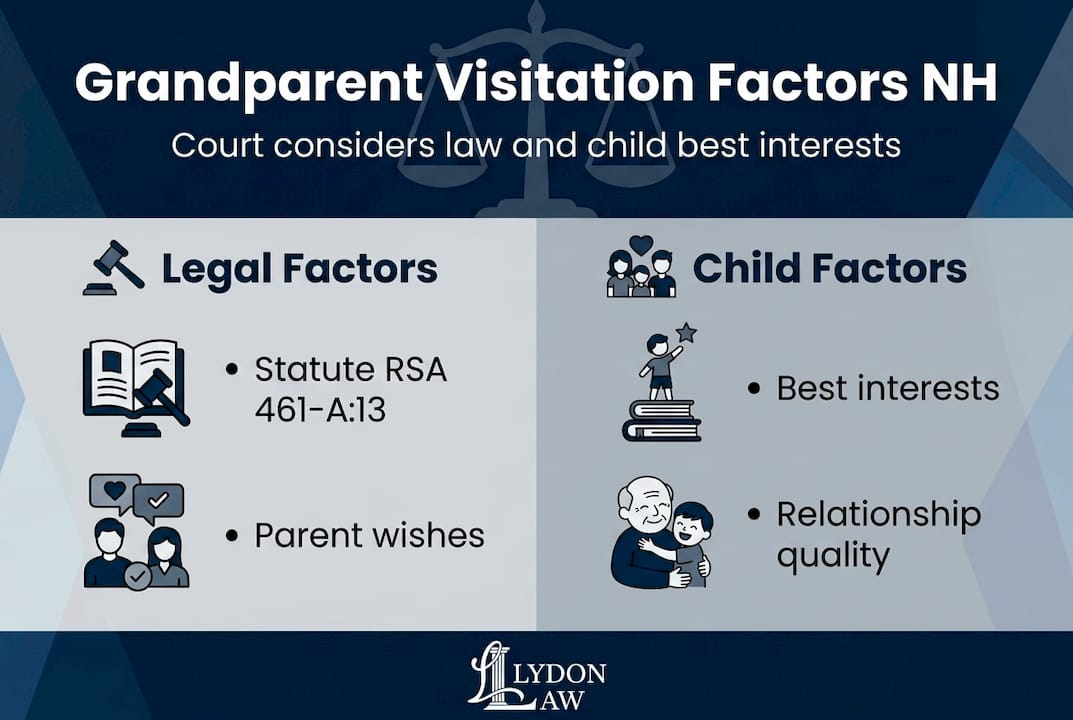
When a judge reviews a grandparent visitation petition, the analysis goes well beyond simply asking whether the grandparent loves the child. New Hampshire courts weigh multiple statutory factors, including the child’s best interests, the quality of the existing grandparent-grandchild relationship, and whether granting visitation would interfere with the parent’s authority or the parent-child bond.
The key factors courts typically examine include:
In some cases, the court may appoint a guardian ad litem, which is a neutral professional appointed to represent the child’s interests independently. The guardian ad litem will interview the child, the parents, and sometimes the grandparents, then submit a report with recommendations. That report carries real weight with the judge.
Understanding guardianship rights in New Hampshire can provide helpful context, especially if your situation involves a grandchild whose parents are unable to care for them and you are considering seeking more than just visitation.
Pro Tip: When preparing for a hearing, focus your evidence on the child’s experience, not your own feelings. Judges respond to concrete examples of how your presence benefits the grandchild, such as involvement in school, medical appointments, or consistent emotional support. Framing your petition around the child’s needs rather than your own desire for contact is a more effective legal strategy.
Even when state law allows a grandparent to petition for visitation, federal constitutional doctrine places a significant ceiling on what courts can actually order. The landmark case that defines this ceiling is Troxel v. Granville, decided by the U.S. Supreme Court in 2000.
In Troxel, the Court ruled that fit parents have a constitutional right to make decisions about their children’s upbringing, including decisions about who the child spends time with. Courts cannot simply override a parent’s choice about grandparent contact just because a judge thinks more visitation would be beneficial. The parent’s decision must be given special weight.
This doctrine, often called the fit-parent presumption, shapes how New Hampshire courts evaluate grandparent petitions. If a parent is considered “fit,” meaning they are capable of caring for their child and making reasonable decisions, the court must do more than conclude that grandparent visitation would be nice. The grandparent must show something more substantial.
The fit-parent presumption shapes how grandparent petitions are evaluated even when a state statute expressly allows grandparent visitation. In practice, this means:
Common pitfalls for New Hampshire grandparents include underestimating how much deference courts give to parental decisions, filing a petition without adequate documentation, and approaching the process in a way that escalates conflict rather than resolving it. Courts notice when a grandparent’s actions seem to be about winning a dispute rather than serving the child.
If you are seriously considering a petition, preparation matters as much as the legal arguments themselves. The statutory factor list under RSA 461-A:13 gives you a roadmap for the evidence you need to gather, and working through that list carefully before you file can significantly strengthen your case.
Here are practical steps to take before and during the process:
Document your relationship history. Gather evidence of regular contact, shared activities, and involvement in the child’s life. This could include school records, photos, medical visit records, or written communications.
Avoid escalating conflict. Courts look unfavorably on grandparents who have made the family situation more contentious. If possible, attempt to resolve the issue through direct communication or mediation before filing.
Understand the constitutional limits. Because fit parents retain constitutional protection against court-ordered third-party visitation, you need to be prepared to show more than just a preference for contact. Identify specific ways the loss of your relationship has affected the grandchild.
Consider mediation. A skilled family law mediator can sometimes help grandparents and parents reach a voluntary agreement, which is often better for the child and less costly than litigation.
Work with an experienced attorney. The procedural requirements, legal standards, and constitutional overlay make these cases genuinely complex. Having legal guidance from someone who understands NH grandparent visitation can help you avoid costly mistakes.
Be realistic about outcomes. Not every petition succeeds, and even successful ones may result in limited visitation rather than the regular contact you are hoping for. Setting realistic expectations helps you make better decisions about how to proceed.
If your situation involves concerns about the child’s safety or welfare, you may also want to explore whether a custody arrangement, rather than just visitation, is appropriate. Child custody attorneys who handle grandparent matters can help you assess which type of petition fits your circumstances.
Pro Tip: If you have not already tried to resolve this informally, consider sending a written, respectful request to the parent before filing. Courts sometimes view a good-faith effort to communicate as evidence that you are focused on the child’s wellbeing rather than conflict. That perception can matter when a judge evaluates your petition.
Most articles about grandparent rights focus on the legal steps and leave out the harder truth: even a legally sound petition can fail when family dynamics work against you. We have seen cases where grandparents had years of documented involvement with their grandchildren, met every statutory factor, and still faced an uphill battle because the court gave significant weight to a fit parent’s sincere, if painful, decision to limit contact.
The fit-parent presumption is not just a legal technicality. It reflects a deeply held principle that parents, not courts and not grandparents, are the primary decision-makers in a child’s life. When you file a petition, you are asking a judge to override that principle. That is a serious ask, and courts treat it as one.
What this means practically is that the emotional strength of your case matters as much as the legal strength. Grandparents who approach the process with humility, a genuine focus on the child’s wellbeing, and a willingness to work with rather than against the parents tend to fare better than those who approach it as a fight to be won. Judges are experienced at reading motivations, and a petition that feels punitive or retaliatory rarely succeeds.
We also think mediation is underused in these situations. Many grandparent-parent conflicts stem from communication breakdowns and hurt feelings rather than genuine concerns about the child’s safety. A skilled mediator can sometimes rebuild enough trust to reach a voluntary agreement, which is almost always better for the child than a court order. Exploring guardianship nuances and related options with an attorney before filing can also reveal paths you may not have considered.
The hard truth is that the law gives you a process, but it does not guarantee an outcome. What it does give you is a fair hearing, and how you use that hearing depends entirely on how well you prepare and how clearly you keep the child’s needs at the center of everything you do.
At Lydon Law, we understand how painful it is to feel cut off from a grandchild you love. Our firm has helped New Hampshire grandparents navigate the legal process with clarity and compassion, from assessing whether a petition makes sense to representing clients through hearings and negotiations. Attorney Kalie Lydon works directly with every client, so you always know who is handling your case. If you are considering a petition or simply want to understand your options, we encourage you to explore our family law help resources and reach out for a consultation. Our grandparent rights attorneys are ready to listen, answer your questions, and help you take the right next step for your family.
No. Grandparents must petition the court under RSA 461-A:13 to obtain visitation rights, and the court must find that visitation serves the child’s best interests before granting it.
Events such as divorce, the death of a parent, or the termination of parental rights can create standing to file a petition, though RSA 461-A:13 sets specific limits on when the statute applies and excludes situations where access was previously restricted.
The court considers multiple statutory factors, including the child’s best interests, the quality of the grandparent-grandchild relationship, and whether visitation would interfere with the parent’s authority or the parent-child bond.
Usually yes. Under Troxel v. Granville, courts must give special weight to the decisions of a fit parent about non-parental visitation, which means a parent’s objection carries significant legal force even when a grandparent has a strong relationship with the child.

© 2026 Lydon Law|Legal Disclaimer|Privacy Policy