Menu


TL;DR:
- Guardianship in New Hampshire is a court-appointed legal authority allowing decisions for minors or incapacitated adults. The process involves filing a petition, type-specific guardianship orders, and ongoing court oversight, including annual reports. It ends when the ward dies, reaches adulthood, or regains capacity, with proper legal procedures for transfer or termination.
Guardianship in New Hampshire is a court-appointed legal arrangement that gives a qualified individual the authority to make decisions for a minor or an incapacitated adult who cannot manage their own affairs. Governed by RSA 464-A, the process runs through the New Hampshire Probate Court and can cover personal care, financial management, or both. Any competent, willing person without a conflict of interest may be appointed. Understanding what guardianship means, how it works, and what it demands is the first step toward protecting someone you care about.
Guardianship is defined as a legal relationship in which a court appoints a guardian to have care and custody of a minor or incapacitated person, with authority that may extend to managing that person’s estate. The New Hampshire Probate Court holds authority over all guardianship appointments in the state. A judge grants guardianship only when the evidence shows that the individual, called the ward, cannot make safe or sound decisions independently.

The term “incapacitated person” under New Hampshire law refers to an adult whose ability to receive and evaluate information or make decisions is impaired by a mental, physical, or developmental condition. This is a legal determination, not simply a medical one. The court weighs medical evidence alongside testimony about the person’s daily functioning before granting any guardianship order.
Guardianship is distinct from other protective arrangements. It is not the same as power of attorney, which requires the person to voluntarily grant authority while they still have capacity. Guardianship is imposed by a court when voluntary options are no longer adequate or available.
New Hampshire law recognizes three primary forms of guardianship, each tailored to the ward’s specific needs. Courts limit guardian authority to only what the ward cannot handle independently. That principle of least restrictive authority is central to how New Hampshire structures every guardianship order.
The three types are:
| Type | Authority Covers | Does Not Cover |
|---|---|---|
| Person only | Health care, housing, daily care | Financial assets, property |
| Estate only | Finances, property, investments | Personal and medical decisions |
| Combined | Both personal care and finances | Nothing excluded by court order |
The court can also grant limited guardianship, restricting the guardian’s powers to specific decisions. For example, a ward may retain the right to vote or choose where to live while the guardian handles medical decisions. This flexibility reflects New Hampshire’s commitment to preserving as much of the ward’s autonomy as possible.
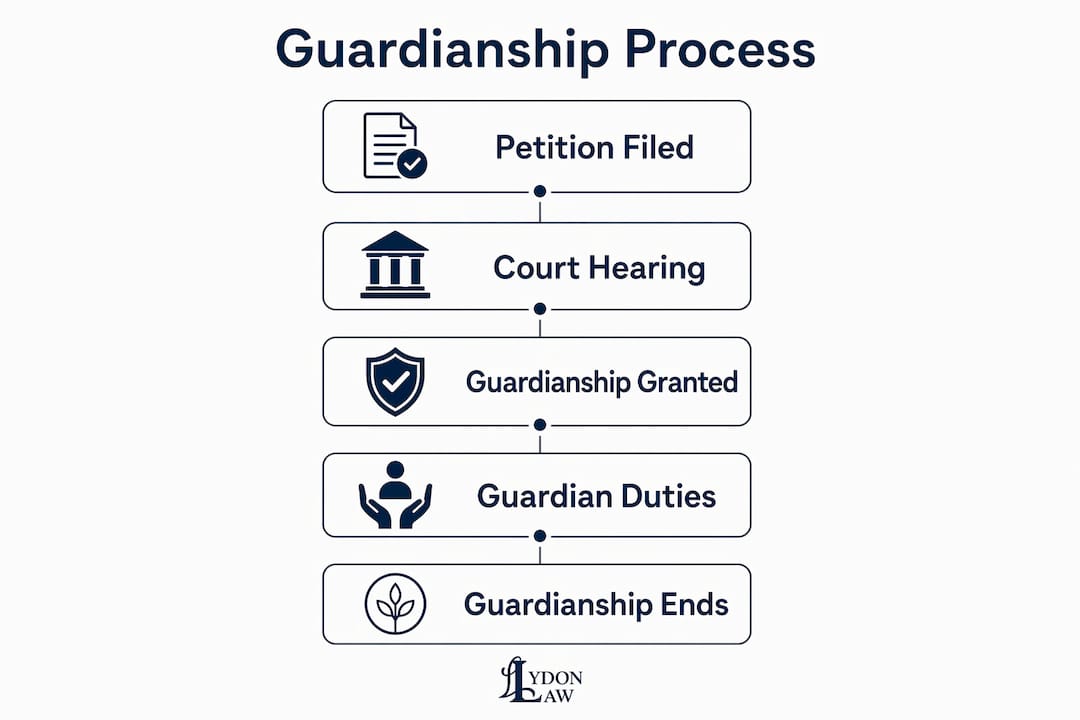
The New Hampshire guardianship process begins with a formal petition filed in the Probate Court in the county where the ward lives. Any interested person, including a family member, friend, or social worker, can file the petition. The petition must identify the proposed ward, explain why guardianship is needed, and name the proposed guardian.
Once the petition is filed, the court follows a structured process:
In urgent situations, the court may hold an expedited hearing and issue a temporary guardianship order to protect the ward while the full process proceeds. Temporary orders are limited in duration and scope.
Pro Tip: File your petition with complete documentation from the start. Incomplete medical records or missing notice forms are the most common reasons for delays in New Hampshire guardianship hearings.
A guardian in New Hampshire carries significant legal obligations from the moment of appointment. The probate court holds guardians strictly accountable, and noncompliance with court-ordered duties can result in removal and personal legal liability. Understanding those duties before accepting the role is not optional. It is a legal necessity.
Core responsibilities include:
Legal experts emphasize that rigorous court oversight of guardianship exists to protect wards and hold guardians strictly accountable, making compliance with every reporting and conduct requirement non-negotiable.
Guardians may receive reasonable compensation for their work, subject to court approval. Compensation is not automatic and must reflect the actual time and effort involved. Most family guardians serving a single ward receive modest compensation, if any.
Guardianship in New Hampshire does not last indefinitely by default. The law provides clear pathways for termination, transfer, and succession. Knowing these pathways matters whether you are a guardian planning for the future or a family member monitoring an existing arrangement.
Guardianship ends under the following circumstances:
| Situation | What happens next |
|---|---|
| Ward regains capacity | Guardian petitions court; guardianship terminated after hearing |
| Ward dies | Guardian closes estate; final accounting filed with court |
| Guardian resigns or becomes unfit | Court appoints successor guardian |
| Minor turns 18 | Guardianship ends automatically unless ward is incapacitated |
When a guardian becomes unable or unfit to serve, the court can appoint a successor guardian without requiring a new showing that the ward needs guardianship. The successor takes on equivalent powers unless the court modifies the order. This continuity protects the ward from gaps in care or financial management.
Pro Tip: If you are a guardian and anticipate needing to resign, notify the Probate Court as early as possible. Courts appreciate proactive communication and can begin the successor appointment process before a gap in care occurs.
The estate does not close automatically when guardianship ends. A guardian of the estate must file a final accounting with the court and receive formal discharge before their legal obligations conclude.
Guardianship in New Hampshire is a court-supervised legal arrangement that limits a guardian’s authority to only what the ward cannot manage, making compliance, reporting, and good-faith decision-making the foundation of every successful guardianship.
| Point | Details |
|---|---|
| Court-appointed authority | Guardianship is granted by the New Hampshire Probate Court under RSA 464-A. |
| Three types available | Courts grant guardianship over the person, the estate, or both, based on the ward’s needs. |
| Formal legal process | Petitions, hearings, guardian ad litem reports, and incapacity evidence are all required. |
| Annual reporting is mandatory | Guardians must file yearly reports; failure to do so risks court intervention or removal. |
| Guardianship can end or transfer | Termination occurs on the ward’s death, recovery, or majority, and successors can be appointed without re-proving need. |
Most people who come to me about guardianship are not looking for a legal lecture. They are worried about a parent with dementia, a sibling with a serious disability, or a child whose circumstances have changed. The legal process feels secondary to the emotional weight they are already carrying.
What I tell every client is this: the paperwork is manageable, but the accountability is not. New Hampshire’s Probate Court takes annual reporting seriously. I have seen well-meaning guardians face court scrutiny simply because they missed a filing deadline or kept informal records. The court does not distinguish between negligence and bad intent when it comes to noncompliance.
The other thing families consistently underestimate is the scope of the guardian’s authority limits. Guardians cannot make gifts from the ward’s estate, sell property without court approval, or make decisions that fall outside the order. Those boundaries exist to protect the ward, but they also protect you as guardian. Staying within them is not a burden. It is your legal shield.
My strongest advice: get legal guidance before you file, not after a problem arises. The guardianship determination process in New Hampshire has specific procedural requirements that are easy to miss without experience. Starting right saves time, money, and stress for everyone involved, especially the person you are trying to protect.
— Rich
Guardianship cases involve real stakes for real families, and having experienced legal support makes a measurable difference in how smoothly the process goes. Lydon’s family law attorneys assist New Hampshire residents with every stage of guardianship, from preparing and filing the initial petition to representing clients at Probate Court hearings and advising guardians on their ongoing reporting obligations. The firm’s offices in Nashua and Portsmouth serve clients throughout the state. If you are considering guardianship for a loved one or need guidance on your current responsibilities as a guardian, Lydon provides direct, practical legal support from an attorney who will work with you personally through every step.
New Hampshire guardianship is governed by RSA 464-A, which defines eligibility, appointment criteria, and guardian duties. All guardianship petitions are filed with and overseen by the New Hampshire Probate Court.
Any interested person, including a family member, friend, or social worker, can file a guardianship petition in the Probate Court of the county where the proposed ward lives.
New Hampshire uses the term “guardianship of the estate” for what some other states call conservatorship. Both refer to court-appointed authority over a person’s finances and property, but New Hampshire law consolidates both roles under the guardianship framework in RSA 464-A.
Guardians may receive reasonable compensation for their work, subject to approval by the Probate Court. Compensation is not automatic and must reflect the actual time and effort the role requires.
Yes. If the ward regains sufficient capacity to manage their own affairs, the guardian or the ward can petition the court to terminate the guardianship. The court holds a hearing and issues a formal termination order if the evidence supports it.

© 2026 Lydon Law|Legal Disclaimer|Privacy Policy