Menu


TL;DR:
- Child support in New Hampshire relies on the income shares model, which combines both parents’ net incomes and divides support proportionally. Parenting time and additional costs such as medical and childcare expenses influence the final amount, with a statutory minimum and no income cap. Proper documentation and prompt action are essential to establish or modify support orders accurately.
Child support in New Hampshire is calculated using the income shares model, a statutory formula defined under RSA 458-C that combines both parents’ net monthly incomes to determine a total support obligation. The court then divides that obligation proportionally based on each parent’s share of the combined income. This approach treats child support as a shared financial responsibility, not a penalty. Understanding how the NH child support formula works, what deductions apply, and how factors like medical costs and parenting time affect the final number gives you a clearer picture before you ever set foot in a courtroom.
New Hampshire uses a six-step process to arrive at a monthly child support obligation. Each step builds on the last, so an error early in the calculation compounds through the rest of the formula.
Step 1: Identify gross income. Gross income under NH law is broadly defined. It includes wages, salaries, self-employment income, rental income, investment returns, disability benefits, and more. Courts can also impute income to a parent who is voluntarily underemployed, meaning they assign an income based on earning capacity rather than actual earnings.

Step 2: Apply permitted deductions. From gross income, the law allows specific deductions to reach adjusted gross income. These include mandatory retirement contributions, health insurance premiums paid by the parent, and certain other court-ordered support payments already in place.
Step 3: Calculate net income. Federal income tax, FICA, and Medicare withholdings are subtracted from adjusted gross income. The result is each parent’s net monthly income, which is the figure the formula actually uses.
Step 4: Apply guideline percentages. The New Hampshire Department of Health and Human Services (DHHS) publishes support schedules that assign a percentage to the combined net income based on the number of children. Guideline percentages range from roughly 25.6% for one child at lower income levels down to 19% at higher combined incomes. This sliding scale reflects the reality that higher-earning families spend a smaller share of income on children proportionally.
Step 5: Allocate the obligation. The total support amount is split between parents in proportion to their individual net incomes. If one parent earns 60% of the combined net income, that parent bears 60% of the total obligation.
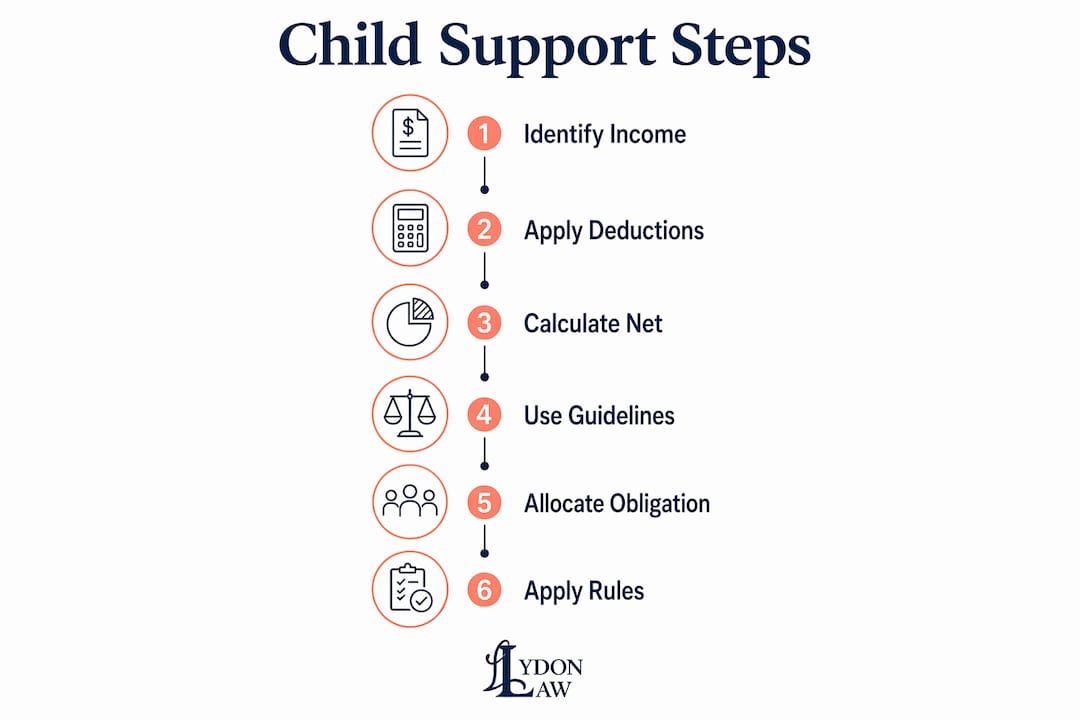
Step 6: Apply the minimum order and no-cap rules. The minimum monthly order is typically $50 unless the obligor can prove genuine hardship. There is no upper income cap, meaning the formula applies at all income levels.
Pro Tip: Run your numbers through the official NH DHHS Child Support Calculator before your hearing. The calculator results are presumptive, meaning courts start there and deviate only for documented special circumstances. Knowing the presumptive number in advance helps you prepare realistic expectations.
The base table amount is only part of the picture. Three separate add-ons regularly increase the total obligation, and many parents focus only on the base figure and miss them entirely.
Medical support. Medical support is a separate obligation added on top of the base amount. The standard rule requires each parent to contribute roughly 4% of their gross income toward health insurance premiums. Uninsured medical and dental expenses are then divided between parents proportionally based on their income shares. This means a parent with a higher income share carries a larger portion of out-of-pocket medical costs.
Work-related childcare expenses. Childcare costs tied to employment are added to the base support amount and allocated proportionally. If you pay $800 per month for daycare so you can work, that cost does not disappear from the calculation. It gets divided between both parents based on their income percentages.
The Self-Support Reserve (SSR). The SSR is a floor built into the formula to prevent support orders from pushing an obligor parent into poverty. The SSR is set at $1,729 per month in 2026. If paying the calculated support amount would drop the obligor’s remaining income below that threshold, the court adjusts the order downward. In those cases, the minimum order is typically $50 per month.
Pro Tip: Do not assume the SSR automatically applies to your situation. You must present clear financial evidence to the court. A child support attorney can help you document your income and expenses accurately so the court has the full picture.
Parenting time directly influences child support amounts, but it does not automatically eliminate the obligation. This is one of the most common misunderstandings parents bring into court.
New Hampshire law recognizes two parenting time thresholds that trigger rebuttable presumptions in the support calculation. When a parent has approximately equal parenting time (above 40%) or substantially shared parenting time (above 35%), the court applies a different calculation that accounts for the reduced financial burden on the receiving parent. These presumptions were updated as part of 2025 statutory changes.
Even with shared parenting time, support can still be required. The court weighs the income difference between parents alongside the parenting time split. If one parent earns significantly more than the other, a support obligation may remain even when parenting time is close to equal. The legal distinction between custody labels and actual parenting time percentages matters here. “Joint custody” does not automatically mean equal time, and equal time does not automatically mean zero support.
Courts also retain discretion to deviate from the guideline amount when parenting time creates unusual financial circumstances. A parent seeking a deviation must present specific evidence, not just assert that the arrangement is fair. Understanding parental visitation rights in New Hampshire is a useful starting point if you are unsure how your current schedule translates into legal parenting time percentages.
Establishing or modifying a child support order in New Hampshire requires specific forms and documented evidence. Courts do not accept informal agreements or verbal representations as a substitute.
Child Support Guidelines Worksheet. This form applies the RSA 458-C formula to both parents’ incomes and produces the presumptive support amount. Both parents typically complete it, and discrepancies between the two versions often become the focus of the hearing.
Financial Affidavit (Form NHJB-2101-FP). Courts rely heavily on this document to assess each parent’s financial situation. Inconsistencies between the affidavit and other evidence, such as tax returns or pay stubs, damage credibility and can affect the outcome.
Proof of income. Pay stubs, tax returns, W-2s, 1099s, and business financial statements are standard. Self-employed parents face additional scrutiny because income can be harder to verify.
Modification criteria. Modification petitions require proof of a substantial and unforeseen change in circumstances. Common triggers include job loss, a significant income increase, or a major change in custody or parenting time. Courts do not retroactively adjust orders before the date of formal notice, so filing promptly matters.
If you are navigating a custody change alongside a support modification, clinical support services can sometimes provide documentation or evaluations that strengthen your case in court.
New Hampshire child support is calculated using the income shares model under RSA 458-C, combining both parents’ net incomes, applying DHHS guideline percentages, and adding medical and childcare costs proportionally.
| Point | Details |
|---|---|
| Income shares model | Both parents’ net incomes are combined and support is allocated proportionally by income share. |
| Guideline percentages | Percentages range from roughly 25.6% to 19% depending on combined income and number of children. |
| Medical and childcare add-ons | A 4% medical support rule and work-related childcare costs are added on top of the base amount. |
| Self-Support Reserve | The SSR of $1,729 per month in 2026 protects obligors from orders that would leave them below a survival income. |
| Modification standard | A substantial and unforeseen change in circumstances is required to modify an existing order. |
Child support cases are among the most emotionally charged legal matters I see. Parents often arrive at hearings convinced the formula will either punish them or reward the other parent. Neither is true. The income shares model is designed to replicate, as closely as possible, what both parents would have spent on the child if they were still living together. That framing changes how you should approach the process.
The biggest practical mistake I see is an incomplete or inconsistent Financial Affidavit. Courts treat this document as a direct reflection of your credibility. If your affidavit shows $3,000 in monthly expenses but your bank statements show $5,000 in withdrawals, a judge notices. Accuracy matters more than strategy here.
The second mistake is assuming parenting time alone resolves the support question. Increased parenting time lowers the obligation in most cases, but the income gap between parents is equally important. A parent earning three times the other’s income may still owe support even with a 50/50 schedule. Presenting both the time split and the income data together gives the court what it needs to make a fair determination.
Finally, do not wait to file if your circumstances change. Courts cannot go back and adjust payments before you formally notify them. Every month you delay is a month the old order stands.
— Rich
Child support questions rarely have simple answers, and the stakes for your family are real. Lydon’s family law attorneys work with parents throughout New Hampshire, from initial support orders to modification hearings, helping you understand exactly how the formula applies to your situation. Lydon’s offices in Nashua and Portsmouth serve clients across the state, and attorney Kalie Lydon brings direct courtroom experience to every case. Whether you are establishing a new order, responding to a modification petition, or trying to understand how a custody change affects your payments, Lydon provides clear guidance at every step. Contact Lydon to discuss your situation with an attorney who will work with you directly.
The income shares model combines both parents’ net monthly incomes to calculate a total child support obligation, then divides that obligation proportionally based on each parent’s income share under RSA 458-C.
Equal parenting time triggers a rebuttable presumption that adjusts the calculation, but it does not automatically eliminate support. Courts also weigh the income difference between parents before setting the final amount.
The Self-Support Reserve is set at $1,729 per month in 2026 and prevents courts from issuing orders that would leave the paying parent below a basic income threshold. If the calculated amount would drop the obligor below this level, the order is reduced, typically to a $50 minimum.
You must file a modification petition and demonstrate a substantial and unforeseen change in circumstances, such as job loss or a significant custody change. Courts do not retroactively adjust orders before the date of formal notice.
You need a completed Child Support Guidelines Worksheet, a Financial Affidavit (Form NHJB-2101-FP), and proof of income such as pay stubs, tax returns, or business financial statements.

© 2026 Lydon Law|Legal Disclaimer|Privacy Policy