Menu


TL;DR:
- Guardianship in New Hampshire is based on specific legal standards that depend on whether the ward is an adult or a minor. The court rigorously evaluates evidence, guardian qualifications, and ongoing supervision throughout the guardianship process to ensure the ward’s best interests are protected.
Guardianship in New Hampshire is determined by a court based on the ward’s best interests and the proposed guardian’s qualifications, governed by RSA Chapter 463 for minors and RSA Chapter 464-A for adults. The court does not simply approve whoever files first. It applies specific legal standards, requires documented evidence, and maintains ongoing supervision after appointment. If you are considering filing a guardianship petition or responding to one, understanding how is guardianship determined in New Hampshire gives you a clear advantage before you ever set foot in a courtroom.
New Hampshire courts apply two distinct evidentiary standards depending on whether the proposed ward is an adult or a minor. For adults, incapacity must be proven by clear and convincing evidence under RSA Chapter 464-A. That is one of the highest standards in civil law, meaning the evidence must be substantially more than a preponderance. For minors, the court applies the best interests standard under RSA Chapter 463, which is more flexible but still requires concrete facts supporting the petition.
The distinction between a guardian of the person and a conservator of the estate matters here. A guardian of the person makes decisions about daily life, medical care, and living arrangements. A conservator of the estate manages financial assets and property. One person can hold both roles, or the court can appoint separate individuals. Knowing which role you are seeking shapes what evidence you need to gather.
Courts also evaluate the proposed guardian directly. Under RSA 464-A, guardians must be competent, willing to serve, and free from conflicts of interest that could compromise the ward’s welfare. A family member with a financial stake in the ward’s estate, for example, may face scrutiny over whether their interests align with the ward’s needs.
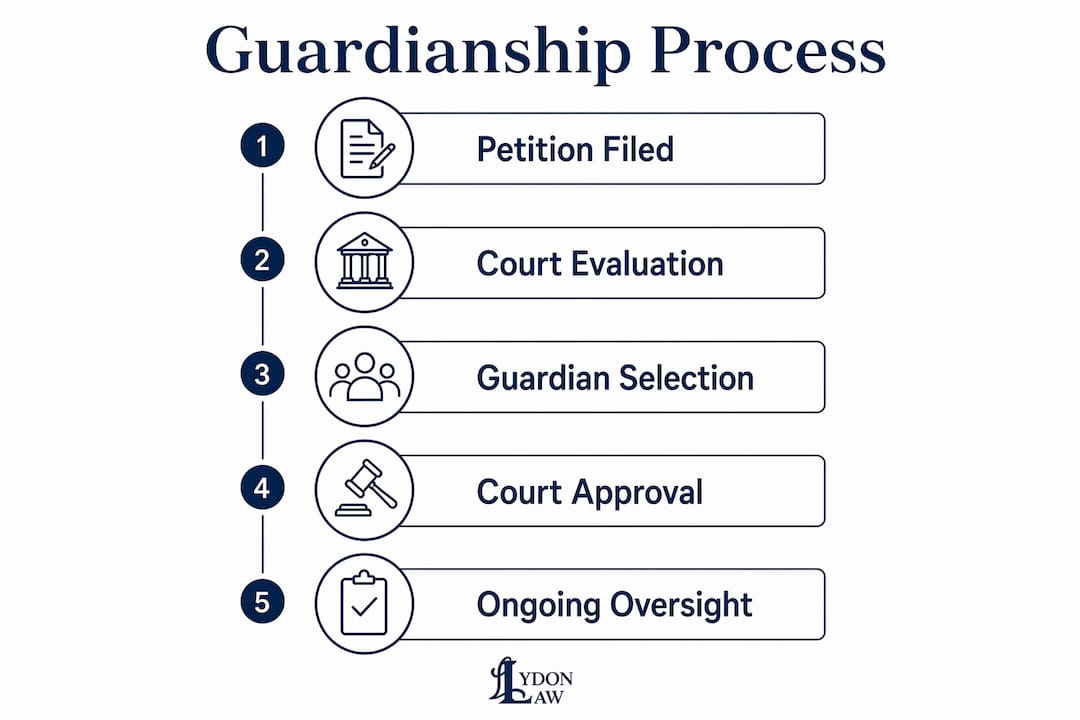
The court retains supervisory jurisdiction after appointment. Ongoing oversight requirements include mandatory reports and review hearings at defined intervals. For minor guardianships, biennial reviews are required. This is not a one-time proceeding. The court stays involved for the duration of the guardianship.
Pro Tip: Gather current medical records, physician statements, and any prior legal documents before filing. Courts weigh documented evidence heavily, and gaps in the record are one of the most common reasons petitions face delays.
The legal process for guardianship in New Hampshire follows a defined sequence from petition filing through final appointment. Each step has specific requirements, and missing one can delay or derail your case.
File the petition. You file in the county where the proposed ward resides. The petition must identify the ward, explain the basis for guardianship, and name the proposed guardian. Filing fees vary by county and can exceed $400, though fee waivers are available for eligible petitioners.
Serve the proposed ward. Personal service by a sheriff or authorized process server is mandatory. Certified mail is not sufficient and is routinely rejected by New Hampshire courts. This step trips up many self-represented petitioners who assume mailing is acceptable.
Notify interested parties. All relatives and interested parties must receive notice. Failure to notify a close relative who later objects can force the court to restart portions of the process.
Legal representation for the ward. The proposed ward has an absolute right to legal representation. If the ward has not retained an attorney, the court appoints one under RSA 464-A:6. The court may also appoint a guardian ad litem to investigate and report independently.
Attend the hearing. Guardianship hearings involve medical evaluations and testimony, and relatives or other interested parties may raise objections. You must be prepared to present your evidence clearly and respond to challenges.
Receive letters of guardianship. If the court approves the petition, it issues letters of guardianship. These documents authorize the guardian to act on the ward’s behalf and are required by hospitals, financial institutions, and government agencies.
Timeline expectations vary. Emergency guardianships can be granted within days when the ward faces immediate risk. Standard guardianships typically take weeks to months depending on county caseload and whether the petition is contested.
Pro Tip: If the situation is urgent, ask your attorney about emergency guardianship. Courts can act quickly when there is documented evidence of immediate harm or risk to the proposed ward.
The two types of guardianship in New Hampshire operate under separate statutes and involve meaningfully different procedures. The table below summarizes the core distinctions.
| Category | Adult Guardianship (RSA 464-A) | Minor Guardianship (RSA 463) |
|---|---|---|
| Governing statute | RSA Chapter 464-A | RSA Chapter 463 |
| Legal standard | Clear and convincing evidence of incapacity | Best interests of the child |
| Court division | Probate Division | Family Division (Probate if estate involved) |
| Review period | Defined intervals with mandatory reports | Biennial reviews required |
| Typical scenario | Elderly parent, adult with disability | Parent deceased, absent, or unfit |
| Impact on ward’s rights | Restricts legal decision-making capacity | Transfers parental authority to guardian |
Minor guardianships are processed in the Family Division unless the minor’s estate is also at issue, in which case the Probate Division handles both matters. This jurisdictional detail matters because filing in the wrong division causes delays and may require refiling. For adults, the Probate Division handles all guardianship matters.
The rights affected also differ significantly. An adult guardianship under RSA 464-A can restrict a person’s right to vote, marry, or make medical decisions. Courts take that seriously. Under RSA 464-A:9, limited guardianships are preferred over full plenary authority wherever possible. The goal is to preserve as much of the ward’s autonomy as the situation allows. For minors, the guardianship transfers parental authority rather than restricting existing adult rights.
Guardian eligibility in New Hampshire centers on three core requirements: the person must be legally competent, genuinely willing to serve, and free from conflicts of interest. Beyond those baseline criteria, courts follow a priority order when multiple candidates are available or when no one has been nominated.
The general priority order for adult guardianships runs as follows:
This priority order is not absolute. A court will bypass a higher-priority candidate if that person has a conflict of interest, a history of neglect, or is otherwise unsuitable. The ward’s own preferences, when they can be expressed, carry weight in the court’s analysis.
Nominations made through a will or a written petition can influence the court’s selection. If a parent has named a guardian for their minor child in a valid will, the court gives that nomination serious consideration. Similarly, an adult who has executed a durable power of attorney or a written nomination of guardian before becoming incapacitated gives the court clear direction. Courts respect those documented preferences as evidence of the ward’s own wishes.

When no suitable family member or friend is available, the court may appoint a professional guardian. Professional guardians in New Hampshire are subject to additional oversight and reporting requirements. For guidance on guardianship responsibilities and appointment, including the role of guardian ad litem, Lydon’s civil law practice covers these matters in detail.
Filing a guardianship petition without preparation is one of the most common reasons cases stall. Courts expect organized, documented, and properly served petitions. The following points reflect what experienced practitioners see go wrong most often.
Pro Tip: Courts look favorably on petitioners who have already arranged care plans, medical appointments, and housing for the proposed ward. Demonstrating that you have thought through the practical responsibilities signals genuine commitment to the ward’s welfare.
Guardianship in New Hampshire is determined by statutory criteria, documented evidence, and court oversight, with the ward’s best interests and the guardian’s suitability at the center of every decision.
| Point | Details |
|---|---|
| Two governing statutes | RSA 463 covers minors; RSA 464-A covers adults, each with distinct standards. |
| Evidence threshold | Adult incapacity requires clear and convincing evidence; minors use best interests. |
| Guardian eligibility | Candidates must be competent, willing, and free from conflicts of interest. |
| Procedural accuracy | Personal service by sheriff is mandatory; certified mail is rejected by NH courts. |
| Ongoing court oversight | Courts require reports and review hearings throughout the guardianship period. |
The cases that go smoothly share one thing: the petitioner came prepared. They had current medical records, they had notified every relative, and they understood what the court was actually looking for. The cases that struggle almost always involve a petitioner who underestimated the procedural requirements or assumed the court would fill in the gaps.
One pattern I see repeatedly is petitioners who focus entirely on why they should be guardian and neglect to document why guardianship is necessary at all. The court needs both. Your suitability matters, but the ward’s need for protection is the threshold question.
Limited guardianship is also underused. Many petitioners assume they need full authority to be effective. In practice, courts grant limited guardianships regularly, and those arrangements often serve the ward better because they preserve dignity and autonomy. If the facts support a narrower scope, proposing it proactively signals that you understand the law and respect the ward’s rights.
Working with an attorney who practices regularly in New Hampshire courts is not just about knowing the statutes. It is about knowing how individual judges approach evidence, what local clerks expect in filings, and how to handle an objection without escalating conflict unnecessarily. That practical knowledge is what separates a smooth process from a prolonged one.
— Rich
Guardianship petitions involve real legal complexity, and the stakes are high for everyone involved. Lydon’s attorneys work directly with clients throughout New Hampshire, from initial consultation through court hearings and post-appointment compliance. The firm’s family law practice covers both adult and minor guardianship matters, with experience in contested petitions, emergency filings, and cases involving multiple interested parties. If you are caring for a vulnerable adult or a child who needs legal protection, Lydon provides the clear guidance and hands-on representation you need to move forward with confidence. Contact Lydon’s offices in Nashua or Portsmouth to discuss your situation with an attorney who knows New Hampshire courts.
RSA Chapter 464-A governs adult guardianship, and RSA Chapter 463 governs guardianship of minors. Each chapter sets out distinct evidentiary standards, procedural requirements, and court oversight obligations.
Emergency guardianships can be granted within days when immediate risk is documented. Standard guardianship cases typically take weeks to months depending on county caseload and whether the petition is contested.
Yes. Courts prefer family members but will appoint a close friend or professional guardian when no suitable relative is available or when family candidates have conflicts of interest.
The proposed ward has an absolute right to legal representation under RSA 464-A:6. If the ward cannot afford an attorney, the court appoints one. The court may also appoint a guardian ad litem to represent the ward’s interests independently.
A guardian of the person makes decisions about daily life, medical care, and living arrangements. A conservator of the estate manages the ward’s financial assets and property. One individual can hold both roles, or the court can appoint separate people for each function.

© 2026 Lydon Law|Legal Disclaimer|Privacy Policy