Menu


TL;DR:
- Guardianship in New Hampshire involves a judge determining authority based on laws and evidence, not family consensus.
- The process includes detailed court evaluations, legal representation rights, and options for modifying or ending guardianships as conditions change.
Guardianship is one of those legal matters that carries enormous weight for families, yet few people fully understand how the process actually works before they need it. If you are wondering how is guardianship determined in New Hampshire, the short answer is that a judge decides, not a family. The court evaluates specific criteria, reviews evidence, and applies state law before granting any guardian authority over another person. Whether you are concerned about a vulnerable adult, a child without parental care, or a loved one whose capacity has changed, understanding this process will help you move forward with confidence.
| Point | Details |
|---|---|
| Courts decide guardianship | A New Hampshire judge makes all guardianship appointments based on evidence and legal standards, not family consensus. |
| Two main guardianship types | NH law distinguishes between guardianship of minors and adults, with different courts and criteria for each. |
| Functional ability matters most | For adults, courts assess actual ability to manage personal or financial affairs, not just a medical diagnosis. |
| Wards have strong legal rights | Anyone facing guardianship in NH has an absolute right to legal counsel and court-appointed representation if needed. |
| Guardianship can be modified | Guardianship is not necessarily permanent. Courts can adjust, limit, or terminate it as circumstances change. |
Guardianship in New Hampshire is governed primarily by RSA 464-A, the state statute that defines the legal standards, procedural requirements, and rights protections for all guardianship cases. The law covers both minors and adults and sets a high bar for what the court must find before stripping any person of decision-making authority.
There are two primary categories: guardianship of minors and guardianship of incapacitated adults. Within each category, the court can grant guardianship over a person, over an estate, or over both. The distinction matters because the responsibilities and oversight levels differ significantly depending on scope.
Guardianship over a minor’s person falls under the Family Division of the court, while a guardianship covering both the minor’s person and estate falls under the Probate Division. Adult guardianship cases are handled by the Probate Division regardless of scope. Understanding which court has jurisdiction over your situation is one of the first practical steps in the process.
The table below summarizes the main guardianship types, court jurisdictions, and primary responsibilities in New Hampshire:
| Guardianship Type | Court Division | Primary Responsibilities |
|---|---|---|
| Minor (person only) | Family Division | Residence, education, medical decisions |
| Minor (person and estate) | Probate Division | All personal decisions plus managing assets |
| Adult (person) | Probate Division | Housing, medical, daily care decisions |
| Adult (estate) | Probate Division | Financial management and asset oversight |
| Adult (person and estate) | Probate Division | Full personal and financial decision-making |
Anyone who is competent, willing, and without a conflict of interest can potentially be appointed as a guardian in New Hampshire. That includes family members, close friends, professionals, or even organizations in some circumstances. The court does not automatically defer to the most closely related family member. Suitability and absence of conflict carry more weight than family ties alone.
For adult guardianship, the central legal question is whether the person is genuinely unable to manage their own personal or financial affairs. The Probate Court appoints guardians based on that functional assessment, not simply because someone carries a diagnosis. A person can have a serious medical condition and still retain the legal capacity to make their own decisions.
For minors, the court’s primary focus is the child’s welfare and best interests. Guardianship of a minor typically arises when parents are deceased, incapacitated, or otherwise unable to provide care. In those situations, the court looks carefully at who can provide stability, safety, and continuity for the child.
When evaluating a proposed guardian, the court considers:
Pro Tip: One of the most common reasons a guardianship petition is delayed or denied is incomplete disclosure of a proposed guardian’s background or an undisclosed financial interest in the ward’s estate. Courts take these concerns seriously, and transparency from the start protects everyone involved.
The New Hampshire guardianship process follows a structured legal path from the initial filing through the court’s final order. Here is how it typically unfolds:
File the petition. The petitioner files with the appropriate court depending on the type of guardianship sought. The petition must describe why guardianship is necessary and identify the proposed guardian.
Notify required parties. A child age 14 or older, an interested person, or an authorized agency can petition for guardianship, and all relevant parties must receive proper legal notice of the proceedings.
Appointment of legal representation. This step is where New Hampshire’s protections stand out. The person facing guardianship has an absolute right to a lawyer. If they cannot afford one or have not retained one, the court will appoint counsel. A guardian ad litem may also be appointed to independently investigate and report to the court.
Court investigation and evaluation. In adult cases, the court typically requires detailed evidence of the person’s functional incapacity. This goes beyond submitting a doctor’s note. Courts require extensive evidence of incapacity, including findings about the person’s specific capabilities and limitations rather than broad diagnostic labels.
The hearing. All parties present their evidence before a judge. The alleged ward or minor’s interests are actively represented throughout this process. The hearing is not a formality. It is an adversarial proceeding where the court weighs competing information.
The court order. If the judge determines that guardianship is warranted, they issue an order specifying exactly what authority the guardian holds, whether over personal decisions, financial matters, or both. Courts can and do issue limited guardianships that address only specific areas of need.
Pro Tip: When preparing for your guardianship hearing, gather documentation that speaks to specific functional abilities and limitations rather than general medical history. Judges are looking for concrete evidence about what the person can and cannot do independently, not just what condition they have been diagnosed with.
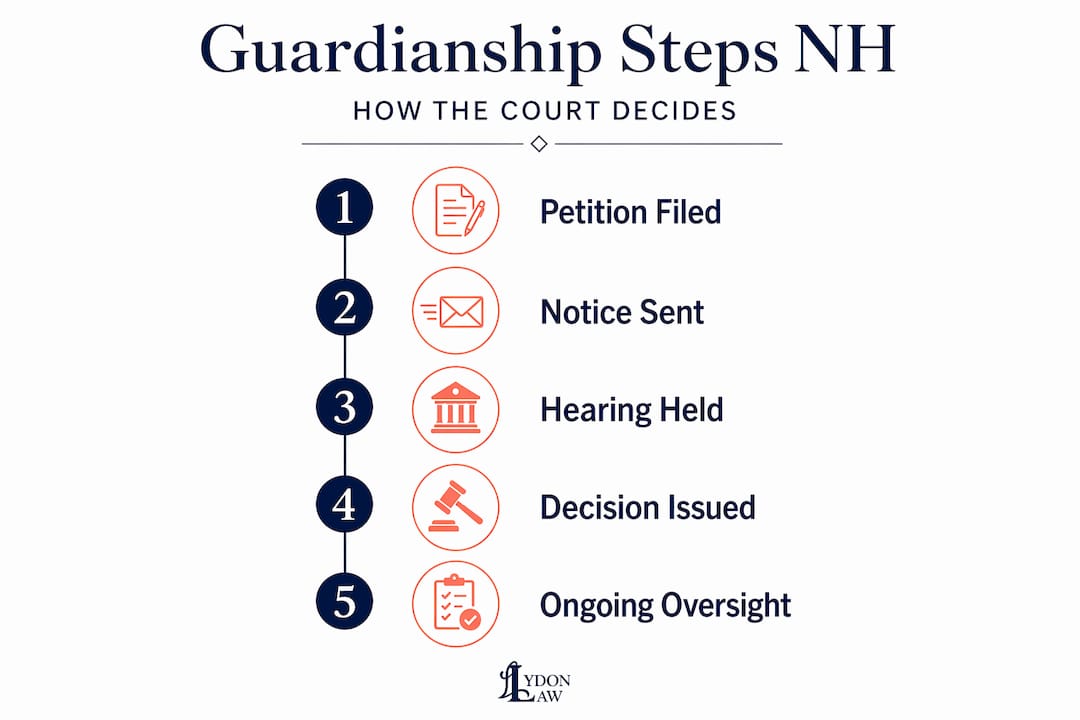
One of the most misunderstood aspects of guardianship is that it does not have to be permanent. New Hampshire courts retain ongoing oversight of guardianship arrangements, and the law provides clear mechanisms for revisiting them.
A ward or interested party can file a Motion to Terminate Guardianship, which triggers a court hearing to evaluate whether the guardianship should continue, be modified, or end altogether. This right exists regardless of how long the guardianship has been in place. The court can revisit guardianship multiple times as the ward’s circumstances change, whether due to recovery, improvement, or a change in the guardian’s own situation.
Common reasons a guardianship might be modified or terminated include a ward’s recovery of functional capacity, the guardian’s death or incapacity, evidence of guardian misconduct, or a change in the ward’s living situation that makes the original arrangement no longer appropriate.
New Hampshire’s commitment to protecting the ward’s rights throughout the duration of a guardianship is reflected in several ongoing protections:
This ongoing oversight and right to motion termination reflects New Hampshire’s approach to balancing protection with personal autonomy. Guardianship is meant to serve the ward, not to permanently remove their voice.
A frequent misconception is that being placed under guardianship means losing all control over your life. That is not accurate under New Hampshire law. Court orders tailor the guardian’s powers to the ward’s actual needs. A limited guardianship may cover only medical decisions while leaving financial and personal choices fully intact. Courts are required to grant the least restrictive form of guardianship that adequately addresses the need.
Another point of confusion involves the difference between guardianship and conservatorship in New Hampshire. In NH, these terms are sometimes used interchangeably at the state level, but broadly speaking, guardianship of the estate functions similarly to what other states call conservatorship. It refers specifically to oversight of a person’s financial assets and property rather than personal care decisions. If you are uncertain which type of proceeding applies to your situation, speaking with an attorney early will save you significant time and expense.
It is also worth knowing that courts expect petitioners to explore less restrictive alternatives before seeking full guardianship. Options such as durable powers of attorney, healthcare proxies, representative payees, or supported decision-making agreements may address the underlying concern without the need for court-supervised guardianship. Demonstrating that you have considered those options strengthens your petition and reflects well on your intentions.
Pro Tip: If you anticipate a future need for guardianship due to a loved one’s progressive illness or aging, planning ahead by working with an attorney on powers of attorney and advance directives can prevent the need for court intervention entirely or at least simplify the process significantly when the time comes.
I have seen many families come into the guardianship process with the assumption that the court will simply rubber-stamp whatever the family has already decided among themselves. That is almost never how it works, and that gap in understanding can cause real frustration and delay.
What I have observed is that the court’s procedural requirements exist to protect everyone involved, including the person seeking to become guardian. The requirement for a formal hearing, independent legal representation for the ward, and detailed findings of incapacity are not obstacles. They are safeguards. They make the resulting guardianship order more durable and legally sound. When families understand this, the process tends to go more smoothly.
I have also seen cases where a family member genuinely needed help but the petition was drafted so broadly that it alarmed the court. Asking for authority over everything when the actual concern is limited to medical decisions, for example, raises questions. Courts respond better to targeted, well-supported requests. That is why having experienced legal guidance is not just a convenience. It is often the difference between a petition that succeeds on the first hearing and one that gets delayed for months.
If you are caring for someone who needs protection, or you are facing guardianship proceedings yourself, know that the law in New Hampshire is structured to take your concerns seriously. The process is formal for a reason, and legal representation matters far more in these cases than most people expect.
— Rich
Guardianship cases touch some of the most sensitive circumstances families face, and the legal process in New Hampshire requires careful attention to procedure, evidence, and the rights of all involved. Lydon’s family law attorneys and probate practice team bring direct, hands-on experience to both minor and adult guardianship matters across New Hampshire, from the initial petition through contested hearings and modifications.
When you work with Lydon, you work directly with your attorney throughout the entire process. Attorney Kalie Lydon and her team provide clear guidance, honest assessments, and strong representation so that your petition is prepared correctly and your rights, or the rights of your loved one, are fully protected at every stage.
Pro Tip: Contact Lydon early in the process, even before filing. Early legal guidance can help you choose the right type of guardianship, avoid procedural mistakes, and assess whether alternatives to guardianship might better serve your situation.
New Hampshire courts appoint a guardian for an adult when evidence shows the person cannot adequately manage their own personal or financial affairs due to functional incapacity. A medical diagnosis alone is not sufficient. The court requires specific findings about the person’s actual capabilities.
An interested person, an authorized agency, or a child age 14 or older can file a petition for guardianship in New Hampshire. The petition must be filed with the appropriate court division depending on whether the case involves a minor or adult and whether an estate is involved.
Yes. In New Hampshire, the person facing guardianship has an absolute right to legal counsel. If they have not retained an attorney, the court will appoint one. A guardian ad litem may also be appointed to independently represent the person’s interests.
Yes. A ward or interested party can file a Motion to Terminate Guardianship at any time, which triggers a court hearing. New Hampshire courts can modify, limit, or fully terminate a guardianship if circumstances have changed or if the arrangement is no longer serving the ward’s best interests.
Guardianship of the person covers decisions about where someone lives, their medical care, and daily life. Guardianship of the estate covers financial assets and property management. New Hampshire courts can grant one or both, and they define the scope precisely in the guardianship order.

© 2026 Lydon Law|Legal Disclaimer|Privacy Policy