Menu


TL;DR:
- Choosing a family law attorney in New Hampshire requires understanding your specific legal needs, such as divorce or child custody, and evaluating their experience and approach accordingly. Building a shortlist through trusted referral sources and reviewing credentials, communication style, and compatibility ensures a strong working relationship. Clear discussions about fees, process expectations, and finding an attorney who combines expertise with compassion are crucial for a successful legal journey.
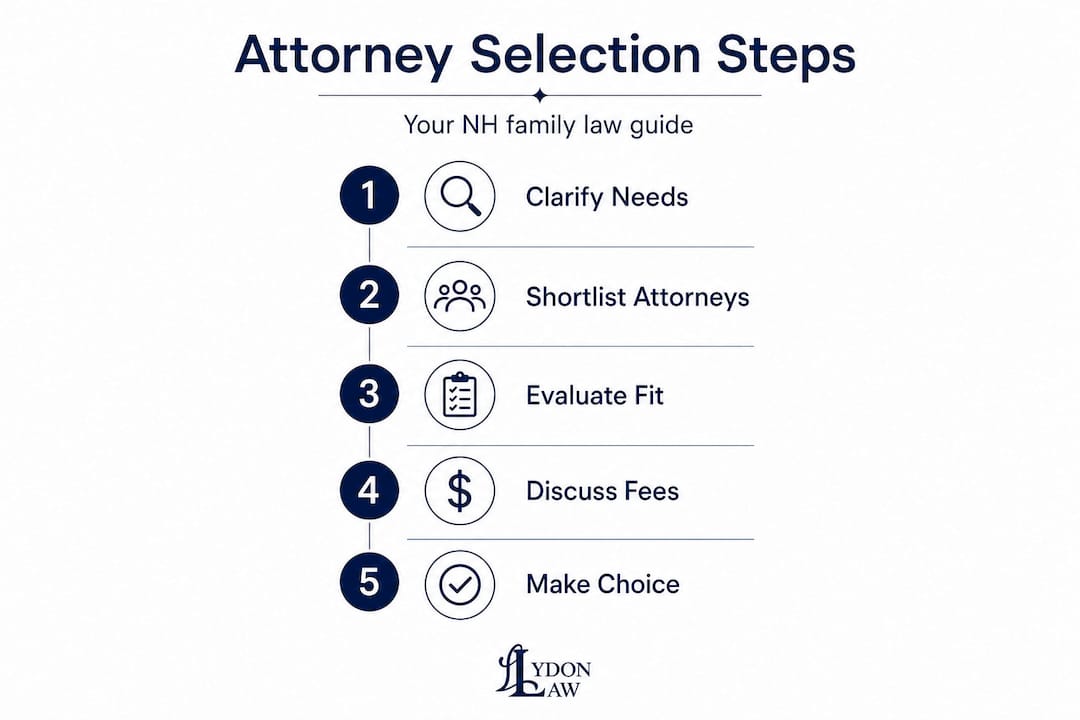
Family legal matters rarely arrive with warning. One day you’re managing everyday life, and the next you’re facing divorce paperwork, a custody dispute, or a protective order, all while trying to hold your household together. The decisions you make during this time, especially about who represents you, can shape your financial stability and your relationship with your children for years to come. This guide walks you through every step of selecting a skilled, compassionate family law attorney in New Hampshire, from clarifying your legal needs to evaluating fees and trusting your instincts.
| Point | Details |
|---|---|
| Clarify your needs | Knowing your specific family law issue ensures you’ll find the right kind of attorney. |
| Use reputable referral sources | Starting with bar association lists or legal aid improves your odds of finding reliable counsel. |
| Vet credentials and fit | Check qualifications, experience, and a lawyer’s personal approach before hiring. |
| Understand costs upfront | Discuss case complexity, fee structures, and possible expenses in detail before agreeing to representation. |
| The relationship matters | Choose someone who communicates well and connects with you—legal matters are personal. |
Before you search for an attorney, you need to understand exactly what kind of legal help you require. Family law in New Hampshire covers a wide range of situations, and not every attorney has deep experience in every area. Taking time to identify your specific issue will save you significant time and frustration later.
Common family law situations include:
High-stakes or complex cases, such as those involving significant assets, relocation disputes, or a history of domestic abuse, may require an attorney with very specific courtroom experience. A straightforward, cooperative divorce calls for a different skill set than a deeply contested custody battle.
It’s also worth understanding your financial eligibility for support resources. The NH Family Law Research Guide from UNH Franklin Pierce Law School points to both full-fee attorney referrals and legal aid options for common issues like divorce and child custody. If cost is a serious concern, knowing about legal aid routes early can help you plan accordingly.
“The more clearly you can describe your situation, including what outcome matters most to you, the more effectively an attorney can assess whether they are the right fit for your case.”
Spend some time writing down a brief summary of your situation before you contact any attorney. Note important dates, key concerns, and any documents you already have. This preparation will make your first consultation far more productive.
Once you know your issue, the next step is finding the right legal professionals to contact. There are several reliable ways to do this, and each has its own strengths.
Here’s a quick comparison of the most common search methods:
| Search method | Best for | Potential drawback |
|---|---|---|
| NH Bar Referral Service | Finding licensed, vetted attorneys | May not filter by specific case type |
| Online directories | Reading reviews and comparing options | Reviews can be uneven or outdated |
| Personal referrals | Getting honest, experience-based advice | Limited to your network’s experience |
| Legal aid services | Lower-income individuals | Eligibility requirements apply |
| Law firm websites | Researching approach and specialization | Self-reported, so research further |
Pro Tip: When reviewing family law attorneys in New Hampshire, pay attention to whether the firm handles related areas like civil law guidance or estate matters. Family situations are often intertwined with other legal issues, and having an attorney who understands the broader picture can be a real advantage.
Aim to create a shortlist of three to five attorneys. A smaller list makes the comparison process manageable without cutting your options too thin.
After identifying candidates, you’ll need a system for comparing their strengths and compatibility with your case. Credentials matter, but they are only one part of the picture.

Start with the basics. Every attorney you consider should be in good standing with the New Hampshire Bar Association. You can verify this through the Bar’s online directory, which also shows any disciplinary history. A clean record is a basic but important filter.
Then consider experience more specifically. Ask yourself:
The NH Family Law Research Guide advises reviewing qualifications, verifying experience, and ensuring the attorney is a good fit for your particular needs. That last element, fit, is one many people overlook.
Here’s a simple framework for evaluating candidates during an initial consultation:
| Evaluation area | Questions to ask | What to look for |
|---|---|---|
| Legal experience | How many similar cases have you handled? | Specific, detailed answers |
| Communication style | How do you prefer to update clients? | Clear, consistent methods |
| Strategy | What approach would you recommend for my case? | Thoughtful, personalized response |
| Availability | Will I work directly with you? | Direct attorney access |
| Outcome focus | What realistic outcomes can I expect? | Honest, balanced assessment |
Understanding the importance of legal representation in a case like yours will help you ask sharper questions. If your case involves custody, reviewing what strong child custody experience looks like can help you set a higher bar. For those facing safety concerns, learning why specialized domestic violence representation matters may be critical to your safety and your legal strategy.
Pro Tip: During your first meeting, notice whether the attorney listens more than they talk. An attorney who asks about your priorities and circumstances before jumping to solutions is usually a much better fit than one who immediately describes what they always do in cases like yours.
With your shortlist in hand, it’s time to contact attorneys and evaluate their fees and clarify expectations before you hire anyone. Cost is a realistic concern, and understanding the factors that drive it will help you budget and make confident decisions.
What you can realistically expect to pay:
Uncontested divorce cases in New Hampshire, where both parties agree on all major issues, typically range from roughly $2,000 to $5,400 in total legal costs. However, contested cases involving disagreements over property, custody, or support can exceed $18,000, particularly when they require expert witnesses, psychological evaluations, or extended litigation.
The key factors that push costs higher include:
Before you commit to any attorney, ask these specific questions:
Transparency about fees is a strong indicator of how an attorney runs their practice overall. An attorney who hesitates to discuss costs clearly is often one who communicates poorly in other areas too.
Understanding the benefits of hiring a family lawyer helps put these costs in perspective. A skilled attorney can prevent costly mistakes, protect your parental rights, and help you avoid agreements you’ll regret. When it comes to custody matters specifically, reviewing what to expect from child custody and visitation proceedings can help you anticipate the scope of work involved.
Whether the case is uncontested or contested, and whether expert evaluations might be needed, are the primary factors that drive higher total costs. Asking about this directly during your consultation puts you in a much stronger position to plan.
Here is something we’ve seen consistently in family law practice: clients who choose an attorney based purely on credentials or aggressive marketing often end up frustrated. Not because the attorney lacked skill, but because the working relationship broke down under the pressure of a difficult case.
Family law is not like other areas of law. When you are navigating a divorce or a custody dispute, you are not just managing paperwork. You are making decisions under stress that will affect your children, your finances, and your daily life for years to come. In that environment, an attorney who communicates clearly, responds promptly, and treats you as a person rather than a case number is not a nice-to-have. It is essential.
We’ve worked with clients who came to us after leaving other attorneys. In most of those situations, the problem wasn’t legal competence. It was that the client felt uninformed, dismissed, or passed from one staff member to another without real continuity. That kind of experience erodes trust at exactly the moment when you need it most.
The way an attorney handles your first conversation tells you a great deal. Do they take time to understand your specific situation? Do they explain your options in plain language? Do they give you a realistic picture of what lies ahead, even when that picture is not what you were hoping to hear? Those qualities matter enormously. Look at how a firm describes its family law approach and whether that approach reflects genuine client focus.
Credentials verify competence. Compassion and communication determine whether that competence actually works for you.
You’ve now worked through the full process of identifying your needs, building a shortlist, evaluating attorneys, and understanding fees. The next step is taking action with confidence. At Lydon Law, our New Hampshire family law attorneys work directly with each client from the first consultation through resolution, so you always know who is handling your case and where things stand. Attorney Kalie Lydon brings extensive courtroom experience across New Hampshire’s courts, combined with a communication style built around clarity and personal attention. Whether your situation involves divorce, custody, support, or domestic violence, we are here to provide practical, compassionate guidance. Explore our all practice areas or contact us to schedule a consultation today.

Check their New Hampshire Bar admission status, disciplinary record, and client reviews. The NH Family Law Research Guide advises verifying qualifications and ensuring the attorney is a good fit for your specific needs before committing.
New Hampshire Legal Assistance may cover divorce, child custody, parenting rights, and child support for clients who meet income eligibility requirements. The NH Family Law Research Guide confirms NHLA offers representation for these core family law issues to qualifying individuals.
Uncontested cases typically range from $2,000 to $5,400, while contested matters involving custody disputes or significant assets can exceed $18,000 depending on the complexity and length of proceedings.
Ask about their experience with similar cases, their recommended strategy for your situation, how they communicate with clients, their fee structure and billing practices, and what realistic outcomes you can expect given the facts of your case.
Many attorneys in New Hampshire offer a free or low-cost initial consultation, though some charge a modest fee for their time. Always ask about consultation fees when you first call to schedule a meeting.

© 2026 Lydon Law|Legal Disclaimer|Privacy Policy