Menu


TL;DR:
- Preparing thoroughly for court in New Hampshire involves understanding your specific division and gathering essential documents to ensure confidence during proceedings. Punctuality, proper courtroom etiquette, and familiarity with your paperwork are crucial to making a positive impression and achieving your desired outcome. Post-hearing actions, including reviewing orders and confirming future dates, are vital steps to properly complete your court experience.
Walking into a courtroom without knowing what to expect is genuinely stressful. Whether you are facing a family dispute, a criminal charge, or a civil matter, knowing how to prepare for court in New Hampshire can make a real difference in both your confidence and your outcome. This guide covers everything from understanding the court structure to what to bring, how to behave, and what to do after your hearing. You will leave with a clear, practical picture of what lies ahead.
| Point | Details |
|---|---|
| Know your court division | NH Circuit Court has District, Family, and Probate divisions, each with different rules and forms. |
| Arrive early and prepared | Arrive at least 10 to 15 minutes early to clear security and locate your courtroom without rushing. |
| Bring the right documents | Carry your summons, photo ID, evidence, and all relevant paperwork organized and ready to present. |
| Follow courtroom etiquette | Speak only when the judge calls on you, address the judge respectfully, and avoid interrupting others. |
| Act on next steps promptly | Collect all court paperwork after your hearing and confirm any required actions or future court dates. |
Before you prepare anything, you need to understand which court you are actually going to. New Hampshire’s court system is organized into two main tiers. The Circuit Court handles the majority of cases and is divided into three divisions: District, Family, and Probate. The three divisions each follow distinct procedural rules, so a family matter is handled very differently from a criminal charge or a probate filing.
The Superior Court handles more serious felony cases and complex civil litigation. If you received a notice to appear, the paperwork will typically identify which court and division applies to your case. Read it carefully.
Here is a quick breakdown of what each division covers:
Once you know your division, visit the NH Judicial Branch official website. The “Represent Myself” portal there provides the correct forms, filing instructions, and procedural guidance for self-represented litigants. Using the wrong form for your case type is one of the most common and avoidable mistakes people make.
Pro Tip: Search your case number on the NH Judicial Branch website before your court date to confirm the hearing time, location, and any filings already submitted. Court schedules can change, and you want to be certain you have the latest information.
Preparation the night before your hearing is just as important as what you do the morning of. Having a clear checklist removes the guesswork and keeps anxiety manageable.
If you are attending a Supreme Court oral argument, note that courtroom doors open 15 minutes before proceedings begin. Arriving late risks losing your opportunity to speak or observe entirely.
Pro Tip: Print multiple copies of your most important documents. Give one set to the court clerk when required, keep one for yourself at the table, and have a spare in case the judge or opposing party needs a copy you were not expecting to provide.
Many first-time court participants are caught off guard not by the legal arguments but by the procedural formalities. Understanding the unwritten rules of court conduct puts you ahead of most self-represented litigants.

When your case is called, approach the table as directed by the court officer or clerk. Do not walk forward on your own initiative until you are signaled. Once you are seated or standing at the table, the judge controls the pace of the hearing completely.
Key conduct guidelines to follow:
“The courtroom is not a debate floor. It is a structured proceeding where the judge controls the conversation. The litigants who do best are the ones who understand that and work within the structure rather than against it.”
Keep your tone calm and factual throughout. Emotional outbursts, even understandable ones, rarely help and can actively work against you.
New Hampshire courts are required to provide reasonable accommodations to participants who need them. Accommodations available include assistive listening devices, materials in alternative formats, sign language interpreters, and specialized staff assistance for individuals with hearing, vision, or communication challenges. Request accommodations as early as possible, preferably when you first receive your court notice, to give the court time to arrange what you need.
If you are preparing for domestic violence proceedings, there are additional steps to take. The NH domestic violence process involves specific forms, protective order hearings, and safety considerations that differ from standard civil matters. Practical steps include:
If you are attending a criminal proceeding, the stakes are higher and the procedural rules are stricter. Only licensed attorneys or individuals with specific court authorization can represent others in New Hampshire courts. If you cannot afford an attorney, you may be eligible for a public defender. Contact the court clerk’s office before your hearing to ask about eligibility. If you are self-represented, review the NH criminal defense process to understand the typical stages and your rights at each one.
Pro Tip: If any new paperwork is filed in your case within a week of your hearing, request a copy from the clerk before your court date. Seeing documents for the first time in the courtroom puts you at a significant disadvantage.
The work does not end when you leave the courtroom. What you do immediately after your hearing shapes what happens next.
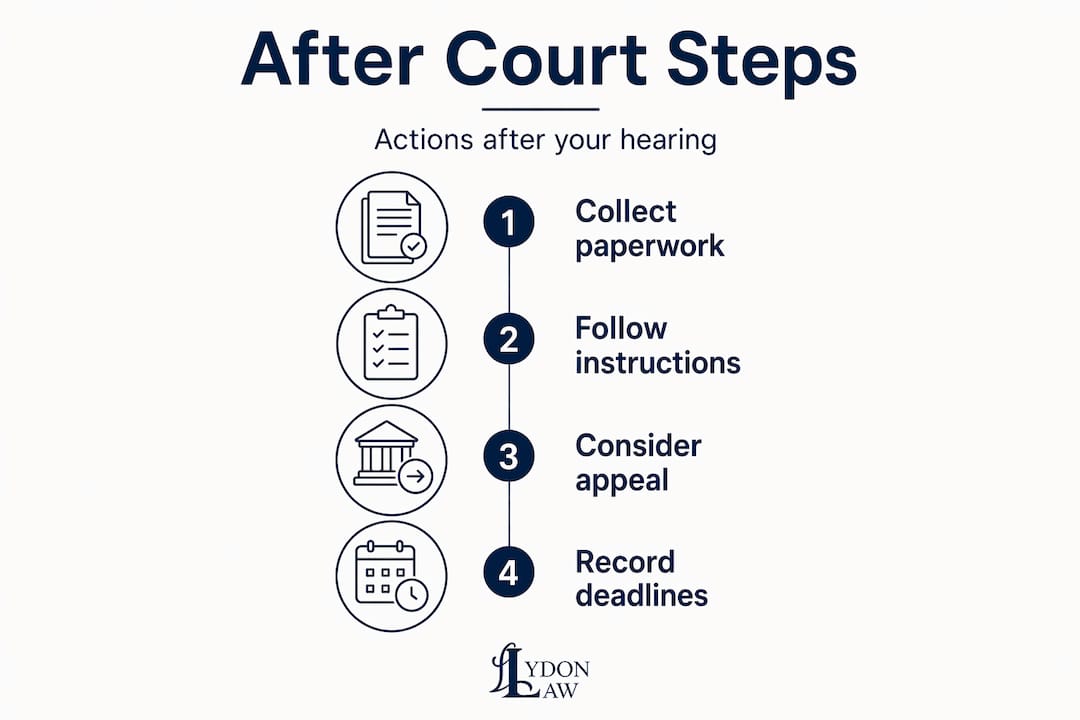
| Action | Why it matters |
|---|---|
| Collect all paperwork | Any orders, judgments, or notices issued during the hearing are your official record. Keep them in a safe place. |
| Confirm future court dates | Ask the clerk before you leave if additional hearings have been scheduled. Do not rely solely on memory. |
| Check your case status online | The NH Judicial Branch website allows you to search your case and verify that orders have been properly entered. |
| Understand compliance requirements | If the court issued an order requiring you to take action, note the deadline precisely and follow through. |
| Consult an attorney if needed | If the outcome was not what you expected or you disagree with the decision, an attorney can explain your options for appeals or motions. |
If you believe the court made an error, you may have the right to file a motion for reconsideration or pursue an appeal. These processes have strict deadlines, often as short as 30 days, so act without delay if you are considering that path.
In my experience working with clients who appear in New Hampshire courts, the most damaging mistakes are almost never about legal arguments. They are about logistics and emotional readiness.
I have seen people arrive to their hearings without a copy of their own filing, assuming the court would have it available. I have watched individuals speak over the judge because they were anxious and felt their point was urgent. Both situations create a poor impression that is difficult to recover from, regardless of the underlying merits of the case.
The single most underestimated part of court preparation is understanding your own paperwork thoroughly before you walk in. If you do not know what you filed, why you filed it, and what outcome you are asking for, no amount of confidence in the courtroom will compensate for that gap. Review your documents the night before until every page feels familiar.
Punctuality carries more weight than most people expect. Judges see dozens of cases. The participants who show up late, underprepared, or visibly rattled signal immediately that they have not treated the matter seriously. Showing up early, dressed appropriately, and composed communicates respect for the court and, by extension, for your own case.
One thing I would correct in conventional wisdom: many self-represented litigants believe that showing strong emotion demonstrates how much they care about the outcome. In practice, calm and organized presentation is far more persuasive. Judges respond to clarity and credibility. Give them that, and you are already ahead.
— Rich
If your court matter involves family law issues like divorce or child custody, criminal charges, or a civil dispute, having experienced legal representation can significantly change your experience and your outcome. Lydon Law serves clients throughout New Hampshire from offices in Nashua and Portsmouth. The firm offers direct, hands-on guidance from attorney Kalie Lydon, who has appeared in New Hampshire courts and the state’s Supreme Court.
Whether you need help understanding your rights before a hearing, assistance with family law matters like custody or domestic violence proceedings, or representation in a criminal defense case, Lydon Law offers compassionate, practical counsel tailored to your situation. You work directly with your attorney throughout the process. Reach out to Lydon today to discuss your case and understand your options before your next court date.
The NH Judicial Branch recommends arriving at least 10 minutes before your scheduled hearing to complete security screening and find your courtroom without added stress.
Bring your summons or court notice, a government-issued photo ID, copies of any evidence or filings relevant to your case, and organized notes summarizing the key points you plan to raise.
Address the judge as “Your Honor” in all NH courts, speak only when called upon, and remain standing when the judge enters or when directly addressed.
Yes. New Hampshire courts provide accommodations such as assistive listening devices, interpreters, and specialized staff assistance. Request accommodations as early as possible after receiving your court notice.
You may have options including filing a motion for reconsideration or pursuing an appeal, but these carry strict deadlines. Consulting an attorney promptly after your hearing is the best way to understand which path applies to your situation.

© 2026 Lydon Law|Legal Disclaimer|Privacy Policy