Menu


TL;DR:
- Legal separation is available in New Hampshire through judicial separation, which produces court orders without ending the marriage.
- Remaining married allows spouses to retain benefits like health insurance, joint taxes, and potential reconciliation options.
Many New Hampshire residents assume legal separation simply isn’t available to them because the state lacks a standalone statute dedicated to it. That assumption is worth correcting before you make any major decisions about your marriage. Legal separation is an option in New Hampshire, though it works differently than you might expect. The state recognizes a process called judicial separation, and understanding how it works, who qualifies, and what it actually accomplishes can help you decide whether it fits your situation better than divorce or informal living arrangements.
| Point | Details |
|---|---|
| NH does allow separation | New Hampshire recognizes judicial separation even without a standalone legal separation statute. |
| Court orders are enforceable | A judicial separation produces court-approved orders covering custody, support, and property while the marriage remains intact. |
| Residency rules vary | Filing eligibility depends on where both spouses live and whether personal service within NH is possible. |
| Informal agreements carry risk | Separation agreements made outside court can be enforced, but they offer less protection than court orders. |
| Divorce is not required first | There is no mandatory separation period before filing for divorce or judicial separation in New Hampshire. |
The short answer is yes, though the terminology trips people up. New Hampshire does not have a dedicated “legal separation” law the way some other states do. What it does have is a judicial separation process that produces court-approved, enforceable orders covering the most important aspects of a marriage, including child custody, financial support, and property, without ending the marriage itself.
This distinction matters. Judicial separation in New Hampshire means you remain legally married while a court formalizes how you and your spouse will live apart. Think of it as a structured arrangement that sits between informal separation and full divorce. You are not single. You cannot remarry. But your rights and responsibilities as a spouse are defined by a court order rather than left to informal understanding.
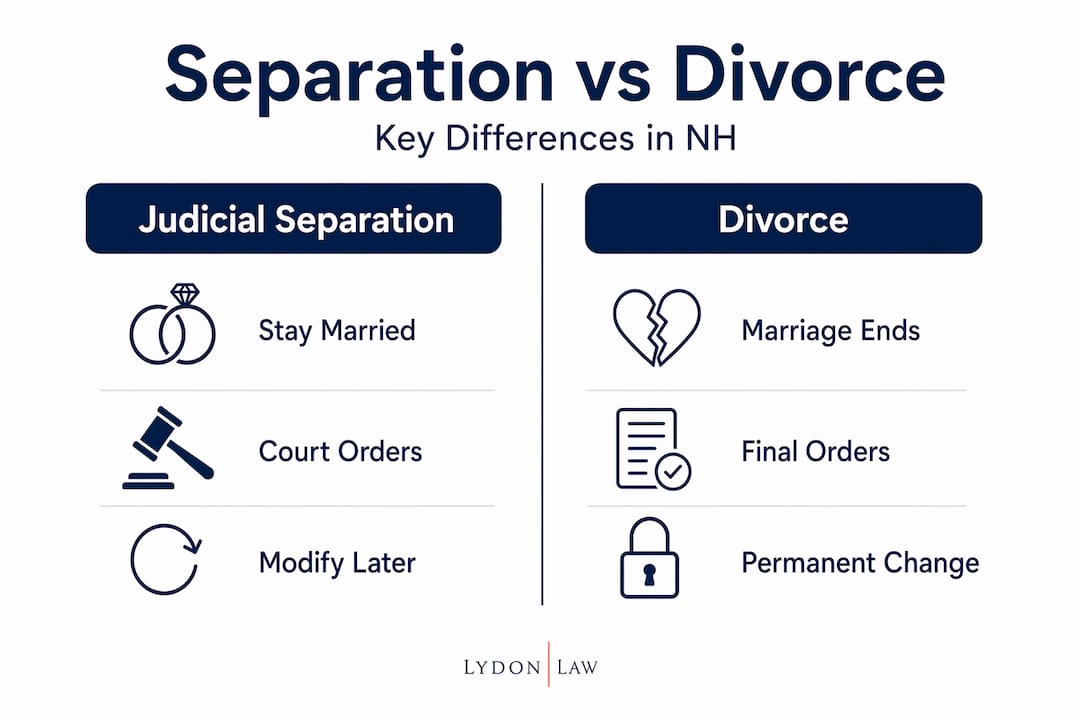
Here is how the three common approaches compare:
| Approach | Marital status | Court involvement | Enforceable orders |
|---|---|---|---|
| Informal separation | Married | None | No |
| Judicial separation | Married | Yes | Yes |
| Divorce | Single | Yes | Yes |
Judicial separation allows couples to live apart with court-recognized arrangements on support, property, and custody without dissolving the marriage. That distinction is meaningful for people who have religious objections to divorce, want to preserve certain marital benefits, or are not yet certain whether the marriage is over.
Before you file anything, you need to confirm that you meet the residency requirements. New Hampshire’s rules vary depending on where each spouse lives. If both spouses are domiciled in New Hampshire, no minimum duration of residency is required. If only the petitioner lives in New Hampshire but can serve the other spouse within the state, the court still has jurisdiction. If the other spouse is out of state and cannot be served within New Hampshire, the petitioner must have lived in the state for at least one year before filing.
Once you confirm eligibility, the process follows these steps:
One thing worth knowing: there is no mandatory separation period before filing. You do not need to have lived apart for six months or a year to qualify. You can file while still sharing the same residence.
Pro Tip: If you are unsure whether judicial separation or divorce fits your situation better, speak with a family law attorney before filing anything. The choice you make at the start of this process affects your legal rights for as long as the order remains in effect.
Choosing judicial separation over divorce carries real consequences across several areas of your life. The most obvious is your marital status. You remain legally married, which means you cannot remarry and are still considered a spouse under the law. That has both benefits and limitations depending on your circumstances.
Here is where the practical effects show up most clearly:
Pro Tip: If maintaining health insurance coverage is a primary concern, confirm with your spouse’s employer whether coverage extends to legally separated spouses before you finalize your strategy. Some plans treat separation the same as divorce for insurance purposes.

Not every couple wants or needs a court order. Some choose to simply live apart under an informal arrangement, sometimes called an informal separation. This approach has no court involvement and produces no enforceable orders. It can work well for couples who trust each other to follow through on verbal agreements and do not have complex financial situations or children involved.
A more structured alternative is a written separation agreement. New Hampshire courts can enforce negotiated separation agreements dealing with support and property division even without a formal judicial separation proceeding. This gives you more flexibility than going to court while still producing a document with legal weight. The risk is that enforcement requires returning to court if a dispute arises, and the process can be slower and less straightforward than enforcing a court order.
Mediation and collaborative law offer a third path. Rather than litigating in front of a judge, you and your spouse work with a neutral third party or a team of professionals to reach agreements on custody, property, and support. Experts advise that mediation emphasizes transparency and long-term family stability, avoiding the kind of adversarial disputes that can cause lasting harm to both adults and children. Many New Hampshire family law attorneys, including those at Lydon, offer mediation support as part of their practice.
Informal separation becomes genuinely risky when children are involved, significant assets are at stake, or one spouse is financially dependent on the other. Without court orders, you have no enforceable mechanism if the other party changes their mind.
If you are in that situation, a negotiated separation agreement or a full judicial separation petition is a safer choice.
In my experience working with people through some of the most difficult periods of their lives, the biggest mistake I see is assuming that legal separation and divorce are the only two options, and that New Hampshire only offers divorce. That misunderstanding sends people straight into proceedings that may not actually serve their needs.
What I’ve found is that judicial separation genuinely fits certain situations better than divorce. For couples where one spouse relies on the other’s health insurance, or where religious convictions make divorce feel off the table, or where there is a real possibility of reconciliation, staying legally married while establishing court-enforced structure can be the most practical solution available.
I’ve also seen the damage that purely adversarial processes cause, especially when children are watching. The shift toward collaborative family law is not just a trend. It reflects what decades of outcomes data and family experience tell us: less conflict produces better long-term results for everyone involved, especially children.
My practical advice is this. Before you decide between separation, divorce, or an informal arrangement, sit down with an attorney who will actually listen to your circumstances rather than plug you into a standard process. The right path depends on your finances, your children’s needs, your relationship with your spouse, and your longer-term goals. Those details matter, and they should drive the decision.
— Rich
If you are trying to sort out whether judicial separation, divorce, or a negotiated agreement makes the most sense for your situation, the family law team at Lydon is ready to help. Lydon Law serves clients throughout New Hampshire from offices in Nashua and Portsmouth, assisting with everything from filing separation petitions to negotiating custody arrangements and financial support terms.
Attorney Kalie Lydon works directly with clients through every stage of the process, whether that involves courtroom advocacy, mediation support, or drafting enforceable separation agreements. You will not be handed off to a paralegal or lost between staff members. If you have questions about New Hampshire divorce options or want to understand exactly what judicial separation would mean for your finances and your family, contact Lydon Law for a consultation.
Yes. New Hampshire recognizes judicial separation, which produces enforceable court orders on custody, support, and property while the marriage remains legally intact. There is no standalone legal separation statute, but the process exists and is accessible through the New Hampshire Judicial Branch.
You file a Petition for Legal Separation using Form NHJB-2059-F with the New Hampshire Judicial Branch, serve your spouse, and attend court hearings where a judge issues enforceable orders. No mandatory separation period is required before filing.
New Hampshire allows both no-fault and fault-based grounds for judicial separation. No-fault filings cite irreconcilable differences, while fault-based grounds include adultery, extreme cruelty, and abandonment.
Legally separated spouses in New Hampshire remain married, so dating could potentially be cited as a fault ground if proceedings escalate to divorce. It is worth discussing this with your attorney before making decisions that could affect your case.
Judicial separation leaves the marriage legally intact, meaning spouses cannot remarry and may retain shared benefits like health insurance and joint tax filing status. Divorce dissolves the marriage entirely, restoring both parties to single status and ending those shared benefits.

© 2026 Lydon Law|Legal Disclaimer|Privacy Policy