Menu


TL;DR:
- Refusing a breathalyzer in New Hampshire now leads to automatic license suspensions that are increasing in length, especially after January 2027.
- Lawmakers have tightened laws to close the “DWI refusal loophole,” making refusal less advantageous and more costly over time.
Many people pulled over on suspicion of drunk driving in New Hampshire believe that refusing a breathalyzer is a safe way out. That assumption is becoming more dangerous by the day. New Hampshire has been actively tightening its laws around breathalyzer refusal, with recent legislation specifically designed to close what lawmakers have called a “DWI refusal loophole.” If you are facing this decision, understanding exactly what the law says, what the penalties are, and how your personal circumstances factor in could make a significant difference in your case.
| Point | Details |
|---|---|
| Refusal penalties rising | Refusing a breathalyzer will result in a longer license suspension starting January 2027. |
| No easy answers | Whether you should take or refuse a breathalyzer depends on your specific circumstances and legal risks. |
| Consult legal experts | Getting professional legal guidance is essential to make the right decision if facing a DWI stop. |
| Implied consent matters | New Hampshire law requires drivers to comply with breathalyzer requests or face administrative penalties. |
New Hampshire operates under what is known as an implied consent law. This means that by simply driving on a New Hampshire road, you have already legally agreed to submit to a breathalyzer test if a law enforcement officer has reasonable grounds to suspect you are driving while impaired. You did not sign anything. There was no formal agreement. The act of driving itself is treated as consent under state law.
When an officer pulls you over and suspects DWI (driving while intoxicated), they can lawfully request that you take a breath alcohol test. If you refuse, the consequences begin immediately, before any criminal charges are even filed. This is an important distinction that surprises many people. The administrative penalties for refusal are separate from any criminal case that may follow.
Here is what you need to know about how implied consent works in practice:
What makes the current legal landscape especially important to understand is the passage of SB 620, which targets the refusal loophole by increasing penalties for refusing breath alcohol testing. Governor Ayotte has publicly supported this effort, and the legislation signals a clear shift in how New Hampshire intends to treat drivers who decline to cooperate with testing.
“New Hampshire law change SB 620 intends to close a ‘DWI refusal loophole’ by increasing the consequence for refusing breath alcohol testing.”
This is not a minor procedural update. It reflects a deliberate policy decision to make refusal a less attractive option for drivers who might otherwise use it as a strategy. If you are navigating DWI laws and guidance in New Hampshire, understanding this shift is essential. The state’s approach to criminal defense strategies in DWI cases is evolving, and the law is no longer as forgiving of refusal as it once was.
One of the most common questions people ask is whether it is better to take the breathalyzer or refuse it. The honest answer is that neither option is automatically better. The right choice depends on your specific situation, your prior record, and the strength of other evidence against you. That said, understanding the concrete penalty differences is a critical starting point.
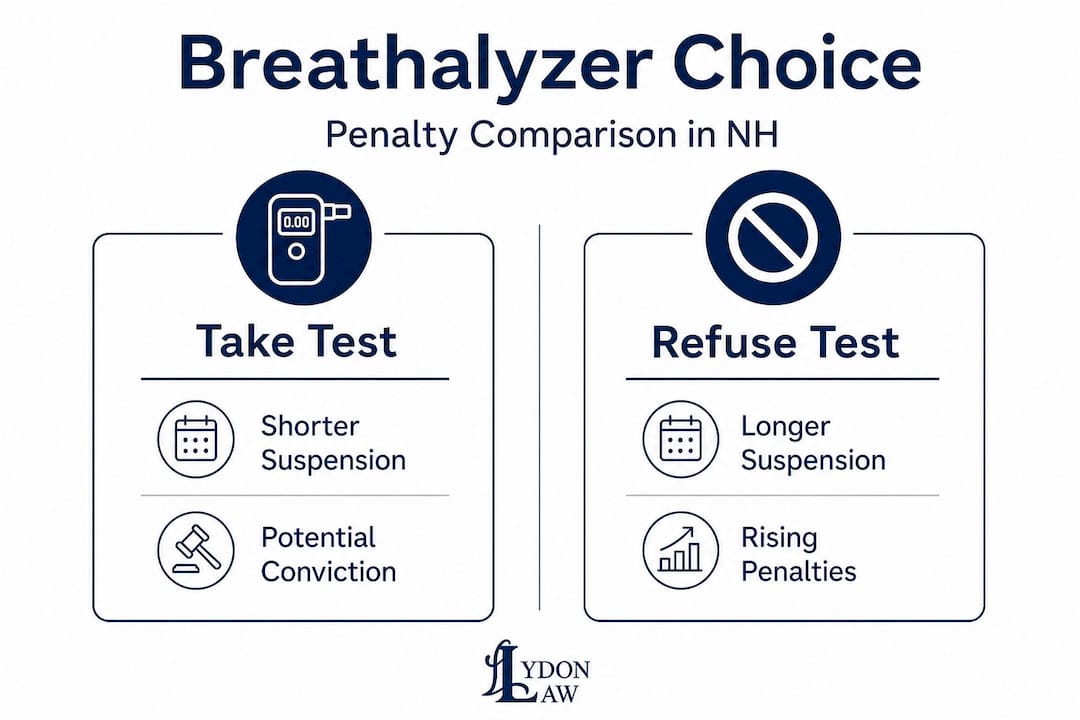
Here is a side-by-side comparison of the key penalties:
| Scenario | Current penalty (2026) | Penalty after Jan. 1, 2027 |
|---|---|---|
| First-time refusal | 6-month license suspension | 9-month license suspension |
| Taking the test and failing | Potential DWI conviction | Potential DWI conviction |
| Taking the test and passing | No administrative suspension | No administrative suspension |
| Refusal with prior DWI record | Enhanced penalties apply | Enhanced penalties apply |
Starting Jan. 1, 2027, New Hampshire increases the administrative license suspension for breath-test refusals for first offenders from 6 months to 9 months. That is a significant jump, and it matters because the license suspension from refusal happens automatically and separately from any criminal court process.
When you take the breathalyzer and the result shows a blood alcohol concentration (BAC) at or above 0.08%, that result becomes direct evidence in a criminal DWI case. A conviction can bring fines, mandatory alcohol education programs, potential jail time, and a criminal record. However, if you take the test and pass, there is no administrative suspension at all, and the officer’s case becomes much harder to build.
Key factors that influence which option carries more risk for you personally include:
Understanding how to defend a DWI charge in NH requires looking at all of these factors together, not just the penalty chart.
The moment you are pulled over and an officer asks you to take a breathalyzer test, you are under stress. You may not remember every detail of the law. That is completely understandable. What helps is having a clear framework in your mind before that moment ever arrives.
Here is a practical step-by-step approach to thinking through your decision:
Pro Tip: If you are stopped on suspicion of DWI, remain calm and polite. You do not have to answer questions beyond identifying yourself. Anything you say can be used against you, so keep your responses brief and ask for an attorney as early as possible in the process.
The timing of your decision also matters in a broader sense. Because the refusal penalty increases in 2027, the practical calculation you face in 2026 is different from the one drivers will face after January 1, 2027. In general, refusal becomes more costly over time under the new law. This is not a reason to panic, but it is a reason to understand the law now rather than later.
Here is a quick reference table to help you think through your personal situation:
| Your situation | Likely better option | Key reason |
|---|---|---|
| Low BAC, no prior record | Take the test | Passing eliminates administrative suspension |
| High BAC, strong other evidence | Consult an attorney immediately | Refusal adds penalties without removing existing evidence |
| Prior DWI conviction | Consult an attorney immediately | Enhanced penalties apply regardless of choice |
| Uncertain about BAC level | Understand both risks | Neither option is clearly safer without legal advice |
Understanding the broader criminal defense impact of a DWI stop, including how a breathalyzer decision affects your long-term record and future opportunities, is something a skilled attorney can walk you through in detail.
Here is something we see regularly in DWI defense work: people come in having followed advice they found online or heard from a friend, and that advice made their situation worse, not better. The idea that “you should always refuse the breathalyzer” is one of the most persistent and damaging pieces of urban legend in DWI law. It has cost people their licenses, their jobs, and in some cases their freedom.
The truth is that what works for one person can be exactly the wrong move for another. Someone who is barely over the legal limit and has no prior record might face a lighter outcome by taking the test, negotiating a reduced charge, and moving on. Someone with a prior conviction and a BAC well above 0.08% might face a different set of calculations entirely. There is no universal answer, and anyone who tells you otherwise is not giving you legal advice. They are giving you a guess.
We also want to be direct about something else: no article, including this one, replaces having a skilled attorney involved in your case from the earliest possible moment. The benefits of legal counsel in a DWI situation go far beyond knowing whether to take a test. An experienced attorney can challenge the legality of the traffic stop itself, question the calibration and administration of the breathalyzer, negotiate with prosecutors, and build a defense strategy tailored to the specific facts of your case.
Relying on outdated assumptions about DWI law in New Hampshire is a real risk. The law changed. The penalties are increasing. The state is actively working to remove the strategies that drivers once used to avoid consequences. Treating a DWI stop as a situation you can navigate alone, based on general advice, is a decision that can follow you for years.
Every legal decision in a DWI case should be grounded in the actual facts of your situation, the current state of the law, and the guidance of someone who practices in New Hampshire courts regularly. That is not a sales pitch. That is simply how the law works best for you.
If you have been stopped on suspicion of DWI in New Hampshire, or if you are trying to understand your rights before that situation ever arises, getting informed legal support is the most important step you can take. At Lydon Law, our criminal defense attorneys work directly with you throughout every stage of the process. You will not be passed between staff members or left wondering where your case stands.
We understand how stressful and disorienting a DWI stop can be. Whether you took the breathalyzer or refused it, there are options available to you, and the outcome of your case depends on how those options are pursued. Explore your legal options in NH and reach out to our team to discuss your specific circumstances. We serve clients throughout New Hampshire from our offices in Nashua and Portsmouth, and we are ready to help you understand exactly where you stand.
Refusing a breathalyzer in 2026 results in an automatic 6-month administrative license suspension, and this penalty increases to 9 months for first offenders starting January 1, 2027. This suspension is separate from any criminal DWI charges.
No. Refusal penalties are increasing, and the better choice depends entirely on your specific circumstances, including your BAC level, prior record, and the other evidence an officer has already gathered. The refusal calculus shifts significantly after January 1, 2027, making refusal more costly over time.
Yes. Refusing a breathalyzer does not prevent DWI charges from being filed against you. Officers can use other evidence such as field sobriety test results, driving behavior, and witness observations, and the refusal loophole is being actively closed by New Hampshire law.
After January 1, 2027, first-time offenders who refuse a breathalyzer will face a mandatory 9-month license suspension, up from the current 6-month suspension, making refusal a significantly more costly decision for anyone without a prior record.

© 2026 Lydon Law|Legal Disclaimer|Privacy Policy