Menu


TL;DR:
- Courts in New Hampshire recognize various evidence types including physical, digital, documentary, and testimonial.
- Proper evidence collection, authentication, and understanding legal rules are crucial for effective case outcomes.
- Systemic issues and procedural errors can lead to the dismissal of strong evidence, impacting victims’ and defendants’ rights.
Many people facing a domestic violence case in New Hampshire assume that physical injuries are the only evidence that truly matters in court. That assumption can be costly. In reality, a single text message sent at the right moment, a pattern of controlling emails, or a counselor’s notes can carry just as much weight as a visible bruise. Understanding what types of evidence exist, how courts evaluate them, and where the rules draw firm boundaries can make a significant difference in how your case unfolds. This article breaks down those rules clearly, so you know what to expect and how to protect yourself.
| Point | Details |
|---|---|
| Texts and digital evidence count | Courts in New Hampshire often admit text messages and digital communications when they are relevant and properly authenticated. |
| Spousal privilege is limited | Marital privilege rarely prevents the use of communications between spouses in domestic violence cases, especially in criminal court. |
| Expert guidance is important | Professional legal support helps ensure evidence is collected, preserved, and presented correctly to maximize its impact. |
| Evidence must be handled correctly | Mistakes in handling or authenticating evidence can lead to it being excluded, weakening a case substantially. |
| Systemic issues affect outcomes | Failures in evidence handling and information sharing can have life-or-death consequences in New Hampshire domestic violence cases. |
To understand what truly influences a case, it helps to break down the types of evidence courts consider. New Hampshire courts recognize a wide range of evidence in domestic violence proceedings, and the variety may surprise you. Each category carries different strengths, and the most persuasive cases typically combine multiple forms.
Physical evidence includes visible injuries, damaged property, broken furniture, and any weapons involved in an incident. Photographs taken immediately after an incident are especially valuable because they capture conditions before healing or cleanup occurs. If you have injuries, document them with photos and timestamps as soon as possible.
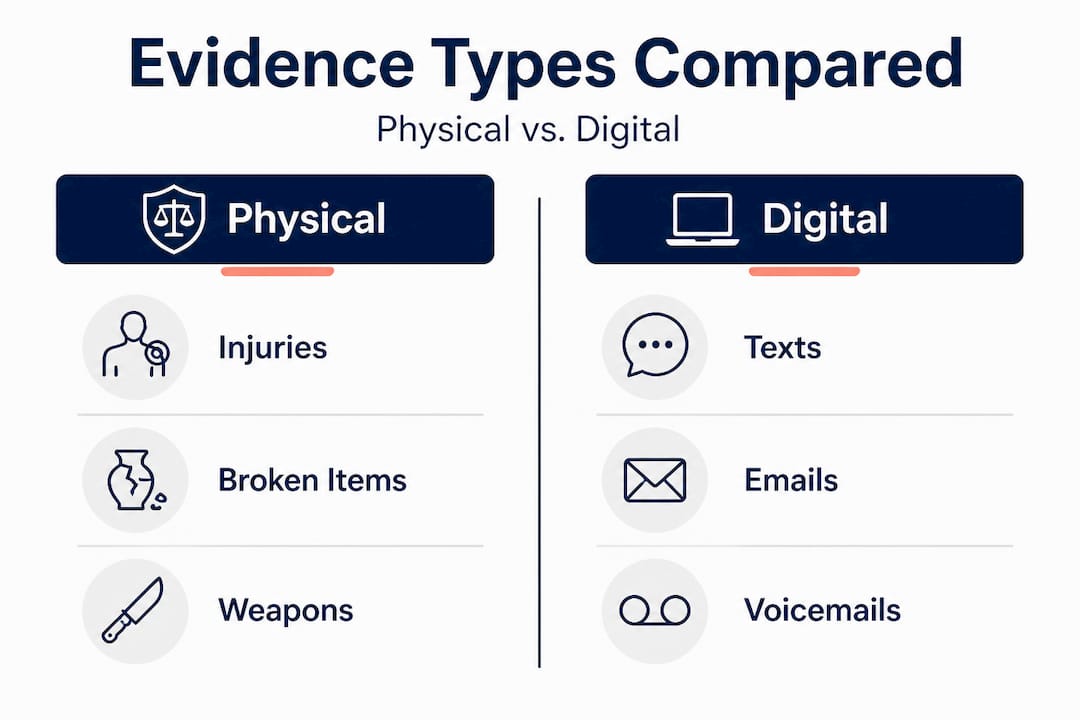
Digital evidence has become one of the most powerful tools in modern domestic violence cases. Text messages, emails, voicemails, social media posts, and even location data from smartphones can all be introduced in court. Text messages are admissible under New Hampshire Rules of Evidence 803(1) and 803(3), which cover present sense impressions and then-existing mental conditions, provided they were sent around the time of the incident. Even if one piece of digital evidence has a technical flaw, courts may still find it acceptable when corroborated by victim testimony, medical records, or police reports.
Documentary evidence covers police reports, emergency room records, medical records, and counseling records. However, counseling records require in camera review, meaning only the judge reviews them privately first, before deciding whether to disclose any portion to the parties. This process balances the defendant’s right to mount a defense against the victim’s legitimate privacy interests.
Testimonial evidence includes statements from the victim, eyewitnesses, neighbors, friends, family members, and expert witnesses. Not every witness is treated equally. Courts weigh the credibility, consistency, and proximity of each witness to the events in question. Corroboration across multiple witnesses strengthens a case considerably.
You can learn more about handling domestic violence evidence and the broader legal process for domestic violence cases to get a clearer picture of how these pieces fit together.
Pro Tip: Save and screenshot digital communications immediately and store copies in a secure location or cloud account that is not shared with the other party. Contemporaneous messages, meaning those sent at or near the time of an incident, are often the most powerful because they are harder to claim were fabricated after the fact.
After knowing the types of evidence, it is critical to understand what the court actually allows and why. Judges do not simply accept everything a party wants to present. They screen each piece of evidence for relevance, reliability, and compliance with procedural rules before it is shown to a jury or considered in a bench trial.
One of the most common issues in domestic violence cases involves the hearsay rule. Hearsay is a statement made outside of court that is offered to prove the truth of what it says. Courts generally exclude hearsay unless an exception applies. In domestic violence cases, several exceptions come into play regularly, especially for contemporaneous communications like texts and voicemails.
Expert testimony adds another layer of complexity. Courts in New Hampshire allow expert witnesses to testify about the general dynamics of intimate partner violence, such as why victims may recant or delay reporting. However, expert testimony on intimate partner violence is limited under Rule 702 and RSA 516:29-a to general education purposes. Experts cannot offer opinions about whether the specific defendant is guilty or whether the specific victim is telling the truth. That distinction matters enormously at trial.
Here is a summary of how different evidence types are typically handled by the court:
| Evidence type | Typically allowed? | Special requirements |
|---|---|---|
| Text messages | Yes, with authentication | Must be contemporaneous or corroborated |
| Medical records | Yes | May require subpoena |
| Counseling records | Conditional | In camera review required |
| Expert testimony | Yes, with limits | General education only, not case-specific |
| Social media posts | Yes, with authentication | Must establish who created the post |
| Prior bad acts | Sometimes | Must meet Rule 404(b) requirements |
The process for getting evidence admitted or excluded generally follows these steps:
Courts take a careful, measured approach to evidence in domestic violence cases precisely because the stakes are so high for everyone involved. The rules exist not to make things harder, but to ensure that what the jury hears is reliable and fair.
Understanding domestic violence protections available under New Hampshire law can also help you see how evidence connects to orders of protection and other legal remedies.
Questions about privacy and spousal protections can confuse and alarm many people involved in domestic violence cases. The law in New Hampshire draws a clear and perhaps surprising line.
Spousal privilege is a legal concept that, in some states and circumstances, allows a married person to refuse to testify against their spouse. However, spousal privilege under Rule 504 applies only to in-court testimony in limited situations. It does not extend to other forms of evidence, including recordings of conversations between spouses. A taped conversation between a married couple, for example, is not automatically protected simply because the speakers were married.
More importantly, no privilege exists for spousal communications in criminal domestic violence proceedings under RSA 632-A:5. This statute specifically removes the spousal privilege when the crime involves domestic violence. That means a spouse can be compelled to testify, and recordings of marital conversations can be admitted as evidence in a criminal case.
The comparison between criminal and civil proceedings is worth understanding:
| Issue | Criminal domestic violence case | Civil or family court case |
|---|---|---|
| Spousal privilege | Removed by RSA 632-A:5 | May apply in limited circumstances |
| Recording admissibility | Generally admissible | Subject to broader review |
| Standard of proof | Beyond a reasonable doubt | Preponderance of the evidence |
| Who initiates the case | The state of New Hampshire | Either party |
Common misunderstandings about spousal evidence in New Hampshire include:
To better understand your rights in NH domestic violence law, it is worth reviewing the specific statutes that govern these situations before making any decisions about what to say or preserve.
Navigating these evidence issues can be the difference between having your story believed or dismissed. Even strong, legitimate evidence can be challenged or excluded if it is not handled correctly from the moment it is collected.
Authentication is one of the most frequent challenges in digital evidence disputes. If you want to use text messages as evidence, you must be able to prove that the messages came from the person you claim sent them. Courts will ask how you obtained the messages, whether the phone number or account is verified, and whether there is any reason to believe the messages were altered. Contemporaneous texts may still be admissible even if sent after a person fled to safety, provided there is no apparent risk of fabrication. However, digital evidence in family court often faces less rigorous chain-of-custody standards than in criminal court, which can actually lead to misjudgments in either direction.

Chain of custody refers to the documented process of who handled evidence and how it was stored from collection to presentation. Law enforcement follows strict chain-of-custody procedures. Individuals preserving their own digital evidence should do the same: note the date and time you saved a screenshot, where you stored it, and who had access to it.
The statistical reality of domestic violence in New Hampshire makes proper evidence collection a matter of urgency. Over half of NH homicides between 2009 and 2023 were domestic violence related, and that figure climbed to 9 out of 10 in 2024. Systemic issues like poor information sharing between courts, law enforcement, and social services have contributed to tragic outcomes. These numbers reinforce why getting the evidence piece right is not just a procedural matter.
Pro Tip: If you are a victim, begin a private written log of incidents immediately, including dates, times, descriptions, and any witnesses. If you are accused, preserve your own communications and do not delete anything, as destruction of evidence can be used against you in court.
Practical steps for safeguarding evidence in a domestic violence case:
Understanding your domestic violence defense rights and reviewing a detailed defense guide for NH residents can help you take informed, protective steps right away.
Here is what most legal articles will not say directly: knowing the rules does not guarantee the rules will work in your favor. The statistics speak clearly. When 9 out of 10 homicides in New Hampshire in 2024 were domestic violence related, that is not just a failure of individuals. It reflects systemic breakdowns, including courts that are not sharing information with law enforcement, agencies that are not talking to each other, and cases where strong evidence existed but was never properly presented or acted upon.
Victims sometimes arrive in court with solid evidence and still lose, not because their evidence was false, but because it was introduced improperly, lacked the necessary corroboration, or was challenged on technical grounds that a non-lawyer could not have anticipated. This is why self-education, while valuable, is not a substitute for qualified legal representation. The legal system is procedural. Substance matters, but procedure is often what determines the outcome.
We have seen situations where a victim had screenshots of threatening messages, medical records, and a police report, and still faced an uphill battle because the messages were not properly authenticated or the police report contained errors. Conversely, someone accused of domestic violence can have their rights significantly harmed by improperly admitted or misleading digital evidence.
Proactive case management is not optional in these situations. It means working with an attorney from the earliest stage, documenting everything consistently, and understanding the process before you are standing in front of a judge. There are clear reasons to hire a domestic violence attorney in New Hampshire, and the evidence rules described throughout this article are a significant part of that answer.
If you or someone you know is facing a domestic violence case in New Hampshire, the evidence questions discussed in this article are only the beginning. The rules around admissibility, privilege, authentication, and chain of custody are genuinely complex, and making a mistake can affect your safety, your freedom, and your family’s future. Our family law attorneys at Lydon Law have experience navigating these exact situations throughout New Hampshire, from the earliest protective order hearings through trial. Whether you need help building a case, challenging evidence, or simply understanding your options, our team is ready to walk with you through each step. Reach out to our domestic violence legal help page to get started with a consultation.
Yes. Text messages are admissible under New Hampshire Rules of Evidence 803(1) and 803(3) when sent around the time of the incident and properly authenticated, making them a powerful form of digital evidence.
No. Counseling records require in camera review by the judge before disclosure, and they are only shared with the parties if the judge finds a reasonable probability that the records contain material evidence.
No. RSA 632-A:5 removes spousal privilege in criminal domestic violence proceedings, meaning spouses can be compelled to testify and recorded marital communications can be used as evidence.
Evidence is frequently excluded when it cannot be properly authenticated, lacks a clear chain of custody, or was obtained in violation of legal rights. Digital evidence authentication failures are among the most common technical reasons family court evidence is excluded or leads to misjudgments.
Because the consequences of mishandled evidence can be life-altering. With 9 out of 10 NH homicides in 2024 connected to domestic violence, failures in evidence collection and information sharing have contributed directly to preventable tragedies.

© 2026 Lydon Law|Legal Disclaimer|Privacy Policy