Menu


TL;DR:
- A domestic violence arrest in New Hampshire triggers a rapid legal process involving protective orders, bail, and court appearances.
- Under mandatory arrest laws, officers must act when probable cause exists, regardless of victim cooperation.
- Understanding this process and securing legal representation are vital to protecting your rights and future opportunities.
A domestic violence arrest in New Hampshire is not the end of the story. For most people, it’s just the beginning of a fast-moving legal process that many are completely unprepared for. Within hours of an arrest, protective orders can be issued, bail conditions set, and court dates scheduled. The decisions you make in those early hours and days carry serious weight. This guide walks you through every major step so you understand what you are facing, what your rights are, and how to protect yourself throughout the process.
| Point | Details |
|---|---|
| Mandatory arrests | New Hampshire law requires police to act if there is probable cause in domestic violence cases. |
| Protective orders | Court-issued orders can impose strict conditions and violations may mean jail time. |
| Court process steps | You will face charging, hearings, and decisions—each affects your legal outcome. |
| Long-term effects | Outcomes can impact employment, housing, and family matters long after court. |
| Expert legal advice | Choosing the right defense early makes a major difference in your case. |
Before anything else, it helps to understand why arrests in domestic violence situations happen so quickly and so consistently. New Hampshire operates under what is known as a mandatory arrest policy. This means that when law enforcement responds to a domestic situation and finds probable cause to believe abuse has occurred, they are required to act, not simply encouraged to.
Mandatory arrest in domestic violence cases is described in New Hampshire’s domestic violence context as requiring officers, when they have probable cause that a person has been abused as defined in RSA 173-B:1, to use all means within reason to prevent further abuse. The word “may” in certain statutory language, in practice, functions as “shall.” Officers do not have wide discretion to walk away once they observe signs of abuse.
Under RSA 173-B, the term “abuse” covers a broad range of conduct, including physical assault, threats, stalking, and sexual assault. The law applies to relationships that include spouses, former spouses, cohabitants, people who share a child, and household members. If you fall into any of these categories, the mandatory arrest framework applies to your situation.
After an arrest, the following steps happen in rapid succession:
Understanding the NH domestic violence legal process in detail will help you see how each of these steps connects to what comes next.
Pro Tip: Do not make statements to police without speaking to an attorney first. Anything you say at the booking stage can be used against you. Silence is a right, not an admission of guilt.
“When an officer has probable cause that abuse has occurred under RSA 173-B:1, New Hampshire law requires them to act with all means within reason to prevent further abuse.” This is not a matter of officer preference. It is a legal mandate.
Reviewing a step-by-step handling guide for domestic violence cases in NH will give you a clearer picture of your options at each point in this process.
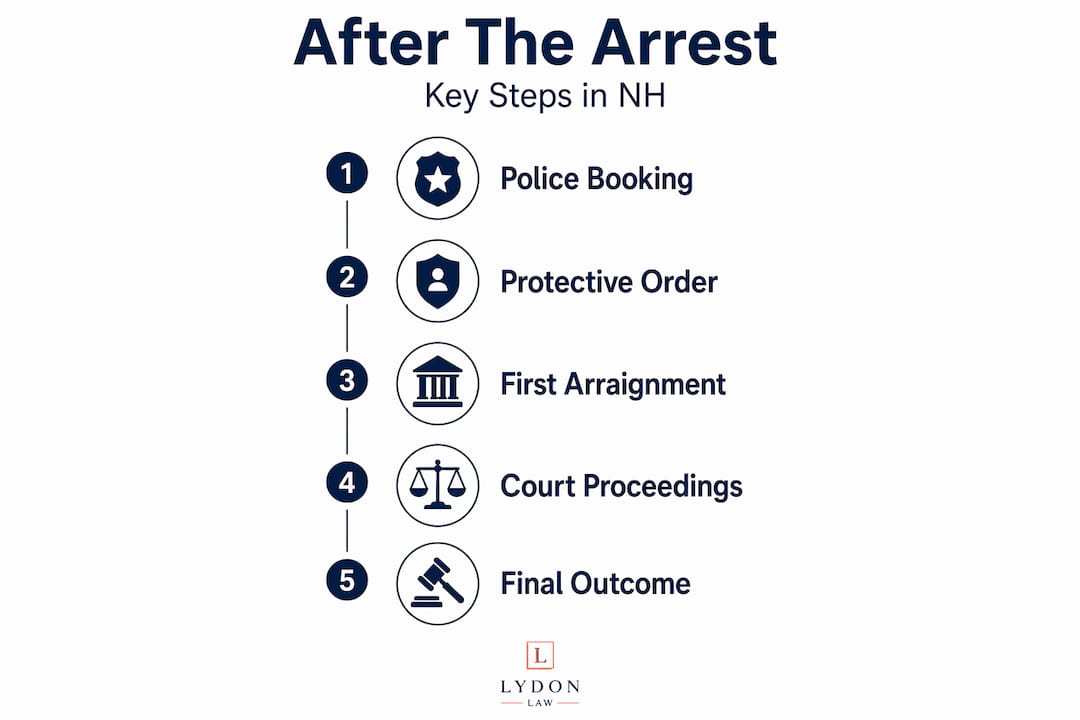
One of the most immediate and life-altering consequences of a domestic violence arrest is the possibility of a protective order. Protective orders are legal directives issued by a court that restrict your contact with the alleged victim and may impose other conditions on your daily life. They can take effect before any conviction, sometimes before you even have a chance to speak with an attorney.

New Hampshire’s victim protection framework is tied to the Domestic Violence Act, RSA 173-B, and protective orders can require no-contact and other conditions. Violating a protective order is a Class A misdemeanor, which carries a penalty of up to one year in jail. That means even an accidental contact, such as a text message or a phone call, can result in a brand new criminal charge on top of the original arrest.
Understanding the full scope of what a protective order can and cannot do is critical. Here is a general comparison to help clarify this:
| What a protective order can do | What a protective order cannot do |
|---|---|
| Prohibit all contact with the alleged victim | Remove your parental rights permanently |
| Require you to leave a shared home | Automatically resolve custody of children |
| Restrict your presence near certain locations | Prevent you from attending your court hearings |
| Mandate counseling or other programs | Serve as a final criminal conviction |
There are a few important points to keep in mind about protective orders:
Pro Tip: If you share a home or children with the alleged victim, the protective order may immediately affect where you live and your access to your children. Address this with an attorney as quickly as possible to understand your options.
Reviewing a thorough domestic violence protections guide will help you understand what is at stake and what steps you can take to protect your rights and your family relationships.
Once you have been arrested and a protective order is in place, the formal court process begins. Each stage carries its own legal weight, and what happens at each appearance shapes the options available to you later.
The general sequence of court events typically looks like this:
The types of charges that can result from a domestic violence arrest in New Hampshire vary based on the alleged conduct. Charges can range from Class A misdemeanors, carrying up to one year in jail, to Class B felonies or higher in cases involving serious bodily injury or the use of a deadly weapon. Each level of charge carries different sentencing guidelines, potential fines, and long-term consequences.
New Hampshire courts handle a significant volume of these cases every year. The NNEDV’s annual DV Counts report tracks domestic violence case data statewide, providing context for how common and how seriously the system treats these matters. The volume of cases means courts have established, structured processes, and deviating from those processes without legal guidance puts you at a real disadvantage.
A step-by-step domestic violence defense guide specific to New Hampshire outlines how to navigate each court stage strategically.
Once you have moved through the court process, your case will reach one of several possible outcomes. Each carries a very different set of consequences, both immediately and over the course of your life.
The four most common outcomes are:
Beyond the courtroom, a domestic violence conviction or even an arrest record creates what attorneys call “collateral consequences.” These are the impacts that ripple out into everyday life:
Expungement, the legal process of sealing or removing a conviction from your record, is available in limited circumstances in New Hampshire. It is not automatic, and not all charges qualify. Timing matters, and the process requires meeting specific criteria. Speaking with an attorney early helps you understand whether expungement is a realistic option for your situation.
It is also worth noting that New Hampshire’s judicial system continues to face scrutiny over how domestic violence cases are handled. A Concord Monitor investigation found that an internal judicial-branch review identified missed opportunities for courts to intervene before violence turned fatal in certain cases. This highlights why the system’s response to these situations, while structured, is not infallible, and why asserting your rights through qualified legal representation matters.
Understanding your defense rights in NH is a critical part of navigating this process well.
Here is something we see often: people arrested for domestic violence charges assume that if the situation was minor, or if the other party calms down and changes their mind, the whole thing will quietly go away. That assumption is one of the most costly mistakes you can make.
The first reason it is wrong is that the state controls the prosecution, not the alleged victim. Even if the person who called police later wants to drop everything, the prosecutor’s office can and often does move forward with charges based on officer observations, photographs, medical reports, and other evidence. The alleged victim’s cooperation is helpful to the prosecution but is not always necessary.
The second reason is that early decisions have an outsized impact. The choice to speak or stay silent at booking, the plea entered at arraignment, whether you contest a protective order, and whether you retain an attorney before your first court appearance all shape the path your case follows. Waiting even a few days to seek legal help can close off options that would otherwise be available.
The third issue is the weight people assign to “minor” charges. A Class A misdemeanor sounds less serious than a felony. But a misdemeanor conviction for domestic violence triggers a federal firearms disability under the Lautenberg Amendment, meaning you cannot legally possess a firearm. For many people, that restriction has serious implications for employment, hunting, or personal safety.
We also know that the courts themselves sometimes fail to catch these cases before they escalate, as the judicial review noted above confirms. That reality reinforces the value of having an advocate who is paying close attention to every procedural step on your behalf.
If you are asking yourself whether you really need an attorney for this, the answer from our experience is almost always yes. Understanding why hiring a domestic violence attorney matters in New Hampshire can help you make that decision with confidence.
A domestic violence arrest in New Hampshire puts your freedom, your relationships, and your future at risk simultaneously. Navigating that alone, while managing the emotional weight of the situation, is extremely difficult. At Lydon Law, our NH criminal defense attorneys work directly with you from the earliest stages, whether that means addressing a protective order, preparing for arraignment, or building a defense strategy for trial. Our NH family law specialists are also available when custody, visitation, or other family issues arise alongside a criminal matter. You can review our full range of practice areas to understand all the ways we can support you. Contact Lydon Law to discuss your situation with an attorney who knows New Hampshire’s courts and is committed to protecting your rights at every stage.
Expungement is possible in certain cases depending on the outcome and the specific charge, but it is not automatic. Consulting with a defense attorney is the best way to determine whether your situation qualifies.
Violating a protective order is a Class A misdemeanor under New Hampshire’s Domestic Violence Act, which can result in up to one year in jail. This applies even to seemingly minor or accidental contact.
Arraignment typically occurs within 24 to 48 hours after arrest, though local court schedules and weekends may affect the exact timing.
A protective order can require no contact and other conditions such as leaving a shared home, staying away from certain locations, or participating in counseling programs, all under New Hampshire’s Domestic Violence Act.
The state, not the alleged victim, controls the prosecution. Prosecutors can continue pursuing charges based on physical evidence, police reports, and other factors even if the victim decides they no longer want to participate.

© 2026 Lydon Law|Legal Disclaimer|Privacy Policy