Menu


TL;DR:
- Bail in New Hampshire allows arrestees to be released before trial through financial guarantees or promises to appear in court.
- The 2025 reforms lowered the standard for pretrial detention from clear and convincing evidence to probable cause, increasing detention cases.
Bail in New Hampshire is a legal mechanism that allows an arrested person to be released from custody before trial, typically by providing a financial guarantee or a formal promise to appear in court. The system exists to balance two competing interests: the government’s responsibility to protect public safety and the individual’s constitutional right to be presumed innocent until proven guilty. If you or someone you love has been arrested in New Hampshire, understanding how bail works, what it costs, and what the 2025 reforms changed can make a significant difference in what happens next.
Bail is a financial or recognizance-based mechanism designed to secure a defendant’s appearance at future court dates while respecting the presumption of innocence. It is not a punishment. A court sets bail to give the state confidence that you will return for your hearings without requiring you to sit in jail while your case moves forward.
New Hampshire’s bail system operates under state statute and is administered through the courts. A judge or, in some cases, a bail commissioner sets the terms of release after an arrest. Those terms can include a financial requirement, specific behavioral conditions, or both. The goal is always the same: protect the public while giving the defendant a fair opportunity to participate in their own defense from outside a jail cell.
The 2025 bail reform law changed the standard courts use when deciding whether to detain someone before trial. That change has had real consequences for defendants across the state, and we will cover it in detail below.
The bail process in New Hampshire follows a defined sequence of steps, and knowing what to expect at each stage helps you respond effectively.
Protective orders, no-contact provisions, and firearms restrictions are among the most common conditions attached to bail orders, particularly in domestic violence cases. Violating any condition, even unintentionally, carries serious legal consequences.
Pro Tip: If you are present at a bail hearing, say as little as possible without your attorney present. Statements made at a bail hearing can be used against you later in the criminal proceeding.
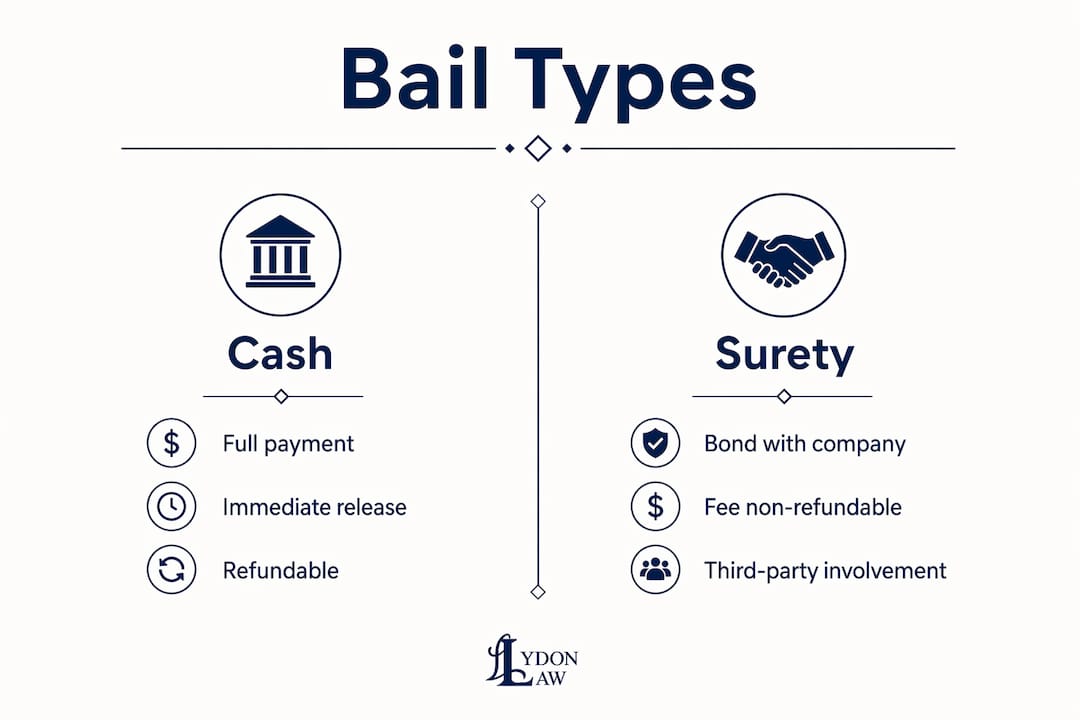
New Hampshire courts use several forms of bail, and the type offered to you depends on the charges, your background, and the judge’s assessment of risk.
| Bail type | How it works | Key consideration |
|---|---|---|
| Cash bail | You or a family member pays the full bail amount directly to the court | Refunded at case conclusion if you appear as required |
| Surety bond | A bail bondsman posts bail on your behalf for a non-refundable fee | Fee is typically 10% of the total bail amount |
| Personal recognizance | Released on your written promise to appear, no money required | Usually reserved for low-risk defendants with strong community ties |
| Conditional release | Released with specific behavioral requirements attached | Conditions may include curfews, check-ins, or no-contact orders |
Each type carries distinct financial and legal implications. Cash bail is straightforward but can be financially out of reach for many families. Surety bonds make release accessible when you cannot pay the full amount, but the bondsman’s fee is not returned regardless of the outcome. Personal recognizance release is the least financially burdensome option, though courts grant it selectively.
When any form of bail is granted, conditions often accompany the release. Common conditions include:
Understanding which conditions apply to your release is critical. Each one is legally binding, and a single violation can result in revocation of bail and immediate return to custody.
The most significant shift in New Hampshire bail law in recent memory came with the 2025 bail reform legislation. The law lowered the standard for pretrial detention from “clear and convincing evidence” to “probable cause.” That change is more consequential than it might sound.
Under the old standard, prosecutors had to present strong, nearly conclusive evidence that a defendant posed a danger before a court could order pretrial detention. Under the new standard, they need only show probable cause, which is the same lower threshold used to justify an arrest in the first place. This means it is now significantly easier for a prosecutor to argue for keeping someone in jail before trial.
“The new bail framework prioritizes public safety by enabling quick access to bail orders and focusing on dangerousness.” — Attorney General John Formella
The practical effect has been measurable. Pretrial detentions have increased in serious cases since the law took effect, with counties like Coös County reporting a 50% rise in pretrial detention. Supporters argue this protects victims and reduces repeat offenses. Critics point out that defendants who cannot secure release are at a disadvantage when preparing their defense.
One additional factor shapes how these hearings unfold. Judges and prosecutors have only hours to prepare for bail hearings in many cases. That compressed timeline means the evidence and arguments presented at arraignment carry enormous weight. Because the probable cause standard is easier to meet, the prosecution’s presentation at that early stage now largely determines whether you go home or stay in custody. Early legal representation is not just helpful under this framework. It is decisive.
Violating bail conditions in New Hampshire is treated as a separate criminal offense. Under state law, breach of bail is a misdemeanor charge that can be prosecuted independently of the underlying case. That means you could face additional criminal exposure on top of the original charges simply for failing to comply with your release terms.
The consequences of a bail violation can include:
Bail forfeiture is a related but distinct issue. If you fail to appear for a scheduled court date, the court can declare your bail forfeited, meaning any money posted is lost. A warrant is then issued for your arrest, and the situation becomes considerably more difficult to resolve.
Pro Tip: If you believe you cannot comply with a specific bail condition, such as a no-contact order that conflicts with a shared living situation, contact your attorney immediately. Courts can sometimes modify conditions, but you must request the change through proper legal channels before violating the order.
Facing the bail process without guidance is one of the most stressful situations a family can encounter. These steps can help you respond clearly and protect your rights.
Understanding how to defend criminal charges in New Hampshire starts at the bail stage. The decisions made in those first hours after arrest shape the entire trajectory of a case.
Bail in New Hampshire is a legally binding release mechanism governed by statute, and the 2025 reforms have made the pretrial detention standard easier for prosecutors to meet, making early legal representation more critical than ever.
| Point | Details |
|---|---|
| Bail definition | Bail secures court appearance while preserving the presumption of innocence before conviction. |
| 2025 standard change | The evidentiary standard dropped from “clear and convincing” to “probable cause,” making detention easier to justify. |
| Types of bail | Cash bail, surety bonds, personal recognizance, and conditional release each carry different financial and legal implications. |
| Bail violations | Breaching bail conditions is a misdemeanor offense in New Hampshire and can result in immediate re-arrest. |
| Early representation | Having an attorney at the bail hearing is the single most effective way to influence release terms. |
The shift from “clear and convincing” to “probable cause” is not a technical adjustment. It is a fundamental change in how much power the state holds over a defendant before any conviction has occurred. I have seen firsthand how the hours immediately following an arrest set the tone for everything that follows. Under the old standard, a well-prepared defense at arraignment could meaningfully push back against detention. Under the new standard, that window is narrower and the stakes are higher.
What concerns me most is not the intent behind the reform. Protecting public safety is a legitimate goal. What concerns me is the speed at which these decisions are made and the limited opportunity defendants have to present their side of the story before a judge decides whether they go home. Families often do not realize that the bail hearing is not a formality. It is the first critical moment in a criminal case, and what happens there matters.
The practical advice I give to anyone in this situation is simple: do not wait. If someone you love has been arrested, the most valuable thing you can do in the first hour is find qualified legal counsel. Not because the system is unfair, but because it moves fast and the consequences of an unprepared hearing can follow a defendant for months.
— Rich
If you or a family member is facing criminal charges in New Hampshire, Lydon Law provides direct, experienced representation from the moment of arrest through case resolution. Attorney Kalie Lydon has appeared in New Hampshire courts and the state’s Supreme Court, and clients work directly with their attorney at every stage, including bail hearings. Lydon’s criminal defense services cover DWI, drug offenses, felonies, and misdemeanors, with offices in Nashua and Portsmouth serving clients throughout the state. If you need guidance on your rights and legal options after an arrest, reach out to Lydon Law for a consultation.
Bail in New Hampshire is a legal process that allows a defendant to be released from custody before trial by providing a financial guarantee or a promise to appear in court. It is governed by state statute and administered by judges or bail commissioners.
The 2025 law lowered the standard for pretrial detention from “clear and convincing evidence” to “probable cause,” making it easier for prosecutors to argue that a defendant should remain in custody before trial. Counties like Coös have reported a 50% increase in pretrial detentions since the law took effect.
New Hampshire courts offer cash bail, surety bonds, personal recognizance release, and conditional release. Surety bonds typically require a non-refundable premium of around 10% of the total bail amount paid to a licensed bondsman.
Violating bail conditions is a misdemeanor offense called breach of bail under New Hampshire law. Consequences include immediate arrest, revocation of bail, and a new criminal charge added to the original case.
Having an attorney at your bail hearing is strongly advisable, particularly under the 2025 reforms. Because judges and prosecutors have only hours to prepare, an attorney who can present evidence of community ties and low flight risk can directly influence whether you are released and on what terms.

© 2026 Lydon Law|Legal Disclaimer|Privacy Policy