Menu


TL;DR:
- A DUI defense involves legal strategies to challenge the evidence and procedural errors in drunk driving cases. Acting quickly to preserve evidence, file motions, and understand local laws can significantly impact the case outcome. Effective defense focuses on procedural violations, not just whether impairment occurred, providing opportunities to reduce or dismiss charges.
A DUI defense is the complete set of legal strategies used to challenge drunk driving charges by contesting the traffic stop, testing procedures, and evidence collection that prosecutors rely on to secure a conviction. In New Hampshire, a DUI charge (referred to in state law as DWI, or Driving While Intoxicated) triggers both criminal proceedings and a separate administrative license suspension process, making a well-prepared defense more consequential than most people realize. Understanding what DUI defense involves, and acting on that knowledge quickly, can be the difference between a conviction that follows you for years and a charge that gets reduced or dismissed entirely.
DUI defense is the formal legal effort to contest the prosecution’s case against a driver charged with operating a vehicle while impaired by alcohol or drugs. The prosecution must prove guilt beyond a reasonable doubt, and that standard creates real openings for a skilled defense attorney to work with. A DUI arrest is not a conviction; prosecutors carry the burden of proof, and technical weaknesses in their evidence provide direct leverage for the defense.
Most DUI defenses focus on challenging the validity of evidence and police procedure rather than simply arguing the driver was not impaired. This distinction matters because the prosecution’s case typically rests on a chain of events: the traffic stop, field sobriety tests, and a chemical test such as a breathalyzer or blood draw. Each link in that chain carries procedural requirements, and a failure at any point can weaken or eliminate key evidence. Cases with comprehensive evidence documentation show a 40% higher chance of favorable outcomes, which reflects how much procedural detail actually matters in these cases.
The types of DUI defenses available to you depend on the specific facts of your arrest, but several strategies appear consistently in successful cases.
Challenging the traffic stop. The Fourth Amendment requires police to have reasonable suspicion before pulling you over. If the stop lacked legal justification, any evidence gathered afterward may be suppressed. This is one of the most powerful defenses because it can eliminate the entire case.
Disputing field sobriety tests. The National Highway Traffic Safety Administration (NHTSA) sets specific protocols for administering the Horizontal Gaze Nystagmus, Walk-and-Turn, and One-Leg-Stand tests. Deviations from those protocols, uneven pavement, poor lighting, or a medical condition affecting balance can all undermine the results.
Contesting breathalyzer accuracy. Breathalyzer machines require regular calibration, typically every 60 days, and missing calibration logs can render test results inadmissible. Defense attorneys routinely request maintenance records for this reason.
The rising BAC defense. Alcohol absorption continues for up to two hours after your last drink, meaning your BAC at the time of testing may be higher than it was when you were actually driving. If there was a significant delay between the stop and the test, this argument can be compelling.
Medical and physical condition defenses. Conditions such as acid reflux, diabetes, or certain neurological disorders can produce false breathalyzer readings or mimic signs of impairment. A physician’s documentation of such a condition can directly challenge the prosecution’s evidence.
Challenging blood test chain of custody. Blood samples must be collected, stored, and analyzed under strict protocols. Any gap in the chain of custody, from collection to the lab, creates grounds to question the reliability of the result.
Pro Tip: Request the police report, dashcam footage, and breathalyzer calibration records as early as possible. Evidence can be lost or overwritten quickly, and having it in hand gives your attorney the clearest picture of what can be challenged.
New Hampshire law treats DWI charges with a specific set of procedural rules that directly affect your defense options. Understanding these local details is not optional. Missing a deadline or misunderstanding a requirement can cost you rights that cannot be recovered.
Request your administrative hearing immediately. New Hampshire separates the criminal DWI case from the administrative license suspension. Strict deadlines govern when you must request a hearing to contest that suspension, and missing the window results in automatic suspension regardless of how your criminal case resolves. Deadlines can range from 10 to 30 days depending on the state, so act within days of your arrest, not weeks.
Understand breathalyzer obligations under New Hampshire’s implied consent law. New Hampshire’s implied consent statute means that by driving on state roads, you have agreed to submit to chemical testing. Refusing a test carries its own penalties, including license suspension. Knowing whether to take a breathalyzer in New Hampshire is a decision with real consequences either way, and it deserves careful legal guidance before you face that moment.
Explore diversion programs and plea options. New Hampshire offers diversion programs for first-time offenders in some circumstances. A plea negotiation may result in a reduced charge such as reckless driving, which carries fewer long-term consequences than a DWI conviction. Your attorney’s knowledge of local prosecutors and court practices directly affects what options are realistically available.
Examine how local police procedure affects your case. Departments in Nashua, Portsmouth, and other New Hampshire cities follow specific protocols for DWI stops and testing. Variations in how individual officers document stops or administer tests can create defense opportunities that only a locally experienced attorney will recognize.
Avoid common pitfalls. Talking to police without an attorney present, missing court dates, or failing to preserve your own evidence such as receipts or witness contact information are mistakes that consistently hurt defendants.
Pro Tip: The criminal case and the license suspension are two separate legal battles. Winning one does not automatically win the other. You need a strategy that addresses both from the start.
The prosecution’s case in a DWI matter is built on evidence, and that evidence is only as strong as the procedures used to collect it. The following table outlines the most common evidentiary vulnerabilities and what they mean for your defense.
| Evidence type | Common vulnerability | Defense implication |
|---|---|---|
| Breathalyzer results | Missing or irregular calibration logs | Test results may be ruled inadmissible |
| Blood test results | Chain-of-custody gaps from collection to lab | Reliability of the sample is directly questioned |
| Field sobriety tests | Deviation from NHTSA protocols | Results lose credibility as proof of impairment |
| Dashcam or bodycam footage | Footage contradicts officer’s written report | Supports motions to suppress or dismiss |
| Traffic stop documentation | Lack of documented reasonable suspicion | All subsequent evidence may be excluded |
Police have a legal obligation to preserve exculpatory evidence, and failure to preserve dashcam footage can support a motion to suppress critical evidence based on police misconduct. Video evidence frequently contradicts officer reports in ways that are difficult for the prosecution to explain away. This is why requesting footage immediately after an arrest is one of the most consequential steps you can take.
Beyond video, Miranda rights violations and denial of timely access to an attorney are procedural errors that can affect the admissibility of statements you made after your arrest. If officers questioned you without advising you of your rights, any answers you gave may be excluded from evidence. These are not technicalities in a dismissive sense. They are constitutional protections that exist precisely because the consequences of a DWI conviction are serious.
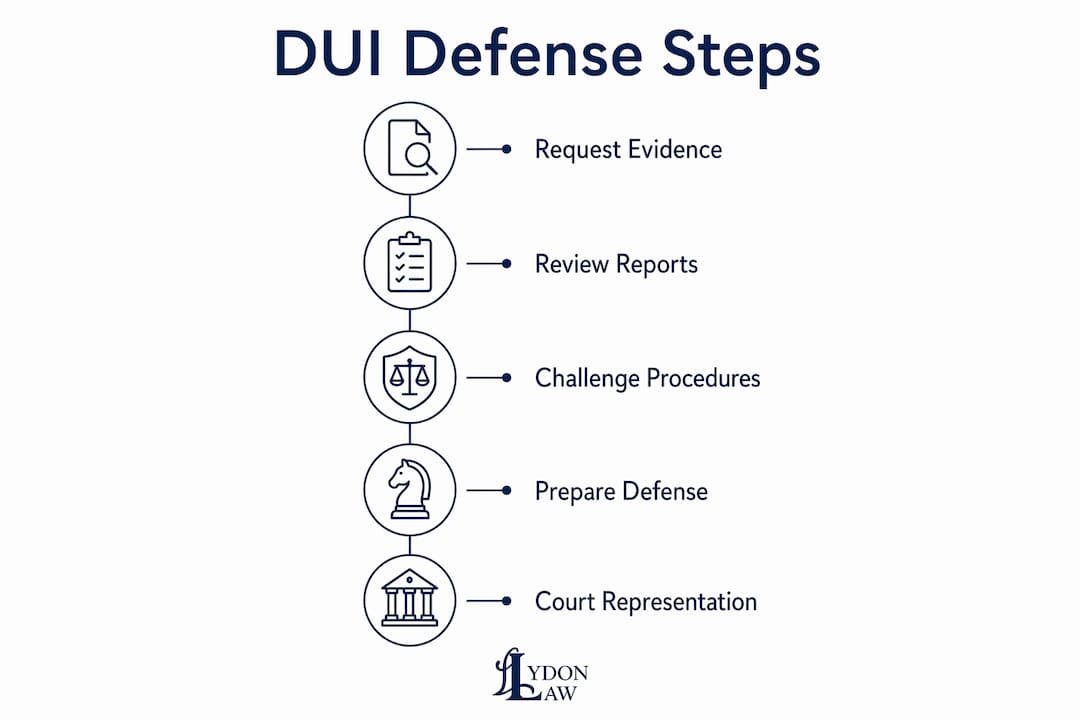
Preparing a strong defense requires deliberate action from the moment of your arrest. The steps below reflect what experienced DWI defense attorneys in New Hampshire consistently identify as the most important early moves.
Collect and preserve all evidence immediately. Write down everything you remember about the stop, including the time, location, what the officer said, and how the tests were administered. Gather any receipts, witness names, or other documentation that establishes your timeline.
Request discovery from the prosecution. Your attorney will file formal discovery requests to obtain the police report, breathalyzer maintenance records, dashcam and bodycam footage, and any lab reports. This material forms the foundation of your defense strategy.
File motions early. Motions to suppress evidence, motions to dismiss for procedural violations, and motions challenging the legality of the stop are most effective when filed before trial. Timing matters, and a missed filing deadline can foreclose an otherwise strong argument.
Understand the plea negotiation process. Many DWI cases in New Hampshire resolve through negotiation rather than trial. A reduced charge, a deferred sentence, or participation in a diversion program can preserve your record and your license in ways that a trial cannot guarantee. An experienced DUI defense attorney knows when a negotiated outcome serves you better than fighting every charge at trial.
Engage qualified local legal help without delay. The procedural deadlines in New Hampshire DWI cases are unforgiving. The sooner you have an attorney reviewing your case, the more options remain open to you.
Pro Tip: Do not assume a high BAC reading makes your case unwinnable. Breathalyzer results have been successfully challenged in New Hampshire courts based on calibration failures, improper administration, and medical conditions. The number on the machine is not the final word.
Effective DUI defense requires challenging the evidence, the procedures, and the timeline of your arrest from the very first day, not waiting to see what the prosecution presents.
| Point | Details |
|---|---|
| Defense targets procedure, not just facts | Most successful defenses challenge how evidence was collected, not just whether impairment occurred. |
| Two separate proceedings require attention | Criminal charges and administrative license suspension must each be contested with their own deadlines. |
| Breathalyzer results are challengeable | Missing calibration logs or improper administration can make breath test results inadmissible. |
| Timing of BAC testing matters | BAC rises for up to two hours after drinking, so test results may not reflect BAC at the time of driving. |
| Early action preserves your options | Requesting evidence, filing motions, and engaging an attorney quickly keeps more defense strategies available. |
I have seen too many people walk into their first consultation convinced they have no options because they failed a breathalyzer or because an officer documented the stop in detail. That assumption is wrong, and it costs people outcomes they could have achieved. A DUI arrest is not a conviction. The prosecution still has to prove every element of the charge beyond a reasonable doubt, and the path from arrest to conviction is lined with procedural requirements that are not always followed correctly.
What I find most telling is how often the strongest defense arguments come not from disputing whether someone had been drinking, but from examining exactly how the evidence was gathered. A breathalyzer that was not calibrated on schedule, a field sobriety test administered on a sloped surface, a dashcam that was conveniently not running during the stop. These are not rare exceptions. They appear regularly in DWI cases across New Hampshire, and they matter enormously. The driving element itself can also be contested in cases where it is genuinely unclear whether the defendant was operating the vehicle.
My consistent advice is this: do not wait to see how things develop. The administrative hearing deadline alone can expire within days of your arrest. Get qualified legal representation in New Hampshire in place immediately, and let an experienced attorney assess what the evidence actually shows before you make any decisions about how to proceed.
— Rich
Facing a DWI charge in New Hampshire is stressful, and the decisions you make in the first days after your arrest carry real weight. Lydon Law, with offices in Nashua and Portsmouth, provides hands-on criminal defense representation for individuals charged with DWI and related offenses throughout New Hampshire. Attorney Kalie Lydon brings direct courtroom experience in New Hampshire courts, including the state’s Supreme Court, and works personally with each client rather than delegating to staff. If you are facing a DWI charge and want a clear-eyed assessment of your defense options, contact Lydon Law to schedule a consultation and understand exactly where you stand.
A DUI defense attorney reviews all evidence against you, including police reports, breathalyzer records, and video footage, then files motions and negotiates with prosecutors to reduce or dismiss charges. Their role covers both the criminal case and the separate administrative license suspension proceeding.
Yes. Charges can be dismissed when evidence is suppressed due to an unlawful traffic stop, improper test administration, or missing calibration records. Cases with documented evidence weaknesses show a 40% higher rate of favorable outcomes.
The deadline to request an administrative hearing to contest your license suspension is very short, often as few as 10 days from the date of arrest. Missing that deadline results in automatic suspension regardless of your criminal case outcome.
Not necessarily. Breathalyzer results can be challenged based on calibration and maintenance records, improper administration, or medical conditions that affect readings. A high BAC reading is one piece of evidence, not a guaranteed conviction.
New Hampshire, like most states, sets the legal intoxication threshold at 0.08% BAC for drivers 21 and older. Lower limits apply for commercial drivers and drivers under 21.

© 2026 Lydon Law|Legal Disclaimer|Privacy Policy