Menu


TL;DR:
- Legal mediation is a voluntary or court-ordered process where a neutral mediator helps disputing parties settle outside court. It is faster, less expensive, and more private than litigation, with parties controlling the outcome. The process involves six stages, from planning to negotiation, and is most effective when parties prepare and approach it cooperatively.
Legal mediation is defined as a voluntary or court-ordered process where a neutral third party helps disputing individuals reach a settlement outside of court. It is a recognized form of alternative dispute resolution (ADR) that gives you control over the outcome rather than leaving a judge to decide. Mediation is typically faster, less expensive, and more private than litigation, making it a practical option for New Hampshire residents facing family or civil disputes. Whether you are dealing with a divorce, a child custody disagreement, or a civil matter, understanding how mediation works can help you make a clearer, more confident decision about your next step.
Legal mediation is a structured conversation guided by a trained, neutral mediator. The mediator does not act as a judge and does not impose a decision. Instead, the mediator manages communication between the parties and helps them identify shared interests and workable solutions. This is the core difference between mediation and litigation: in court, a judge decides the outcome; in mediation, you and the other party decide together.

Confidential mediation communications are protected from court admissibility under state and federal standards. That protection encourages both sides to speak openly without fear that their words will be used against them later. This candor often leads to faster, more satisfying resolutions than adversarial court proceedings.
Mediation applies to a wide range of disputes in New Hampshire. Family law matters such as divorce, child custody and visitation, and child support are among the most common. Civil disputes involving property, contracts, or neighbor disagreements are also well suited to the process.
The legal mediation process generally follows six stages: planning, mediator introduction, opening remarks, joint discussion, caucuses, and negotiation. Each stage has a clear purpose, and understanding them helps you walk in prepared rather than anxious.
Preparation matters as much as the session itself. Participants commonly bring 3–5 categories of documents such as financial records, medical information, and relevant correspondence. Arriving with organized documentation shortens the session and keeps discussions focused.
Pro Tip: Before your session, write down your top three priorities and your minimum acceptable outcome for each issue. Knowing your limits in advance prevents you from agreeing to terms you will regret.
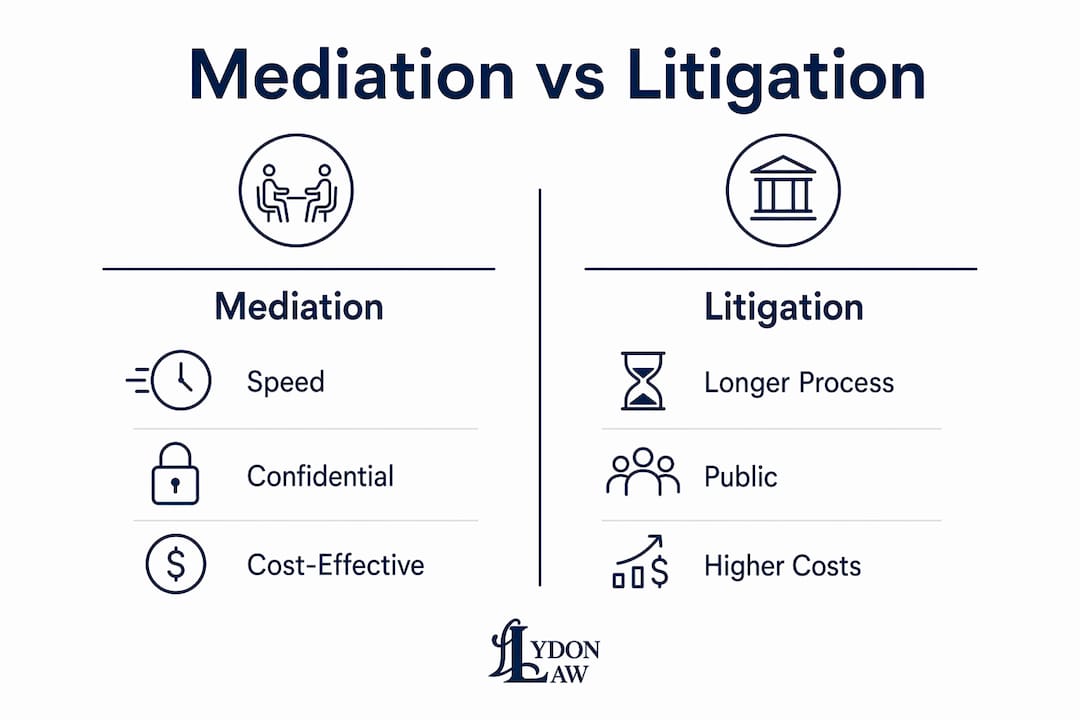
Mediation offers real advantages over litigation, but it is not the right fit for every situation. The table below compares the two approaches across the factors that matter most to New Hampshire residents.
| Factor | Mediation | Litigation |
|---|---|---|
| Speed | Often resolved in one to several sessions | Can take months or years |
| Cost | Significantly lower than court proceedings | Attorney fees, court costs, and discovery expenses add up quickly |
| Privacy | Discussions are confidential and not part of the public record | Court proceedings are generally public |
| Control | Parties shape the outcome together | A judge decides the outcome |
| Enforceability | Binding once a written agreement is signed | Court orders are immediately enforceable |
Mediation can often resolve about 80% of disputes, which is a strong success rate. That figure drops when participation is reluctant or forced, which is why a cooperative mindset matters so much.
Mediation has real limitations. It works less well when one party refuses to negotiate in good faith, when there is a significant power imbalance, or when the facts themselves are heavily disputed. In those situations, litigation may be the more appropriate path.
Early mediation prevents extensive pretrial discovery and motions, which means the financial and emotional savings are greatest when you choose mediation before the legal process escalates.
Pro Tip: If you are considering mediation, start the conversation before filing court motions. Late-stage mediation still helps, but the cost and stress savings are far greater when you begin early.
Mediation works best for parties who are willing to communicate and problem-solve, even when the relationship is strained. Mediation requires shifting from an adversarial “win-lose” mindset to a problem-solving approach focused on shared interests such as co-parenting stability or financial security. That shift is not always easy, but it is the foundation of a productive session.
The following situations are well suited to mediation in New Hampshire:
Legal counsel is not required for mediation but is highly recommended for complex family or civil disputes. An attorney can review any draft settlement before you sign it, protecting you from unintended consequences. If mediation fails, you retain the full right to proceed to court. Nothing said during mediation can be used against you in that subsequent proceeding.
Preparation is the single biggest factor you control before walking into a mediation session. Arriving organized and clear-headed gives you the best chance of reaching an agreement that holds.
Mediation works best when factual disputes are largely settled and both parties are focused on resolution options rather than relitigating the past. Walking in with that mindset, and the documents to support it, puts you in the strongest possible position.
Legal mediation is the most cost-effective, private, and controllable path to resolving family and civil disputes in New Hampshire, provided both parties enter the process willing to collaborate.
| Point | Details |
|---|---|
| Mediation defined | A neutral mediator guides parties to a voluntary agreement without a judge deciding the outcome. |
| Six-stage process | Sessions follow planning, introduction, opening remarks, joint discussion, caucuses, and negotiation. |
| Confidentiality protection | Mediation communications are protected from court admissibility, encouraging honest discussion. |
| Early mediation saves more | Starting mediation before litigation escalates reduces both financial cost and emotional strain. |
| Agreements are binding | A signed mediation agreement is legally enforceable and may require court approval in family cases. |
People often come to mediation thinking it is a softer, less serious version of going to court. That assumption costs them. Mediation is a structured negotiation with real legal consequences, and the parties who do best are the ones who treat it that way.
What I have seen repeatedly is that the outcome of mediation depends less on the mediator and more on how prepared and mentally ready each party is. Someone who walks in with clear goals, organized documents, and a genuine willingness to find common ground almost always leaves with a better result than someone who shows up hoping the mediator will fix things for them.
The other thing worth saying plainly: do not wait until you are deep in litigation to try mediation. Early mediation leads to better financial and emotional outcomes because you have not yet spent months paying attorneys to fight over discovery. The earlier you start, the more options you have.
Attorney involvement matters too. A mediator cannot give you legal advice. Having an attorney review the draft agreement before you sign is not optional if you want to protect yourself. The negotiation in family law context is especially high-stakes because the terms you agree to today affect your children and finances for years. Treat mediation as the serious legal process it is, prepare accordingly, and you will be in a far stronger position.
— Rich
Mediation is a powerful tool, but it works best when you have an attorney in your corner before, during, and after the process. Lydon serves clients throughout New Hampshire from offices in Nashua and Portsmouth, helping individuals prepare for mediation, understand their rights, and review settlement agreements before signing. Whether your dispute involves family law matters such as divorce or child custody, or a civil law issue requiring negotiation and resolution, Lydon provides clear, practical guidance at every stage. Contact Lydon to discuss your situation and get the legal support you need to approach mediation with confidence.
Mediation uses a neutral facilitator to help parties reach their own agreement, while arbitration involves a neutral decision-maker who imposes a binding ruling. In mediation, you retain control over the outcome.
Yes. A mediation agreement becomes legally binding once both parties sign it. In family law cases, it may also require court approval before it takes full legal effect.
Yes. You have the right to have an attorney present or to consult one before and after sessions. Legal counsel is especially recommended for complex disputes involving finances or children.
If mediation fails, you retain the full right to proceed to court. Nothing discussed during mediation can be used as evidence in subsequent legal proceedings.
New Hampshire courts may order mediation before a family law case proceeds to trial. Even when not required, voluntary mediation is often faster and less costly than contested litigation.

© 2026 Lydon Law|Legal Disclaimer|Privacy Policy