Menu


TL;DR:
- In New Hampshire, parental visitation is called “parenting time” and is governed by RSA 461-A, which emphasizes parental rights and responsibilities. The law distinguishes between residential responsibility, decision-making authority, and parenting time, allowing flexible arrangements based on the child’s best interests. Courts may enforce parenting plans, including virtual visitation and supervised visits, through specific legal procedures to protect child welfare.
If you’ve been searching for answers about parental visitation rights in New Hampshire, you may have already noticed something confusing: the state doesn’t actually use the word “visitation” in its family law statutes. What is parental visitation, in practical terms, is what New Hampshire now calls “parenting time” or “residential responsibility” under RSA 461-A. Understanding this distinction isn’t just a technicality. It shapes how courts talk about your rights, how parenting plans are written, and how you protect your relationship with your child through the legal process.
| Point | Details |
|---|---|
| NH uses updated terminology | New Hampshire replaced “custody and visitation” with “parental rights and responsibilities” in 2005 under RSA 461-A. |
| Two types of parental authority | Residential responsibility covers where the child lives; decision-making responsibility covers education, healthcare, and religion. |
| Virtual visitation is legally recognized | NH law authorizes video calls and other digital contact as part of a formal parenting plan. |
| Parenting plans are legally required | Courts require a filed parenting plan that addresses schedules, communication, and dispute resolution. |
| Enforcement tools exist | Parents denied court-ordered parenting time can file a Family Access Motion with a $225 filing fee for expedited relief. |
New Hampshire made a significant shift in 2005 when it replaced custody and visitation terminology with the broader framework of “parental rights and responsibilities” under RSA 461-A. This wasn’t just a language update. It reflected a genuine change in how the state thinks about children and separated parents.
Under this framework, parental authority is divided into two distinct categories. The first is residential responsibility, which refers to where the child primarily lives and the day-to-day care provided during that time. The second is decision-making responsibility, which covers major choices about the child’s life, including education, medical care, and religious upbringing.
Both of these responsibilities can be shared jointly between parents, or one parent may hold primary authority in one or both areas. The specific arrangement depends on the circumstances of the family and, above all, what the court determines is in the best interest of the child. NH family law is gender-neutral and does not presume that one parent is more suited to a particular role based on gender.
Here is a quick breakdown of what each term covers:
Pro Tip: Use the statutory language from RSA 461-A in any court filings or communications. Referring to “residential responsibility” instead of “custody” and “parenting time” instead of “visitation” signals to the court that you understand the legal framework and helps avoid unnecessary confusion.
Even though New Hampshire uses updated terminology, the practical reality of how visitation works covers a range of arrangements that parents and courts build into formal parenting plans. Understanding the types of visitation available to you helps you advocate for an arrangement that genuinely supports your child’s wellbeing.
The most common form of parenting time is regular in-person contact. This typically includes a weekly or biweekly schedule, alternating weekends, and specific arrangements for school holidays and summer vacations. Courts encourage parents to create detailed schedules that account for school calendars, extracurricular activities, and each parent’s work schedule.

Holiday and vacation time deserves special attention in any parenting plan. Many plans alternate major holidays each year, so one parent has Thanksgiving in odd years and the other has it in even years, for example. Vacation time is often handled as a separate block of days each parent may take with the child annually, with advance notice requirements built in.
This is an area where New Hampshire has been notably forward-thinking. Virtual visitation is authorized by statute under RSA 461-A:4 and includes video calls, texting, and phone calls as recognized forms of parenting time. For families where one parent lives at a distance, or where schedules make frequent in-person contact difficult, virtual contact helps maintain the emotional bond between parent and child.
Practically speaking, virtual visitation appears in over 90% of New Hampshire parenting plans today. Parents use it for nightly check-ins, homework help, reading bedtime stories, and even attending school events through livestream. It supplements in-person time rather than replacing it.
When a court has concerns about a child’s safety during visits with one parent, it may order supervised visitation. This means a neutral third party or a professional supervisor is present during all contact. Supervised visits may take place at designated visitation centers that have security measures in place. Courts typically order this arrangement when there is a history of domestic violence, substance abuse, or other safety concerns.
| Type of parenting time | When it applies | Key features |
|---|---|---|
| Regular in-person time | Standard arrangements | Weekly schedule, alternating weekends, holidays |
| Virtual visitation | Distance or schedule limits | Video calls, texting, school event participation |
| Supervised visitation | Safety concerns present | Neutral supervisor, visitation center, court-ordered |
Pro Tip: If you are a long-distance parent, ask your attorney to include specific virtual visitation terms in your parenting plan. Vague language like “reasonable contact” is harder to enforce than a defined schedule of video calls.
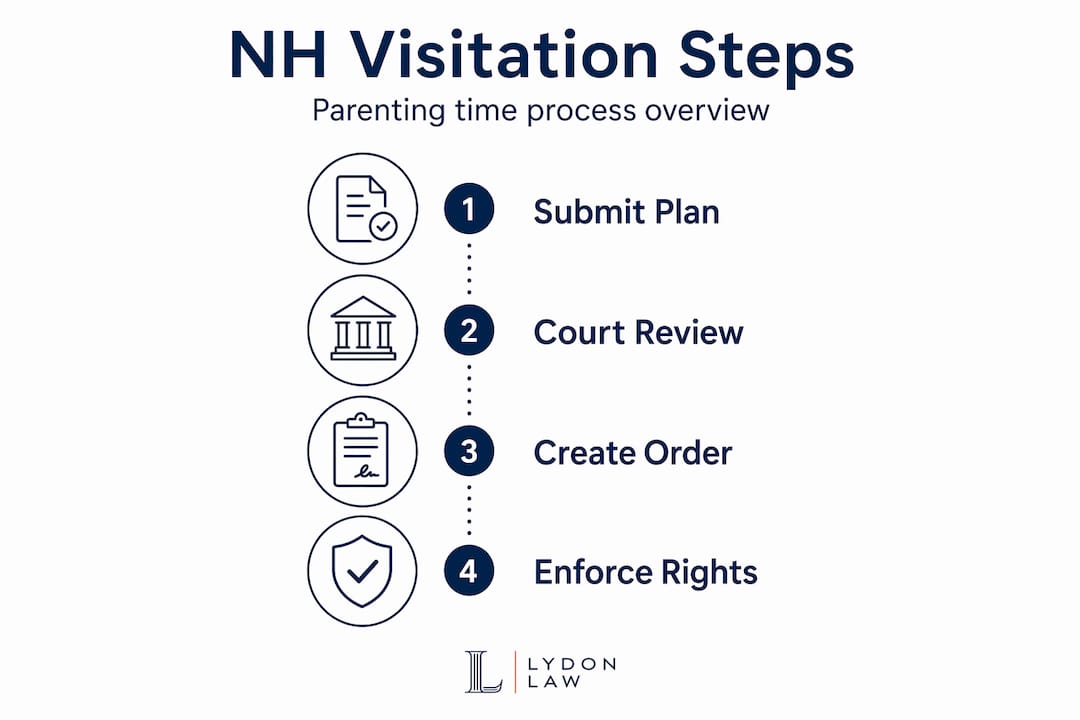
Understanding how visitation works on paper is one thing. Getting a parenting plan in place and enforcing it when the other parent doesn’t comply is where many parents need the most support.
RSA 461-A:4 requires parenting plans to address several specific components. A thorough plan will include the following:
If parents cannot agree on a plan, the court will develop one based on the best interests of the child standard. This standard considers factors like the child’s relationship with each parent, each parent’s ability to meet the child’s needs, the child’s adjustment to home and school, and any history of domestic violence or abuse.
For high-conflict situations, parallel parenting plans are sometimes approved by NH courts. These plans specify independent parental roles with minimal direct communication between parents, often requiring all exchanges to happen at neutral locations and all communication to go through a co-parenting app or written format.
If the other parent is refusing to follow the court-ordered parenting plan, you have a direct legal remedy available. Parents can file a Family Access Motion under RSA 461-A:4-a, which triggers an expedited court process. The filing fee is $225, the court must issue a summons within 10 business days, and the matter must be resolved within 60 days.
The court has real authority here. Remedies can include makeup parenting time, fines against the non-compliant parent, and in some cases, an award of attorney’s fees. This process exists precisely because the legislature recognized that denied parenting time causes real harm to children and parents alike.
Not every visitation situation fits a standard parenting plan. Several circumstances can significantly affect how parenting time is structured or restricted.
Understanding these limitations matters because they affect what you can realistically expect from the court and how to prepare your case. Working with an attorney who knows NH family law helps you anticipate these issues before they become obstacles.
I’ve worked with many parents in New Hampshire who come in frustrated and confused, often because they’ve been using terms like “custody” and “visitation” and then feel blindsided when the court speaks a completely different language. That terminology gap isn’t trivial. It can make parents feel like they don’t understand their own case.
What I’ve found is that the parents who do best in these situations are the ones who invest time in building a detailed parenting plan upfront, even when it feels tedious. Vague agreements create conflict later. A plan that specifies the exact pickup time, the exchange location, how last-minute changes are handled, and what happens when a holiday falls on a school day saves enormous grief down the road.
I’ve also seen how much damage a parent’s conduct can do to their own case. Courts are watching. How you communicate with the other parent, whether you follow the existing plan, and how you speak about the other parent in front of your child all factor into how a judge perceives you. The parents who approach this process with consistency and good faith almost always end up in a better position, regardless of how difficult the other side is being.
The one thing I’d tell every parent reading this: don’t wait until there’s a crisis to get legal guidance. Understanding your rights before things escalate gives you options. Waiting until you’re already in a dispute limits them.
— Rich
Parental visitation rights in New Hampshire involve real legal requirements, specific court procedures, and consequences that affect your family for years. Whether you are creating a parenting plan for the first time, trying to enforce an agreement the other parent is ignoring, or facing a modification request, having an attorney who knows NH family law makes a measurable difference.
Lydon works directly with parents throughout New Hampshire from offices in Nashua and Portsmouth. Attorney Kalie Lydon brings hands-on courtroom experience to every case, and clients work with her directly rather than being passed to staff. From drafting thorough parenting plans and visitation agreements to filing enforcement motions, Lydon provides clear guidance at every step. If you are ready to protect your relationship with your child, reach out to Lydon’s family law team to discuss your situation.
In New Hampshire, parental visitation is referred to as “parenting time” under RSA 461-A. It describes the schedule of when each parent spends time with their child as part of a formal parenting plan.
If parents cannot agree on a parenting plan, the court will create one based on the best interests of the child standard, considering factors like each parent’s relationship with the child and any history of domestic violence.
Yes. A court can restrict or deny parenting time if there is evidence that contact would harm the child, such as in cases involving domestic violence, substance abuse, or repeated violations of court orders.
Virtual visitation includes video calls, texting, and phone contact between a parent and child. New Hampshire law explicitly authorizes it under RSA 461-A:4 as a recognized component of parenting plans.
You can file a Family Access Motion under RSA 461-A:4-a. The filing fee is $225, the court must respond within 10 business days, and the matter must be resolved within 60 days, with possible remedies including makeup time and fines.

© 2026 Lydon Law|Legal Disclaimer|Privacy Policy