Menu


TL;DR:
- Custody determines a child’s decision-making authority and living arrangements after parental separation, significantly impacting their well-being. Courts decide custody based on the child’s best interests, considering emotional ties, stability, and parental capacity, with a preference for joint custody when appropriate. Stable routines, effective co-parenting, and avoiding alienation are essential for promoting children’s emotional health and long-term development.
Custody is the legal framework that assigns both decision-making authority and living arrangements for a child after parents separate, and it directly shapes that child’s emotional health, academic success, and long-term stability. Understanding why custody is important goes far beyond knowing who a child lives with. It determines who controls major life decisions, how consistently a child experiences daily routines, and how well both parents can cooperate in raising a healthy, secure child. New Hampshire courts, like all U.S. courts, resolve these questions through the child’s best interests standard, a legal test that places your child’s welfare above every other consideration.
Custody splits into two distinct types: legal custody and physical custody. Courts decide each one independently, and understanding the difference is the first step toward protecting your rights as a parent.

Legal custody is the authority to make major decisions about your child’s life. This covers education, medical care, religious upbringing, and extracurricular activities. A parent with legal custody has the right to enroll a child in school, consent to surgery, or choose a religious community. Legal custody remains in effect until the child turns 18.
Physical custody determines where the child lives and who provides day-to-day care. This includes feeding, transportation, homework help, and bedtime routines. A parent with primary physical custody handles these responsibilities on most days, while the other parent typically has scheduled parenting time, often called visitation.
Courts can award each type separately. One parent may hold sole legal custody while both share physical custody, or both parents may share legal custody while the child lives primarily with one parent. Misunderstanding these distinctions leads directly to conflict, because parents sometimes assume that having the child at home gives them the right to make unilateral decisions about school or medical care. It does not.
Pro Tip: Keep a written log of all major decisions you make for your child, including school enrollment, medical appointments, and activity sign-ups. This record demonstrates active, responsible parenting and can carry real weight in a New Hampshire courtroom.
In all U.S. states, including New Hampshire, custody decisions rely on the best interests of the child standard. This is not a single test but a multi-factor evaluation that judges apply to every case individually.
New Hampshire courts weigh the following factors when determining custody:
Judges focus on minimizing disruption to the child’s existing daily life and routines rather than on parental fault or income levels. A parent who earns less or lives in a smaller home is not automatically at a disadvantage. What matters most is the demonstrated ability to prioritize the child’s needs and cooperate fairly with the other parent.
The process typically moves through temporary orders, which set immediate arrangements while the case is pending, then mediation, where parents attempt to reach agreement with a neutral third party, and finally a permanent custody ruling if no agreement is reached. Parents’ communication and willingness to co-parent significantly affect outcomes at every stage. Courts prefer parents who put the child’s needs above personal grievances, and detailed, neutral records of parenting activity consistently improve results.
Pro Tip: Document your involvement in your child’s daily life before and during any custody proceeding. School pickup records, medical appointment notes, and activity schedules all tell a story that a judge can evaluate. Neutral, factual records carry far more credibility than emotional testimony alone.
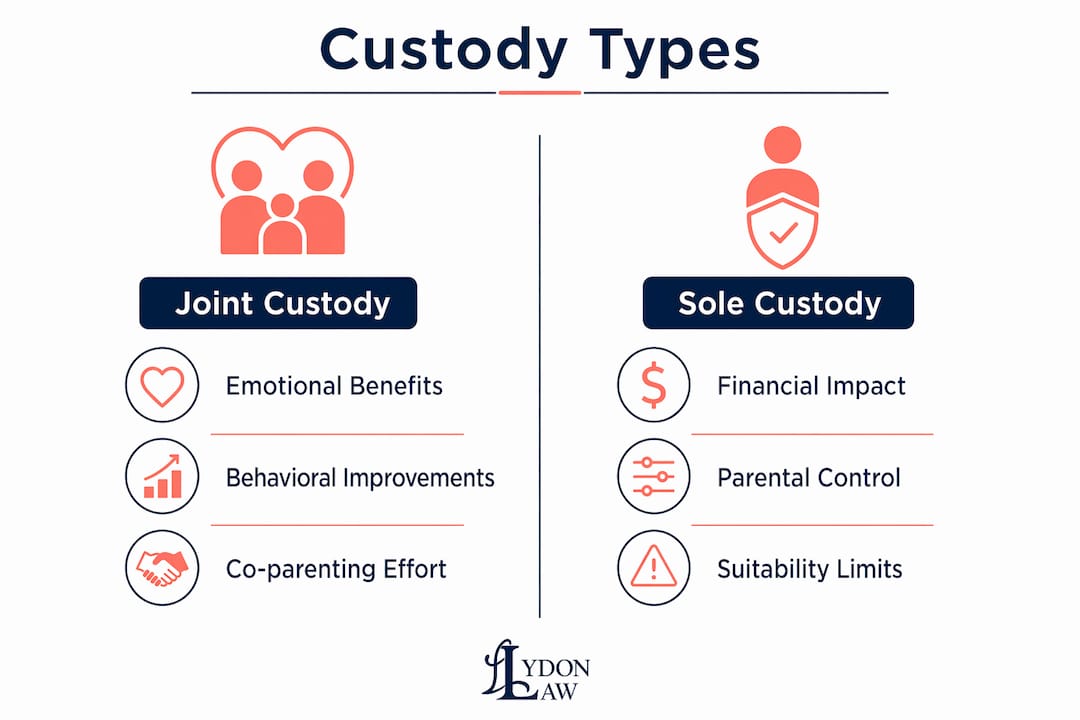
The difference between joint and sole custody arrangements has measurable consequences for children, and the research on this point is clear.
| Custody Type | Key Benefits | Key Challenges |
|---|---|---|
| Joint custody | Better emotional adjustment, fewer behavioral problems, higher self-esteem | Requires strong parental communication and coordination |
| Sole custody | Simpler logistics when conflict is high or abuse is present | Linked to higher child poverty rates and increased stress |
| Joint legal, sole physical | Preserves both parents’ decision-making role with one primary home | Can create friction if communication breaks down |
| Sole legal and physical | Appropriate when one parent is absent, abusive, or incapacitated | Removes one parent’s voice entirely, which courts avoid when possible |
Children in joint custody arrangements show 17% better emotional adjustment and 30% fewer behavioral problems compared to children in sole custody. Joint custody girls specifically experience 16% fewer depression symptoms, and shared care can improve self-esteem by 22%. These are not marginal differences. They represent meaningful improvements in a child’s daily experience and long-term development.
Sole custody carries its own risks. Sole maternal custody is linked to 25% higher child poverty rates, and shared parenting reduces repeated custody litigation by 15% compared to high-conflict sole custody arrangements. This means joint custody is not just better for children emotionally. It also tends to reduce the financial and legal burden on families over time.
That said, joint custody is not appropriate in every situation. When one parent has a history of domestic violence, substance abuse, or severe mental illness, sole custody may be the only arrangement that keeps a child safe. New Hampshire courts recognize this and will award sole custody when the evidence supports it. The importance of custody arrangements in these cases is precisely that they create a legal structure protecting the child from harm.
Joint custody does require real effort from both parents. Scheduling, communication, and flexibility are ongoing demands. Parents who struggle to communicate civilly often find that a parenting coordinator or a clearly written parenting plan reduces friction significantly.
The practical effects of custody decisions show up in children’s lives every day, not just in courtrooms. Stable custody arrangements reduce the number of school changes a child experiences, which directly improves academic performance and social development. Children who move between schools frequently due to unstable living situations consistently show lower academic outcomes and greater difficulty forming peer relationships.
Children form separate secure attachments to each caregiver, and experts advise parents to support both relationships without competition. When one parent undermines the child’s bond with the other, the child suffers the most. Courts penalize parents who alienate children from the other parent, and behavior that undermines the child’s relationship with the other parent is treated as a serious negative factor in custody evaluations.
Consistent parenting routines matter as much as the formal custody label. A child who knows what to expect each week, who picks them up from school, who attends their games, and who helps with homework, develops a stronger sense of security than a child whose schedule shifts unpredictably. This is why judges prioritize how parents manage custody logistics in daily life over the custody label itself. Effective communication between parents reduces relitigation and keeps the child’s life stable.
The benefits of custody arrangements that work well extend to parents too. When both parents feel their role is respected and legally protected, conflict decreases. When conflict decreases, children thrive. The goal of any custody arrangement is not to declare a winner between parents. It is to give your child the most stable, supported, and loving environment possible given the circumstances.
Custody is the single most consequential legal decision affecting your child’s daily life, emotional health, and long-term development after a family separation.
| Point | Details |
|---|---|
| Two types of custody | Legal custody controls decisions; physical custody controls where the child lives. Courts decide each independently. |
| Best interests standard | New Hampshire courts weigh emotional ties, parental capacity, stability, and the child’s own preferences. |
| Joint custody outcomes | Joint custody produces 17% better emotional adjustment and 30% fewer behavioral problems than sole custody. |
| Parental behavior matters | Courts favor parents who communicate well, document involvement, and avoid alienating the child from the other parent. |
| Stability drives wellbeing | Consistent routines and minimal school changes directly improve children’s academic and social outcomes. |
After years of working with families through custody disputes in New Hampshire, the pattern I see most often is this: parents come in focused on winning, and the ones who do best are the ones who shift their focus to their child.
The legal framework exists to protect children, not to score points for parents. The best interests standard is not a technicality. It is a genuine instruction to every judge to ask one question above all others: what does this child need? Parents who understand that early, and who build their case around demonstrating their commitment to their child’s welfare rather than attacking the other parent, consistently achieve better outcomes.
I have also seen how damaging it is when parents conflate legal and physical custody. A parent who has the child most of the week sometimes assumes that gives them the right to make every major decision alone. It does not, and acting on that assumption can trigger a custody modification that works against you. Understanding the difference between legal and physical custody before you act is not just good legal strategy. It is how you protect your relationship with your child.
My honest advice: document everything, communicate in writing when possible, and never say anything about the other parent in front of your child that you would not want a judge to hear. Courts notice, and more importantly, your child notices.
— Rich
Custody decisions carry consequences that last years, sometimes decades. Getting clear legal guidance from the start protects both you and your child. Lydon’s family law attorneys work directly with clients throughout New Hampshire, including in Nashua and Portsmouth, on custody arrangements, parenting plans, mediation, and court proceedings. Attorney Kalie Lydon brings extensive courtroom experience, including appearances before the New Hampshire Supreme Court, to every case. You work directly with your attorney throughout the process, not a rotating staff. If you are facing a custody matter and want to understand your rights and options, Lydon is ready to help you take the right steps for your child’s future.
Custody refers to the legal rights and responsibilities a parent holds regarding their child’s care and upbringing. It divides into legal custody, which covers decision-making authority, and physical custody, which determines where the child lives.
Research shows joint custody produces 17% better emotional adjustment and 30% fewer behavioral problems in children compared to sole custody. Courts in New Hampshire and across the U.S. increasingly favor joint arrangements when both parents are capable and willing to cooperate.
New Hampshire courts apply the best interests of the child standard, weighing factors such as emotional ties, parental capacity, home stability, history of abuse, and the child’s own preferences as they mature.
Yes. A child’s preference gains weight as they get older, and judges assess the child’s maturity and reasoning as part of the best interests evaluation. Some states allow children aged 14 and older to meaningfully influence the outcome.
Courts treat parental alienation as a serious negative factor. Behavior that undermines the child’s relationship with the other parent can result in a modified custody order that favors the parent who supports the child’s bond with both caregivers.

© 2026 Lydon Law|Legal Disclaimer|Privacy Policy