Menu


TL;DR:
- Legal counsel significantly improves criminal case outcomes, including higher acquittal and lower incarceration rates.
- Courts in New Hampshire are required to appoint counsel for indigent defendants in felony and Class A misdemeanor cases.
- Early, local, and experienced legal representation is crucial for protecting rights and achieving favorable results.
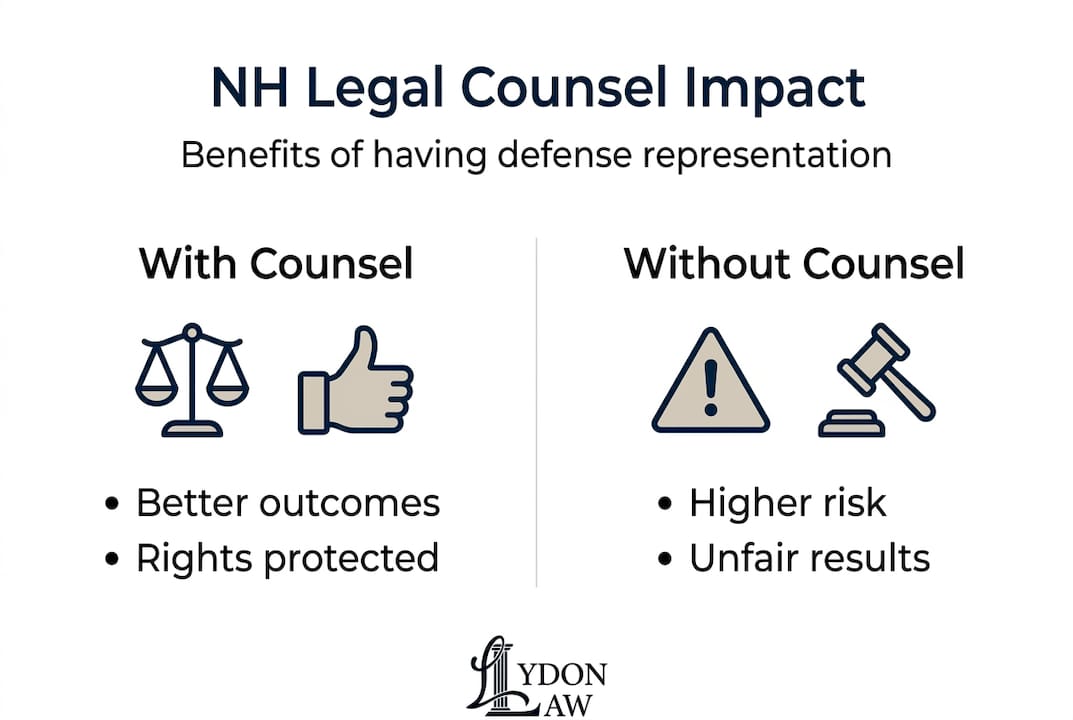
Facing a criminal charge in New Hampshire is one of the most stressful situations you can encounter. Many people assume that getting a lawyer is optional or that the process will somehow work itself out. That assumption can cost you dearly. Empirical research shows that indigent defendants without retained counsel are 50% more likely to plead guilty, 40% more likely to be convicted, and twice as likely to be incarcerated. Those numbers reflect real people whose futures were shaped by a single, consequential decision. This guide explains what your rights to counsel are in New Hampshire, why skilled legal representation changes outcomes, and how to make the right choice for your case.
| Point | Details |
|---|---|
| Legal counsel protects your rights | Having a lawyer ensures your rights are protected during criminal proceedings in New Hampshire. |
| Representation changes outcomes | Defendants with legal counsel face significantly lower risks of conviction and harsh sentencing. |
| Choosing counsel matters | Selecting the right attorney type can impact case results due to resources and local expertise. |
| Early action is crucial | The sooner you consult legal counsel, the more effective your defense against criminal charges will be. |
With the risks so pronounced, it is vital to understand exactly what your rights to counsel are under New Hampshire law. The state has a specific statute that governs how courts must respond when a person facing criminal charges cannot afford a lawyer.
New Hampshire Statute RSA 604-A:2 mandates that courts provide counsel for indigent defendants, meaning those who cannot afford a private attorney, in all felony cases and Class A misdemeanor cases. A Class A misdemeanor is a criminal offense that carries a potential jail sentence of up to one year. This matters because any case involving potential incarceration requires professional legal defense.
“The court shall inform the defendant of his right to counsel and, if he requests counsel, shall appoint counsel before any interrogation or proceeding.” — RSA 604-A:2
The process for receiving appointed counsel in New Hampshire follows a specific priority order:
It is important to understand that qualifying for appointed counsel requires demonstrating financial need. Courts assess your income, assets, and financial obligations before making a determination. If you do qualify, you have the right to a criminal defense attorney in New Hampshire at no direct cost to you, though some costs may be assessed later.
You should also know that the right to counsel attaches at the moment charges are formally filed against you, not just at trial. This includes arraignments, bail hearings, plea hearings, and any other critical stage of the proceeding. Understanding why representation matters in NH at each of these stages is foundational to protecting your rights from the very start.
Knowing your rights is one thing, but does having a lawyer actually change the outcome? The data says yes, and the differences are significant enough that they should inform every decision you make.
Empirical studies confirm that defendants with retained counsel consistently achieve better results across every major measure compared to those without qualified representation. The following table summarizes what the research shows across key outcome categories.
| Outcome category | With retained counsel | Without counsel or with inadequate representation |
|---|---|---|
| Pretrial release rate | Significantly higher | Lower |
| Guilty plea rate | Lower, more strategic | 50% higher |
| Acquittal rate | Higher | Lower |
| Conviction rate | Lower | 40% higher |
| Incarceration rate | Lower | Up to 2x higher |
| Favorable sentencing | More likely | Less likely |
These are not marginal differences. They represent the gap between going home and going to jail, between a felony record and a reduced charge, between years of your life lost and a path forward.
The impact of representation shows up in several specific ways. In plea negotiations, a skilled attorney can identify weaknesses in the prosecution’s case, use forensic and other evidence strategically, and push for charges to be reduced or dismissed entirely. In some cases, attorneys identify Fourth Amendment violations, meaning unlawful searches and seizures, that allow key evidence to be suppressed. Suppression of a critical piece of evidence can change the entire direction of a case.
For felony charges in New Hampshire, the stakes become even higher. A felony conviction can follow you for the rest of your life, affecting employment, housing, professional licensing, and your civil rights. In misdemeanor cases, people sometimes make the mistake of thinking the charge is minor enough to handle alone. However, even a Class A misdemeanor can result in jail time, fines, and a permanent criminal record. Knowing how to defend criminal charges in NH properly requires an understanding of local court procedures, prosecutorial tendencies, and available legal options that only experienced attorneys carry.

Understanding criminal defense and your rights at every stage gives you the foundation to make informed decisions rather than reactive ones.
Pro Tip: Do not settle for the first lawyer you speak with simply because they are available. Look specifically for an attorney with demonstrated experience handling cases like yours in New Hampshire courts. The difference between a generalist and a focused criminal defense attorney is often the difference between a favorable outcome and a conviction.
Not all legal counsel is alike, and choosing wisely can make a tremendous difference in your case’s trajectory. Understanding the real distinctions between your options helps you advocate for yourself more effectively.
| Factor | Public defender | Retained private attorney |
|---|---|---|
| Cost | Free (if eligible) | Varies, can be significant |
| Caseload | Very high | Lower, more manageable |
| Local court knowledge | Strong | Varies by attorney |
| Institutional resources | Significant | Varies |
| Direct access to attorney | Limited | Greater |
| Flexibility in strategy | Somewhat limited by caseload | More flexible |
Research specifically on murder cases in Philadelphia found that public defenders achieved 19% lower murder conviction rates, 62% lower probability of a life sentence, and defendants served 24% less time compared to those represented by appointed private counsel. Why? Institutional resources. Public defender offices often have in-house investigators, forensic experts, and legal researchers that private attorneys may lack unless they invest significantly on your behalf.
The reality of attorney expertise and outcomes shows that the quality of your legal representation matters more than the simple category of who is representing you. This brings us to self-representation.
Self-representation, sometimes called “pro se” defense, is almost never advisable in a criminal case. Here is a step-by-step look at why.
Understanding why hiring a defense attorney matters goes beyond the courtroom. It is also about having someone who knows when to negotiate, when to fight, and how to read the situation clearly.
Pro Tip: If you are considering self-representation because of cost concerns, talk to a private attorney before making that decision. Many attorneys offer payment plans, and the long-term financial cost of a conviction (lost employment, fines, licensing consequences) almost always exceeds the cost of hiring qualified counsel.
There is more nuance than many realize when it comes to the value and limits of legal representation in criminal cases. Understanding these nuances helps you make decisions with realistic expectations.
It is true that some research shows minimal outcome differences between self-represented defendants and those with counsel in certain narrow categories of felonies. However, the dominant trend across most research is clear: representation improves outcomes across virtually every meaningful measure. The exceptions tend to involve very specific case types, not the broad range of charges most defendants face.
A critical point that is often missed is that the private versus public distinction matters far less than the quality of institutional support and attorney experience behind the representation. A well-resourced public defender office with investigators and forensic experts can outperform a private attorney who handles criminal defense as a side practice.
New Hampshire state-specific rules add another layer of complexity. Local procedures, competency evaluation requirements, unique sentencing guidelines, and the particular practices of individual courts across the state all influence how cases proceed. An attorney who practices regularly in Nashua or Portsmouth courts will understand nuances that an out-of-state or general-practice attorney simply will not.
“Local legal knowledge is not a luxury in criminal defense. It is a practical necessity that affects how your case is handled from the first hearing to the last.”
Several common myths deserve direct attention. Understanding criminal defense options in NH requires dispelling these misconceptions first.
Bringing it all together, here is what the statistics combined with real case experience show about making legal counsel truly work for you. And it starts before you ever walk into a courtroom.
The single most important thing you can do when facing criminal charges is involve an attorney early. Most people wait. They hope the situation will resolve itself, or they want to gather more information before committing to a lawyer. That delay is consistently one of the most damaging decisions defendants make. Statements made to police before an attorney is involved, decisions made at arraignment without counsel, and bail conditions set without a lawyer advocating for you all have lasting consequences.
The second critical factor is local expertise. We understand that when you search for legal help, you might be tempted to look for the biggest firm or the most impressive online presence. But in criminal defense, courtroom presence and local relationships are often more valuable. An attorney who has appeared before the same judges, worked with the same prosecutors, and navigated the same court systems as yours brings insight that cannot be replicated. For felony charges, misdemeanor cases, and everything in between, experience in felony and misdemeanor support in New Hampshire specifically changes what is possible for your case.
The third factor is honest, open communication with your attorney. Your lawyer can only defend what they know. Withholding information, even out of embarrassment or fear, limits your attorney’s ability to build the strongest possible strategy. Clients who engage openly and early tend to have better experiences and better outcomes, not because the facts are always better, but because preparation is deeper.
Ready to take action? Here is how to connect with legal professionals who know New Hampshire’s system inside and out. If you are facing criminal charges of any kind, the most important step is reaching out to an experienced attorney as quickly as possible. Timing influences outcomes. Early involvement means more options for your defense.
At Lydon Law, our New Hampshire criminal defense practice is built around exactly the kind of hands-on, client-focused representation that makes a genuine difference. Attorney Kalie Lydon brings extensive courtroom experience in New Hampshire courts, including the state’s Supreme Court, and works directly with every client throughout the legal process. You will not be handed off to support staff when you have questions. You work with your attorney directly.
We encourage you to explore your criminal defense rights and options and to hire a criminal defense attorney who understands New Hampshire law from the inside. We offer consultations so you can ask questions and understand your situation without pressure. Reaching out costs nothing, and knowing your options is the first step toward protecting your future.
A public defender is a government-paid attorney who handles high caseloads but typically has deep experience with local courts, procedures, and prosecutors. Under New Hampshire’s appointment priority, public defenders are the first option courts turn to for indigent defendants, meaning they are often the most experienced option available within the appointed system.
Rarely, if ever. Empirical research consistently shows that while a narrow category of felony cases may show minimal outcome differences, the overwhelming majority of data supports having qualified counsel, especially for cases involving potential incarceration or felony records.
Yes. New Hampshire RSA 604-A:2 mandates that courts appoint counsel for eligible indigent defendants in felony and Class A misdemeanor cases. You must demonstrate financial need, and the court will assess your income and assets before making the appointment.
Significantly yes. Research shows defendants with counsel are far better positioned to negotiate favorable plea agreements, identify weaknesses in the prosecution’s case, and avoid the pressured guilty pleas that unrepresented defendants frequently accept without fully understanding the long-term consequences.

© 2026 Lydon Law|Legal Disclaimer|Privacy Policy