Menu


TL;DR:
- Legal separation allows spouses to live apart with enforceable court orders while maintaining their marriage status, providing clarity and protection without dissolving the marriage. It helps preserve health insurance, safeguards Social Security benefits, respects religious beliefs, and offers a flexible trial period for reconciliation. In New Hampshire, the process involves court petitions, negotiations, and court approval, with important legal and financial considerations influencing the decision to choose separation over divorce.
Legal separation is a court-ordered status in which spouses live apart and resolve financial, custodial, and support matters without dissolving the marriage. Unlike an informal arrangement where one spouse simply moves out, a legal separation produces enforceable court orders covering property division, child custody, and spousal support. It preserves your marital status while giving both parties the legal clarity and protection that only a formal court process can provide. For many New Hampshire residents, understanding why seek legal separation versus divorce is the first and most consequential decision they will face.
The reasons people choose legal separation over divorce are more specific and practical than most people realize. Health insurance is one of the most compelling. Health insurance stays active under an employer-sponsored plan during legal separation but ends immediately upon divorce. For a spouse or child with ongoing medical needs, that distinction can represent thousands of dollars annually in premium costs and coverage continuity. COBRA coverage is available after divorce but is typically far more expensive than remaining on a spouse’s employer plan.
Social Security benefits are another concrete financial reason to consider this path. Divorcing before 10 years of marriage removes eligibility for Social Security spousal benefits entirely. If you are approaching that threshold, a legal separation allows you to remain married on paper while living separately, preserving your future retirement income options.
Religious conviction is a third major driver. Many individuals, particularly within Catholicism, choose legal separation because their faith prohibits divorce while still permitting a formal, court-supervised separation. This allows them to address real legal and financial concerns without acting against deeply held beliefs.
Legal separation also functions as a structured trial period. If reconciliation remains a possibility, a separation agreement gives both spouses defined boundaries and legal protections without permanently closing the door on the marriage. Compared to an informal arrangement, a court order protects you from asset depletion and unresolved custody disputes that can arise when nothing is formalized.
Pro Tip: Before filing for legal separation, verify with your spouse’s employer health plan administrator whether your coverage continues during separation. Plan terms vary, and some plans may treat legal separation the same as divorce for coverage purposes.
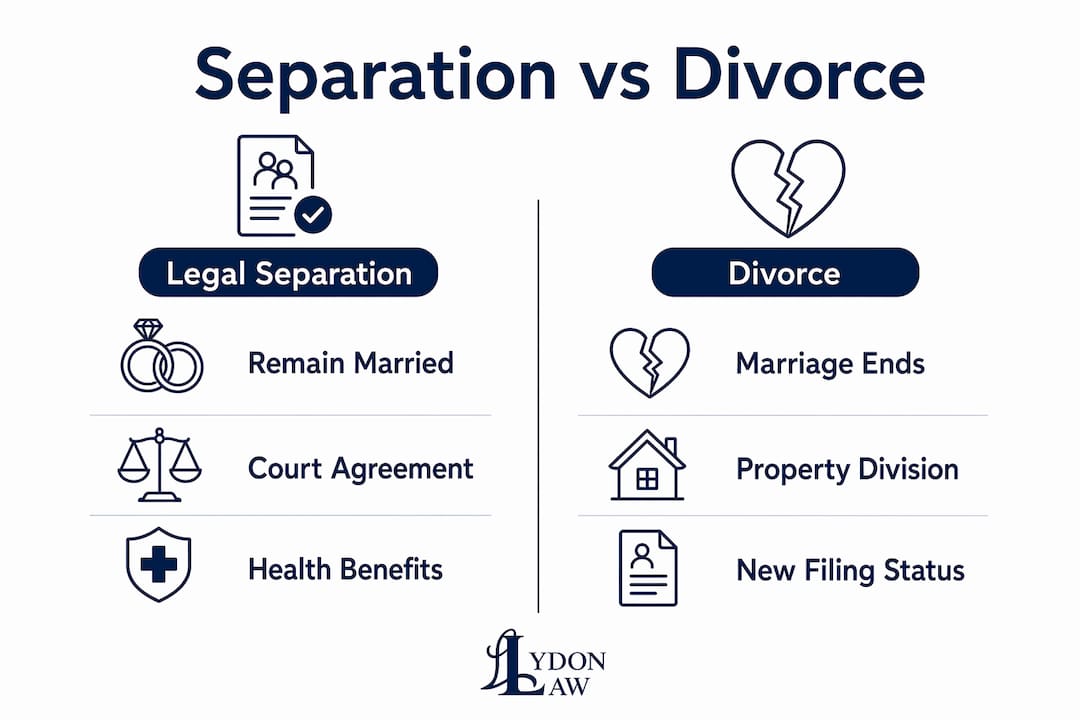
Legal separation and divorce involve similar legal processes and financial negotiations. Both require addressing property division, child custody, visitation, and support. The critical difference is that divorce terminates the marriage entirely, while legal separation leaves marital status intact. That single distinction carries significant downstream consequences.
| Factor | Legal separation | Divorce |
|---|---|---|
| Marital status | Remains married | Marriage terminated |
| Ability to remarry | No | Yes |
| Health insurance | May remain on spouse’s plan | Coverage ends immediately |
| Inheritance rights | Generally preserved unless changed | Typically terminated |
| Social Security benefits | Preserved if under 10-year mark | Lost if marriage under 10 years |
| Tax filing status | Married filing jointly or separately | Single or head of household |
| Reconciliation | Simpler, no new marriage required | Requires remarriage |
Tax filing status is a detail many people overlook. During legal separation, you remain legally married, which means you may still file jointly and access the associated tax benefits. After divorce, you file as single or head of household, which can increase your tax liability depending on income levels and deductions. This is not a reason to avoid divorce if it is the right choice, but it is a factor worth calculating before you decide.
Inheritance and beneficiary rights also differ. Separated spouses remain legal survivors unless the separation decree specifically changes that status. This can work in your favor or against you depending on your circumstances, which is why reviewing estate planning documents alongside your separation agreement is critical.
Pro Tip: Terms agreed upon in a separation agreement often carry directly into a later divorce settlement. Draft your separation agreement carefully, because it may become the foundation of your final divorce decree.
In New Hampshire, legal separation requires filing petitions, negotiating terms over custody and support, and obtaining court approval, following procedures that closely mirror the divorce process. Understanding each step helps you prepare and avoid delays.
File a petition in family court. You begin by filing a petition for legal separation in the New Hampshire family court with jurisdiction over your county. The petition states the grounds for separation and outlines what you are requesting regarding property, support, and custody.
Negotiate a separation agreement. Both spouses, typically through their attorneys, negotiate the terms of the separation. This agreement covers division of marital assets and debts, spousal support, child custody and visitation schedules, and child support obligations.
Attend court hearings. A judge reviews the proposed agreement and may schedule hearings to address contested issues. If both parties agree on all terms, the process moves faster. Contested matters require more court involvement and time.
Receive court approval. Once the judge approves the separation agreement, it becomes a legally enforceable court order. Both parties are bound by its terms.
Modify, dismiss, or convert the order. Separation orders in New Hampshire can be modified if circumstances change, dismissed upon reconciliation, or converted into a divorce filing if the marriage does not recover. This flexibility is one of the practical advantages of choosing separation over divorce initially.
Legal separation agreements are complex documents that often form the foundation of future divorce settlements. Errors or oversights in the original agreement can affect long-term financial and custodial outcomes for years. Working with an experienced New Hampshire family law attorney from the start protects you from those risks.
The financial and personal implications of legal separation are significant and deserve careful evaluation before you file. One of the most common misconceptions is that legal separation is simpler or cheaper than divorce. The cost and complexity of legal separation can be similar to divorce, and if the marriage ultimately ends, you may face two separate legal processes, increasing your total costs.

Tax liability is a practical concern. While remaining married allows joint filing, it also means you share tax liability for your spouse’s income and deductions. If your spouse has significant tax exposure, legal separation without a clear tax agreement can leave you financially vulnerable.
Retirement benefits require attention as well. Pension rights, 401(k) division, and IRA beneficiary designations all need to be addressed in the separation agreement. Failing to update beneficiary designations means your estranged spouse could inherit retirement assets even after a formal separation.
Navigating the intersection of separation, tax status, health insurance, and retirement benefits requires professional guidance to avoid costly mistakes. The emotional weight of separation can make it difficult to focus on these details, which is exactly why having a knowledgeable attorney review every aspect of your agreement matters.
Informal separations carry their own serious risks. Without legal orders, spouses are exposed to asset depletion, unresolved custody disputes, and financial decisions made by one party that bind the other. A formal separation agreement eliminates that exposure by creating enforceable obligations on both sides.
Choosing between legal separation and divorce depends on your specific circumstances, not a general rule. The following situations point toward legal separation as the more appropriate path.
You have religious or personal objections to divorce. If your faith or personal values prohibit divorce, legal separation provides a court-supervised structure that addresses your legal and financial needs without requiring you to dissolve the marriage.
You need to preserve health insurance or federal benefits. If you or your children depend on your spouse’s employer health plan, or if you are approaching the 10-year Social Security eligibility threshold, legal separation protects those benefits while you live separately.
Reconciliation remains a realistic possibility. Legal separation acts as a reversible, court-enforced trial period, making reconciliation simpler than after divorce. If there is genuine uncertainty about the future of the marriage, separation gives both parties time and structure without permanent consequences.
You need immediate financial and custodial clarity. When informal arrangements are breaking down and you need enforceable agreements on child custody, support, or property, legal separation provides that structure quickly.
Divorce may be preferable when one party is firmly committed to ending the marriage, when the financial benefits of remaining married do not outweigh the costs of two legal processes, or when tax and estate planning goals are better served by a clean legal break.
One critical point: no-fault divorce laws mean one party can pursue divorce regardless of the other’s preference for separation. You cannot use legal separation to block a divorce. Understanding this reality early helps you focus your energy on protecting your interests rather than controlling the outcome.
Pro Tip: Consult with a New Hampshire family law attorney before deciding between separation and divorce. The right choice depends on your health coverage, the length of your marriage, your tax situation, and your long-term financial goals. A one-hour consultation can clarify which path serves you best.
Legal separation is a formal, court-ordered status that preserves your marriage while providing enforceable agreements on property, custody, and support, making it a practical alternative to divorce for specific financial, religious, and personal reasons.
| Point | Details |
|---|---|
| Health insurance protection | Legal separation keeps employer plan coverage active; divorce ends it immediately. |
| Social Security threshold | Remaining married past 10 years preserves eligibility for spousal retirement benefits. |
| Similar process to divorce | Separation requires court filings, negotiations, and approval, with comparable costs. |
| Reversible and flexible | New Hampshire separation orders can be modified, dismissed, or converted to divorce. |
| Professional guidance is critical | Separation agreements often become the foundation of future divorce settlements. |
After working with clients through separation and divorce cases in New Hampshire, one pattern stands out clearly. People often arrive believing legal separation is a simpler, lower-stakes version of divorce. It is not. The agreements you reach during separation carry real legal weight and frequently shape the outcome of any divorce that follows. Treating the process casually is one of the most expensive mistakes a person can make.
What I find most valuable about legal separation, when it is the right fit, is the breathing room it creates. Clients who are genuinely uncertain about the future of their marriage benefit from having enforceable structure without permanent consequences. It protects children’s routines, clarifies financial responsibilities, and removes the chaos of informal arrangements that leave both parties exposed.
The misconception I address most often is the belief that one spouse can use legal separation to prevent the other from filing for divorce. That is not how New Hampshire law works. Understanding that reality early allows clients to focus on what they can control: protecting their financial interests, their children’s wellbeing, and their own future. That is where good legal counsel makes the most difference. You can read more about separation versus divorce in New Hampshire to understand how state law applies to your situation specifically.
— Rich
Lydon’s family law attorneys serve clients throughout New Hampshire from offices in Nashua and Portsmouth. If you are weighing legal separation against divorce, the decisions you make now about property, custody, and support will have long-term consequences for your finances and your family. Lydon provides clear, practical guidance through every stage of the process, from drafting separation agreements to representing you in court hearings. Attorney Kalie Lydon works directly with each client, so you always know where your case stands. To speak with a New Hampshire family law attorney about your options, contact Lydon today for a consultation.
Legal separation keeps the marriage legally intact while establishing court-ordered terms for property, custody, and support. Divorce terminates the marriage entirely, allowing both parties to remarry.
Health insurance under an employer-sponsored plan typically remains active during legal separation but ends upon divorce. You should verify the specific terms with the plan administrator, as coverage rules vary by employer.
The timeline depends on whether both parties agree on all terms. Uncontested separations move faster, while contested matters involving custody or property disputes can extend the process significantly.
Yes. In New Hampshire, a legal separation order can be converted into a divorce filing if the marriage does not recover. The terms of the separation agreement often carry forward into the divorce settlement.
Remaining married through the 10-year mark preserves your eligibility for Social Security spousal benefits. Divorcing before 10 years removes that eligibility entirely, making the timing of any legal action financially significant.

© 2026 Lydon Law|Legal Disclaimer|Privacy Policy